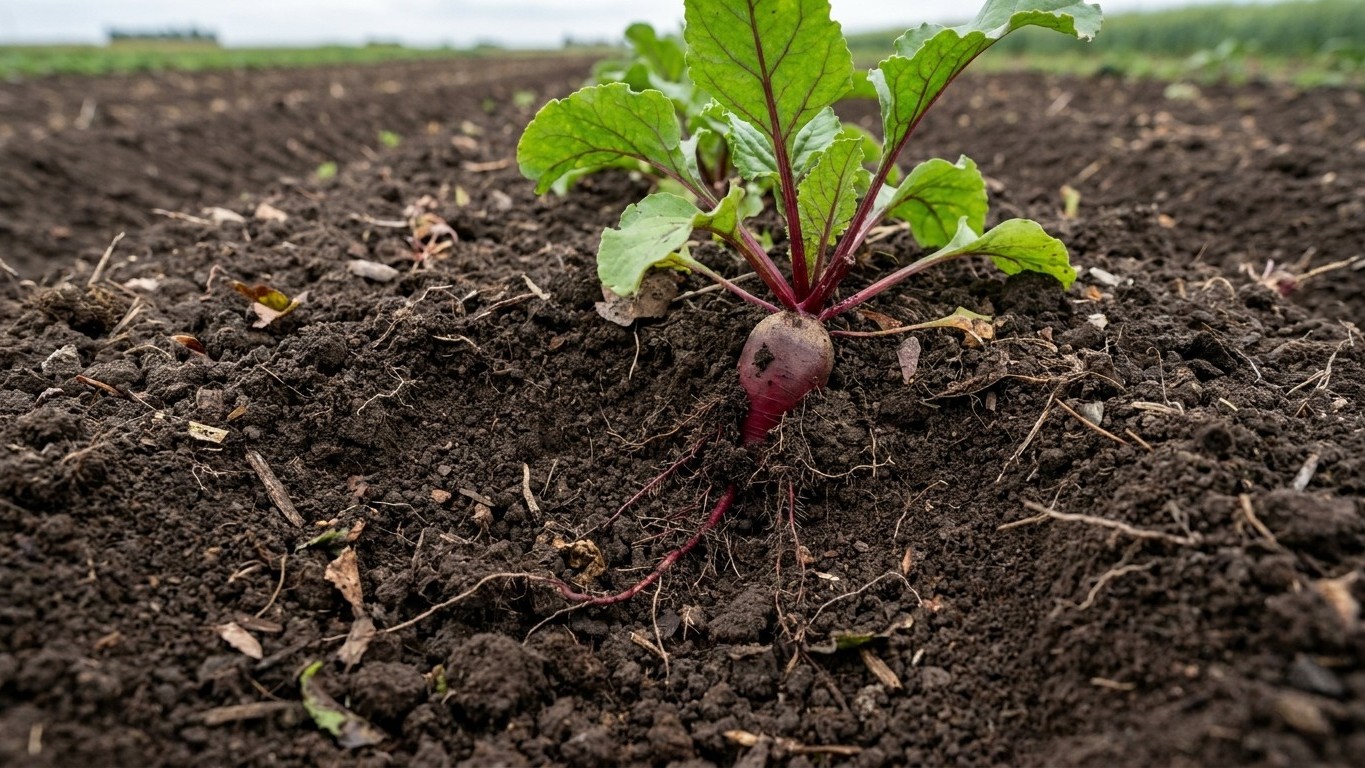

Pull beets once the roots reach the size you want, usually 60 to 80 days from seeding, and before the ground freezes hard. Then hold the topped roots at 33 to 36 °F with 98% humidity. That last part surprises people who keep carrots as cold as the fridge allows. USDA Handbook 66 reports that beets stored at 32 to 34 °F develop more black spot and rot than beets held a little warmer, so the coldest corner is the wrong place for them.
Why colder is not better for beets
The storage numbers come from USDA Agricultural Handbook 66, The Commercial Storage of Fruits, Vegetables, and Florist and Nursery Stocks, in a chapter by F. Adamicki (full handbook from USDA ARS). It was written for people who hold tons of roots at a time. The way beets respond to temperature still applies to a few bushels in a basement.
What temperature does Handbook 66 give for topped beets?
Topped beets, meaning the leaves have been cut off, should be stored at 33 to 36 °F (1 to 2 °C) and 98% relative humidity. The same chapter adds that storage at 32 to 34 °F (0 to 1 °C) produces more black spot and rot than higher temperatures do. The two ranges touch at their edges, which shows how narrow the window is. A degree or two on the cold side is enough to tip the batch toward loss.
This contradicts the habit most gardeners bring from carrots. Carrots are held as close to freezing as the fridge or cellar will go, and the cold is the whole point. Beets look like the same kind of crop, so the same treatment feels natural. Following it costs you roots. Every other root crop on this site rewards the coldest spot you can find, and beets are the exception.
How long do bunched beets keep?
Bunched beets, with the leaves still on, keep about 10 to 14 days at 32 °F and above 98% humidity. Handbook 66 gives no longer figure for them. That span is reached in a cold, humid space with the bunches kept moist. A dry fridge shelf, a warm counter or a bag that lets air through will cut it short.
For anything you plan to keep past two weeks, cut the tops off first. Top the beets before storing, and keep the leaves for the kitchen. Greens that wilt in a day or two should not stay attached to a root you want to hold for weeks.
A bunch pulled for tomorrow’s supper does not need any of this attention. The temperature rules matter for roots you intend to hold for weeks, because that is where black spot and rot do their damage.
Where in the house that actually is
A standard refrigerator is built to run colder than the 33 to 36 °F target, and a heated room is far warmer. Neither matches what the handbook describes. For cellars and pits (clamps), it sets the limits at about 31 °F on the low end and 41 °F on the high end. Inside that band, the closer you sit to the 33 to 36 °F range, the better the roots hold up.
In a Montana house, the best match is usually an unheated basement room or a cellar corner along a north or east wall. A hillside root cellar, if you have one, holds steady through the swings of winter. An insulated crawl space can work. An attached garage or a shed is riskier, because winter nights there can drop below 31 °F and freeze the roots. If a fridge is your only option, the crisper drawer farthest from the cooling vent is the likeliest spot to fall near the target, and a thermometer will tell you whether it does.
Humidity needs the same attention. The target is 98%, which is damp air, and beets in dry air lose water and shrivel. A covered tote or a perforated plastic bag slows that loss in a basement that runs dry.
Sorting by size pays off here. Handbook 66 says large roots keep much better than small ones because they lose water and shrivel more slowly. So store the large roots and eat the small ones first, even though the small ones tempt you to put them away. Skipping that sort means the smallest roots go soft and wrinkled while the big ones are still firm.
When are beets ready to pull?
Beets are sown directly in the ground, so the days on the seed packet run from seeding, never from a transplant date. Most packets promise 60 to 80 days from seeding, and that gives you a rough window for tasting. Pull one or two and check them. The root should be the size you want on the plate, and storage roots can stay in longer to size up.
The seeding date depends on frost. At Billings, one of the milder valleys, the last spring frost falls between April 29 and May 10, according to NOAA NCEI climate normals (the 30 to 70 percent probability band for a 32 °F freeze). Mountain valleys elsewhere in Montana can frost in any month, so the county extension office is the best source for your own valley. For the full season plan, see Growing Beets in Montana.
What makes beets bolt or turn woody before you can pull them?
These are two different failures. Utah State University Extension notes that water stress during the first 6 weeks causes premature flowering, which is bolting. Heat above 85 °F combined with water stress makes the root woody. The first happens to young plants that went thirsty, and the second to roots that were maturing in a hot dry spell. Steady water through the first six weeks addresses one problem. Mulch and watering during hot spells address the other.
Soil sets the stage for both. Beets want deep, sandy, well-drained ground rich in organic matter, and Utah State University Extension advises no more than 1 inch of composted organic matter per 100 sq ft. Montana’s state soil, the Scobey series, is a Mollisol that runs about 35 percent sand, 31 percent clay and 34 percent silt. The surface pH is near 7.0, organic matter is about 2.0 percent, and it drains well. That is the soil that represents the state, not necessarily your garden. River bottoms, hill country and scraped or filled ground can be very different, so a soil test gives you your own numbers. Beet Soil in Montana: What the Root Will Meet explains how to read them.
Before you store anything, go over each root. Chewed or damaged ones go to the kitchen first, since damage invites rot, and What Eats Beet in Montana, and When describes what to look for. Then pull before the ground freezes hard. Soil that has frozen solid around the roots makes lifting difficult and can harm the beets. A hard freeze in the forecast is the cue to dig everything you plan to keep.
Common questions
Can I leave beets in the ground into winter?
Leaving them is a gamble in a climate where the soil freezes solid. Roots that freeze in the ground are damaged, and lifting them from frozen soil is hard. Pull the storage beets before the ground freezes hard, top them, and move them to a space between 31 and 41 °F. The county extension office can tell you what the first hard freeze looks like in your valley.
Is the refrigerator a good place to store beets?
It is fine for a week or two, with limits. Top the beets and put them in a bag that holds in moisture, in the crisper drawer if it runs warmest. A fridge is built to run colder than the 33 to 36 °F target, so check with a thermometer. For storage lasting weeks, a cool basement or cellar that stays between 31 and 41 °F is a better fit.
How long will beets keep?
Bunched beets, with leaves on, keep about 10 to 14 days, and that is the maximum under ideal conditions. Topped roots held at 33 to 36 °F and 98% humidity keep much longer, and large roots keep best. Check the crate every week or so and use any root with a soft spot or dark patch first.
Why did my beets bolt or turn woody?
Bolting follows water stress in the first 6 weeks after seeding. Woody roots follow heat above 85 °F combined with water stress. They are separate problems with separate causes, and the fix for one does not cure the other. Consistent water early prevents bolting, and mulch plus watering through hot spells protects the roots later.