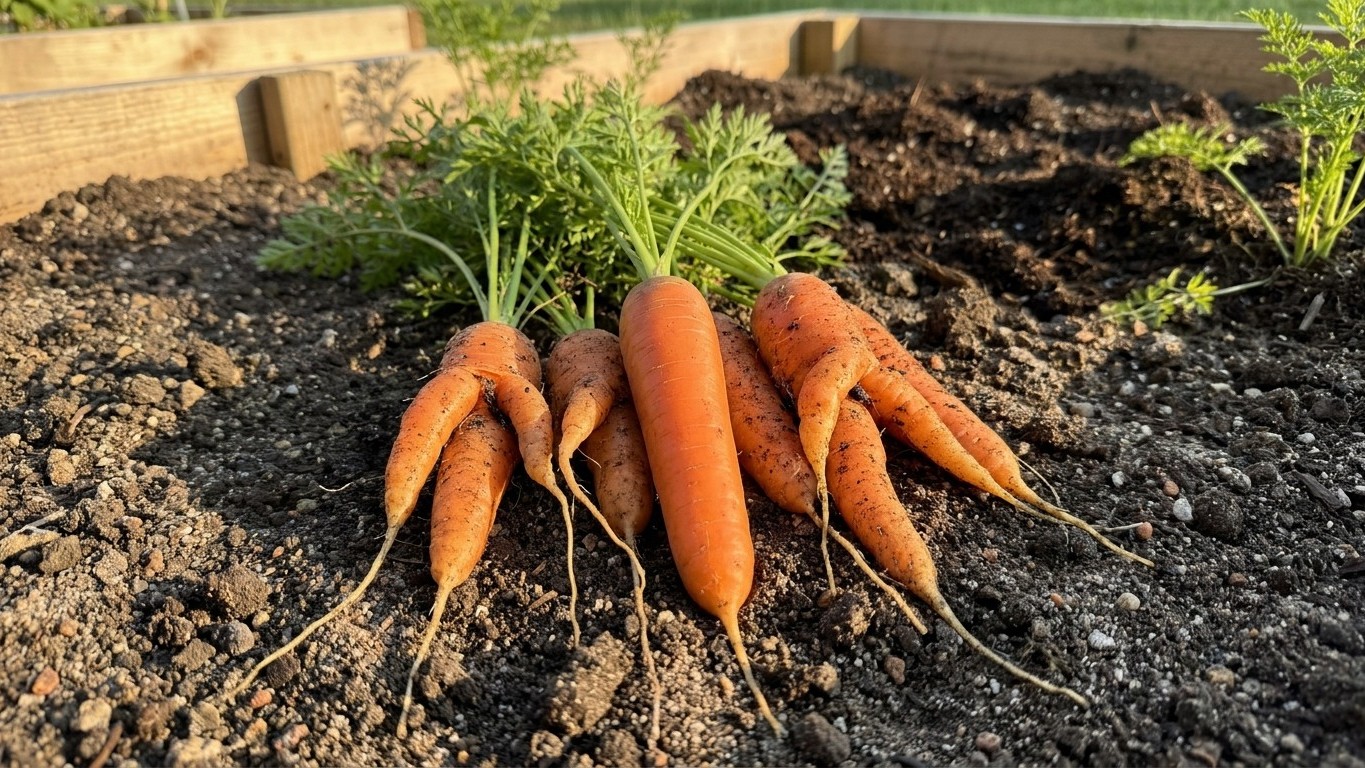

Pull carrots once they have had enough days from seeding, about 65 to 75 by Clemson Cooperative Extension’s count, and once a test pull shows full, deeply colored shoulders. Some seed packets run as long as 100 days. After harvest, cut the tops off and chill the roots. Clemson’s storage numbers are tight: 33 °F, high humidity, and only about 10 to 14 days for carrots left in a bunch with the tops on.
How do you know carrots are ready to pull?
Carrots are sown in place, so the clock starts the day the seed goes into the ground. Clemson Cooperative Extension says to harvest about 65 to 75 days after planting. Seed packets for carrots commonly list anywhere from 70 to 100 days, counted from seeding. The spread comes from the variety and from how quickly the soil warms or cools while the roots size up. A packet date is a starting estimate for when to start checking, and the roots make the final call.
The roots tell you more than the calendar. Look at the top of the carrot where it meets the soil. The shoulder should be full and rounded, often pushing up a little above the surface, and the color should be deep orange (or whatever color your variety is) right up to the crown. Pale, skinny shoulders mean the root still has sizing up to do. The tops should be thick and leafy, though foliage alone is a poor guide, because a lush top can sit on a small root.
Cool ground is more forgiving than warm ground. Carrots sown for a cool-season harvest can wait in the soil for a few weeks past maturity, while a row racing the heat of late spring should be pulled promptly. Roots that sit too long in warm, wet soil tend to split and attract the pests covered in What Eats Carrot in Texas, and When.
When the packet window opens, pull one carrot and look at it. If it is too small, firm the soil back and wait a week. If it matches the size and color on the packet, harvest the row in batches over a few days so you are not storing more than you can handle.
Does Texas clay change how you pull carrots?
It can change a lot. USDA NRCS Soil Data Access lists the Houston Black series, a Vertisol, as the soil that represents Texas. This is a shrink-swell clay that cracks open when dry and turns to glue when wet. The representative surface layer is 20 percent sand, 54 percent clay and 26 percent silt, with organic matter around 3.0 percent, an alkaline pH of about 7.9, and moderately well drained. Those are values for the mapped surface of that series, and they describe what the state’s ground tends to do. They do not describe your bed.
Utah State University Extension says carrots want deep, sandy, well-drained soil rich in organic matter, and that heavy or rocky soil makes the root fork. Set that next to 54 percent clay and moderate drainage, and you can see why forked, stubby or cracked carrots turn up so often in clay gardens. The fix is a raised bed or double digging with plenty of compost, rather than a different variety. The full story is in Will Carrots Fork in Texas Soil?, and the basics of the crop are in Growing Carrots in Texas.
River bottoms, hill country and ground that a builder has scraped or filled can differ completely from Houston Black. To find out what you have, try the jar test. Fill a straight-sided jar with soil from a few inches down and water, shake hard, and let it settle. Sand drops first, then silt, then clay, and the layer thicknesses show your mix. For a pH and nutrient number, send a sample to your county extension office.
Clay also changes harvest day. Dry clay sets like a brick and snaps carrots at the shoulder, while saturated clay grips the root and tears the skin. Water the evening before, slide a fork in several inches from the row, and rock it gently before you lift.
Keeping them, and for how long
What temperature and humidity do stored carrots need?
Clemson Cooperative Extension gives the storage target plainly: “Store them at 33 °F and high humidity to prevent wilting.” That puts the number right at the edge of freezing, which makes it colder than a root cellar and much colder than a kitchen. Clemson’s carrot, beet, radish and parsnip fact sheet adds the clock: “Bunched carrots (plants with tops on) can be stored for about 10 to 14 days.”
Treat that as a ceiling. It is the most you can expect when the temperature and humidity are right, the roots came out of the ground undamaged, and nothing else is going wrong. A carrot stored at a warmer temperature, with nicks from the fork or with soft spots, will not last that long. A reader who keeps carrots at 50 °F loses them to sprouting and softening in a fraction of that time.
Why cut the tops off first?
The leaves keep drawing moisture out of the root after harvest, so the carrot shrivels while the greens still look fresh. Cutting the tops removes that drain. Trimmed carrots, kept cold and humid, store for months at best, compared with 10 to 14 days for bunched ones. Cut the greens off above the crown, brush off the loose soil, and sort out any cracked or split roots to eat first.
| How they are kept | What to expect at best |
|---|---|
| Tops on, 33 °F, high humidity | About 10 to 14 days |
| Tops cut off, 33 °F, high humidity | Months |
| Tops cut off, around 50 °F | Sprouting and softening in a fraction of that time |
Even a well-run setup is only as good as the carrots you start with. A root with a deep crack or a mouse-chewed shoulder will rot and can spread softness to its neighbors, so store only the clean ones.
Where in the house that actually is
A heated room is too warm. A kitchen counter, a pantry shelf and a closet all sit far above 33 °F and dry the air, which sends carrots toward the sprouting and softening that Clemson’s numbers are meant to avoid. A garage runs the other way: it swings with the weather, baking on a warm afternoon and dropping sharply during a cold snap. Neither extreme is something a stored root can ride out.
The refrigerator comes closest. Its cold would hurt tender crops such as tomatoes, but carrots can take cold right up to freezing and keep best there. The crisper drawer is the best spot, because the closed drawer holds humidity better than an open shelf. Put trimmed carrots in a plastic bag that stays loosely closed, so moisture stays in without sealing the air out completely.
| Spot in the house | How it behaves | Verdict for carrots |
|---|---|---|
| Crisper drawer | Cold and humid, but the setting varies from one refrigerator to the next | Closest match |
| Back wall of the refrigerator | Can run cold enough to freeze | Avoid |
| Kitchen, pantry or other heated room | Warm and dry | Too warm |
| Garage | Swings with the weather | Unreliable |
Refrigerator dials are not labeled in degrees, so the number on the dial tells you little. Leave an inexpensive appliance thermometer in the crisper drawer before you trust it with the harvest. If it reads well above 33 °F, turn the control a notch colder and check again later. If the carrots come out glassy or show ice crystals, the spot is running too cold, so move them away from the back wall. Skipping the check can mean finding a drawer of limp or sprouting carrots a couple of weeks later.
Common questions
How many days from seeding until carrots are ready?
Clemson Cooperative Extension puts harvest at about 65 to 75 days after planting. Seed packets commonly run from 70 to 100 days, counted from the day the seed goes in. Carrots are sown in place, so there is no seedling date to count from. Use the packet as a guide to when to start checking, then confirm with a test pull.
Can carrots stay in the ground until I need them?
They can for a while in cool weather, since cool soil holds mature roots well. In warm, wet conditions, roots left too long tend to split and draw pests. Check a few every week or two, and pull the row if you see cracking or damage.
Why are my carrots forked, and can I still eat them?
Heavy or rocky soil makes the root fork, according to Utah State University Extension. Forked carrots are fine to eat, though they are harder to peel. For the next planting, loosen the bed deeply with compost or build a raised bed.
Do carrots keep in the garage?
Not reliably. A garage swings with the weather, so the temperature wanders far from the 33 °F that Clemson recommends. The crisper drawer of a refrigerator is a safer choice. Use a thermometer to confirm it is cold enough.