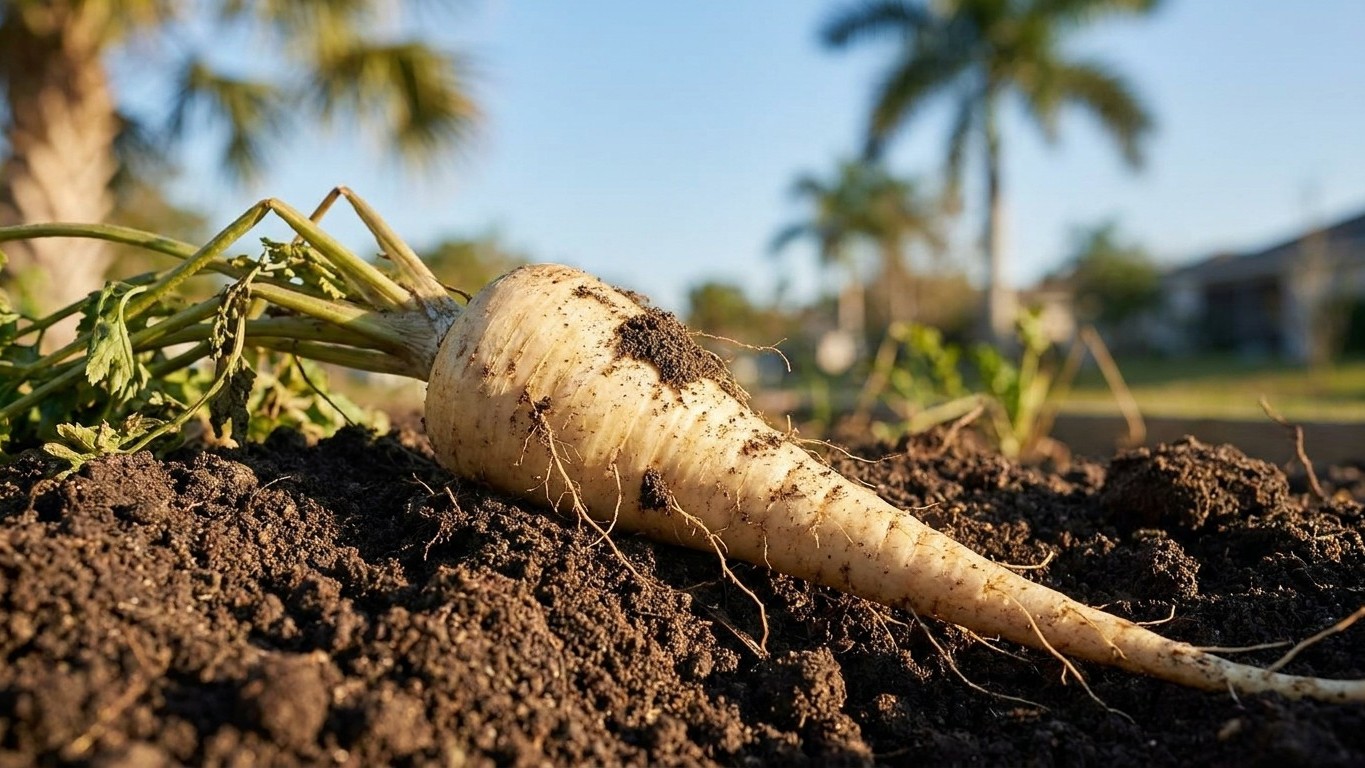

Lift parsnips in North Carolina after the first fall frost and a few weeks of cold nights. Once dug, topped and kept cold, they hold for four to six months, but only if storage conditions are right and no fruit shares the shelf. The details below decide whether your row ends up sweet or just edible. For the full crop plan, start with Growing Parsnips in North Carolina.
The short answer
Does North Carolina deliver several frosty weeks? Only partly. At the Charlotte reference station, the coldest month has a mean daily minimum of 31.8°F. That puts a typical winter night right at the freezing line. Some nights drop below it and many sit just above it. Frost shows up, but the long, steady cold that parsnips like is not guaranteed.
Will a parsnip sweeten here?
Parsnips taste best after several weeks of cool, frosty weather, which converts stored starch to sugar (Utah State University Extension says as much). A parsnip grown in the Piedmont will always grow. Whether it sweetens depends on the winter you get. A cold one gives you a properly sweet root. A mild one gives you a fine, mild-flavored parsnip that is good roasted but never reaches that candied edge. The deciding factor is how many frosty nights the roots actually sit through. The hardiness zone on the seed rack says nothing about that, and a comfortable zone is not the same thing as several frosty weeks. I cover the mechanism in Will Parsnips Sweeten in North Carolina?
Charlotte sits in the Piedmont, so adjust for where you garden. The Blue Ridge mountains to the west run several weeks later in spring and get colder, longer winters, which favors sweetening. The coastal plain frosts earlier in spring and has the mildest winters, so sweetness is the least certain there.
When do you actually dig them?
The first fall frost at the reference station arrives between October 30 and November 8. Start counting your frosty weeks from that window, not from the calendar date. Pull one root in late November or early December and taste it. If it is still starchy, wait. You can keep harvesting through winter as the ground allows, then clear the row before new leaves push up in spring. Roots left past that point put their energy into regrowth and turn tough.
How long do parsnips keep after lifting?
USDA Agricultural Handbook 66 puts it at four to six months at 32 to 34°F with 98 percent relative humidity (USDA Agricultural Handbook 66). That is a long keeper by any standard. It also assumes those conditions hold steady, which almost no house manages. A refrigerator crisper drawer, with the roots in a perforated bag, comes closest.
Cold itself is no danger, since parsnips are not chilling sensitive. Ethylene is. Parsnips produce very little of it, but even low levels from nearby apples or other ripening fruit make the roots bitter, even at the right temperature. Keep them in a separate drawer from the fruit bowl. Top them after harvest, but do not trim into the crown.
Does the season fit?
Parsnips are sown in place, so the clock starts at seeding. The packet number of 100 to 120 days counts from sowing, with no transplant date to subtract. Here is how that plays out against the Piedmont frost window.
- The last spring frost at the reference station falls between March 23 and April 5. Sow 2 to 3 weeks ahead of it, which means early to late March, as soon as the bed can be worked.
- Germination is slow, so keep the seedbed evenly damp. Expect bare soil for the first two to three weeks. Mark the row so you do not dig it up and re-sow.
- Count 100 to 120 days from seeding. A March sowing reaches harvest size from about mid-June into July.
- The roots then wait through summer heat. They are mature by midsummer, but sweetness does not come until cold arrives, and the first fall frost lands between October 30 and November 8.
- Start tasting roots a few weeks after that first frost. Dig through winter, ahead of spring regrowth.
On the calendar, the season fits comfortably. A March sowing finishes growing months before the first fall frost, so a late spring or a slow germination will not push it past the deadline. The tight part comes afterward, in how many cold nights follow.
Adjust the dates if you garden outside the Piedmont. In the mountains, spring frost comes several weeks later, so sowing shifts later too, but the longer cold season there gives roots plenty of time to sweeten. On the coastal plain you can sow earlier, and the extra warm weeks at the front of the season do little for flavor.
Soil matters as much as timing. Parsnips want deep, loose ground, and Utah State University Extension recommends deep sandy soil, with heavy soil double dug before sowing. Much of the Piedmont is clay, so check your own bed with a spade rather than assuming the soil type from a map.
What goes wrong here
Most failures trace back to one of a handful of causes. Each has a fix.
- Forked roots from heavy or stony ground. Roots split around a clod or rock when the soil resists them. Double dig the bed to full spade depth, remove stones, and break up clay before sowing. Piedmont red clay is common, but confirm yours with a spade.
- Forked roots from overwatering. This is a separate cause with the same result. Water deeply but less often, and check the soil before watering again.
- Bare soil after two weeks. Seed that has not come up yet has not failed. Germination is slow, so wait before re-sowing, and keep the seedbed evenly damp until then.
- A winter too mild to sweeten. In a warm year the roots stay starchy. Leave them in longer, taste-test weekly, and if sweetness never arrives, use them roasted or in soups where mild flavor works.
- Bitter roots in storage. Ethylene from apples or other ripening fruit causes this, even at the right temperature. Store parsnips in a separate drawer, away from the fruit bowl.
- Rotting or shriveled roots. Cutting into the crown when topping opens the root to decay. Remove the leaves but leave the crown intact. For what chews on the roots in the ground, see What Eats Parsnip in North Carolina, and When.
Common questions
Can I leave parsnips in the ground all winter?
Yes, and that is the easiest way to get sweetness, since the roots keep taking frost. Dig them before spring growth begins, because roots that start regrowing turn tough and lose quality. If a hard freeze is forecast, a layer of mulch makes digging easier.
Can I store parsnips next to apples?
No. Parsnips produce very little ethylene, but exposure to even low levels in cold storage causes bitterness. Keep them in their own drawer or container, away from apples and other ripening fruit.
Should I cut the tops off before storing?
Yes, top them after harvest, but do not cut into the crown. Trimming the crown opens the root to rot and shortens storage life. Twist or cut the leaves off just above the shoulder.
Why have my parsnip seeds not come up?
Most likely you have not waited long enough. Parsnip seed germinates slowly, and the bed can look empty until the last few days. Keep the soil evenly moist, mark the row, and give it the full three weeks before you dig or re-sow. Your county extension office can advise on local conditions if the row is still bare after that.