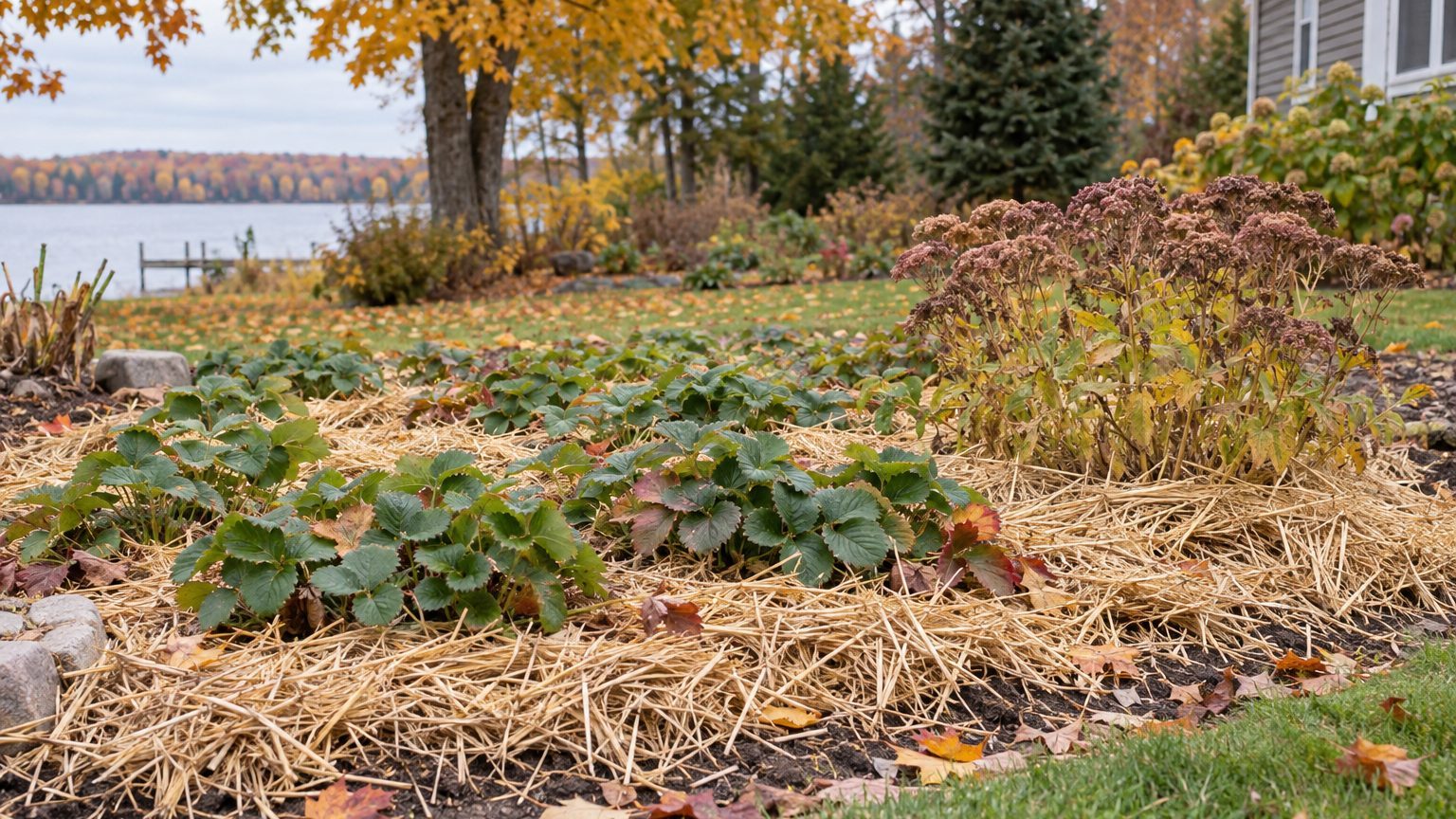

Wait for the first fall frost, then mulch in the weeks that follow. Around Portland, NOAA’s 1991-2020 climate normals put that first frost between November 11 and November 27, which makes late November into December the time to spread straw over strawberries and a layer over perennials. Central and eastern Oregon freeze earlier, so mulch goes down earlier there. West of the Cascades, winter mulch is optional, and its job is moisture and weed control more than cold protection.
When to put winter mulch down in Oregon
Winter mulch works backward from what most gardeners expect. Its job is to keep frozen soil frozen. In a cold climate, soil that freezes, thaws in a warm spell and freezes again swells and shrinks, and each cycle can push a shallow crown up out of the ground. A layer laid over soil that is already frozen holds it steady until spring. The same layer laid in October, over soil that is still warm and damp, traps moisture next to the crown and gives rot fungi and mice a comfortable place to settle.
Oregon makes a single statewide date impossible. The USDA Plant Hardiness Zone Map 2023 runs from 4a-9b across the state, and that system is built on one variable, the average annual extreme minimum temperature. Portland’s numbers anchor the dates below, and Portland sits west of the Cascades. Central and eastern Oregon are high desert with a far shorter growing season, so the Portland window should never be copied onto a garden over there.
Do you need winter mulch west of the Cascades?
Often not. The coldest month in Portland has a mean daily minimum of 36.2°F, according to the NOAA NCEI Climate Normals 1991-2020. That is the average night in the coldest month, and it sits above freezing. Cold snaps still happen: the NOAA NCEI U.S. Climate Normals 1991-2020 put the first 32°F freeze (the 30% to 70% probability band) between November 11 and November 27. But the soil seldom stays frozen for weeks at a stretch. Established strawberries and hardy perennials generally get through a west-side winter without a blanket.
Mulch still earns its keep there for three reasons. It slows moisture loss, it blocks weed seeds, and a bale of straw kept handy can be tucked over tender plants on a frost night. NC State Extension describes the weed benefit this way: “A 2-inch to 3-inch layer of mulch suppresses most annual weed seeds and makes it easy to hand-pull any that do germinate.” If you mulch on the west side, wait until after the first fall freeze, then spread it in the weeks that follow, roughly late November into December.
When should you mulch in central and eastern Oregon?
Here the ground does freeze, and the northern logic applies in full. The first fall frost arrives earlier than Portland’s November 11 to November 27 window, so the mulch goes on earlier too. Even so, watch the soil more than the calendar. After the first frost, wait for a run of hard freezes, until the surface stays stiff through the afternoon, and then mulch. Going sooner invites rot and rodents. For your own frost dates, see First and Last Frost Dates in Oregon, and ask your county extension office, which knows the local ground.
| Area | First fall frost | What winter mulch does | When it goes down |
|---|---|---|---|
| West of the Cascades (Portland) | November 11 to November 27 | Holds moisture, blocks weeds, covers plants on a frost night | Optional; after the first freeze, late November into December |
| Central and eastern Oregon (high desert) | Earlier than the Portland window | Keeps frozen soil frozen, protects shallow crowns | After the soil starts to freeze, earlier in the fall than on the west side |
Strawberries
A strawberry plant keeps its growing point, the crown, right at the soil surface. A few leaves are the only thing standing between that crown and the weather. In the colder parts of Oregon, two things hurt it over winter. Heaving comes first: freeze and thaw cycles lift the crown and leave roots exposed to air. Cold wind on uncovered crowns does the rest, drying them out. Both problems start after the soil freezes, which is the reason straw goes on after the freeze and not before.
On the west side, with Portland’s coldest-month minimum of 36.2°F (NOAA NCEI, 1991-2020), neither problem is a regular visitor. Straw there does other work. It keeps weeds down through the wet months, holds some moisture, and gives you something to throw over plants when a frost is forecast. In spring it keeps berries off the dirt.
What kind of mulch works on strawberries, and how deep?
Use clean straw. Check the label, because hay is cut with its seed heads and sprouts a lawn of weeds in your strawberry bed. Good straw is bright and dry, and it springs back when you squeeze it. Spread it loosely over the crowns and between the plants. Stay inside the same 2-inch to 3-inch range that the NC State Extension handbook gives for general mulching, and remember that fresh straw settles. Piling it deeper does not add protection, and it does add the risk of a soggy mat that holds the crown wet. For planting, spacing and care across the season, see Growing Strawberries.
When do you pull strawberry mulch back in spring?
Straw comes off the crowns when new growth starts, once the worst of the winter freezes are over. Check by lifting a handful. Leaves growing under straw come up pale yellow and floppy, and that is your signal. Rake the straw off the crowns and into the aisles, where it keeps weeds down and keeps the fruit clean. Spring comes later in the colder parts of the state, so the uncovering happens later in central and eastern Oregon than west of the Cascades. Pull the straw off the crowns as soon as new leaves push through, but leave it at the edge of the bed for frost nights while the plants are in bloom.
Perennials and borderline plants
Established perennials that are rated for your zone usually need no winter mulch at all on the west side. The USDA Plant Hardiness Zone Map 2023 spans 4a-9b across Oregon, and since the system rests on the average annual extreme minimum, a plant’s zone rating tells you whether it survives the typical worst night. Mulch helps the plants at the edge of that rating, and the ones that are new. Think of rosemary, lavender, hardy fuchsia and agapanthus, which are often sold at the limit of their range, and of anything planted this fall whose roots have not settled in.
In the high desert, the list changes. Shallow-rooted perennials such as coral bells can heave out of the ground after repeated freezes, and fall-planted divisions are the most exposed. Mulch them after the soil has frozen. Woody herbs deserve their own care: rosemary and sage dislike a wet crown, and Getting Perennial Herbs Through the Winter covers what each one tolerates.
How do you mulch around a perennial without burying the crown?
Make a ring. Leave bare soil right at the crown or stem, and spread the mulch outward over the root zone. A pile against the crown keeps the tissue wet and gives rot a start, and it hands voles a covered runway to the stem. Shredded leaves, bark or compost all work. For depth, stay within the 2-inch to 3-inch range from NC State Extension. For trees, the handbook says: “Provide a 3-inch layer of mulch to reduce water loss and maintain uniform soil moisture and temperature around roots.” That is the ceiling, and a shrub or perennial gets the same depth or less. Deeper layers are how a ring becomes a volcano. The full method, with the trouble spots, is in Mulching Without Killing the Plant.
Aim for a 2-inch to 3-inch ring with bare soil at the crown, laid after the first fall freeze. On the west side, that means late November into December. In the high desert, it means once the ground has begun to freeze.
What goes wrong
Mulching too early is the most common mistake. In the high desert, mulch laid before the soil freezes keeps the ground warm and moist, and mice move in. On the west side, early mulch sits wet through the autumn rains. The crown stays damp, slugs shelter in the straw, and rot gets a head start. Watch for plants that look soft or dark at the base in winter. The cure is patience: wait for the first freeze, then spread.
Matted mulch causes a different failure. Whole leaves, especially big wet ones, press into a slick layer that sheds air and holds water against the plant. Shredded leaves or loose straw stay open. If a layer has gone slimy, rake it loose.
Voles can be a problem in cold-winter areas, so watch for their runways and damage in the colder high desert. They tunnel under a mulch blanket and chew crowns and bark through the winter. Keep mulch pulled back from stems and trunks, stay in the 2-inch to 3-inch range, and do not mulch early.
Forgetting to uncover in spring does the quiet damage. Strawberries come up pale and leggy under straw, and the crowns stay wet and cold. Perennials leaf out late. Check beds as the soil warms, and pull mulch back from crowns when growth shows.
Common questions
Can I mulch strawberries in October in Oregon?
It is too early almost everywhere. Soil is still warm and damp in October, and straw laid then invites rot and rodents. Wait until after the first fall freeze. For Portland, NOAA’s 1991-2020 normals put that between November 11 and November 27, so mulch late November into December. Colder central and eastern Oregon gardens mulch earlier than that, once the ground starts to freeze.
Do I need winter mulch at all in Portland?
Usually not for cold protection. The coldest month’s mean daily minimum is 36.2°F, above freezing, so the heaving problem rarely arises. A layer of straw or shredded leaves still saves moisture and suppresses weeds. Keep some dry straw on hand for a frost forecast, especially for plants at the edge of their hardiness.
Is straw better than leaves or bark for winter mulch?
For strawberries, clean straw is the standard because it is light, drains well and lifts off easily in spring. Shredded leaves and bark suit perennials and shrubs. Whole wet leaves mat and rot, and whatever you use belongs in a ring that leaves the crown bare.
Does the November 11 to November 27 window apply to the whole state?
No. That range is the first fall frost at Portland, west of the Cascades. Central and eastern Oregon are high desert with a much shorter season and an earlier first frost, so mulch there should go on earlier, after the soil starts to freeze. Your county extension office can give a local first-frost range for your elevation.