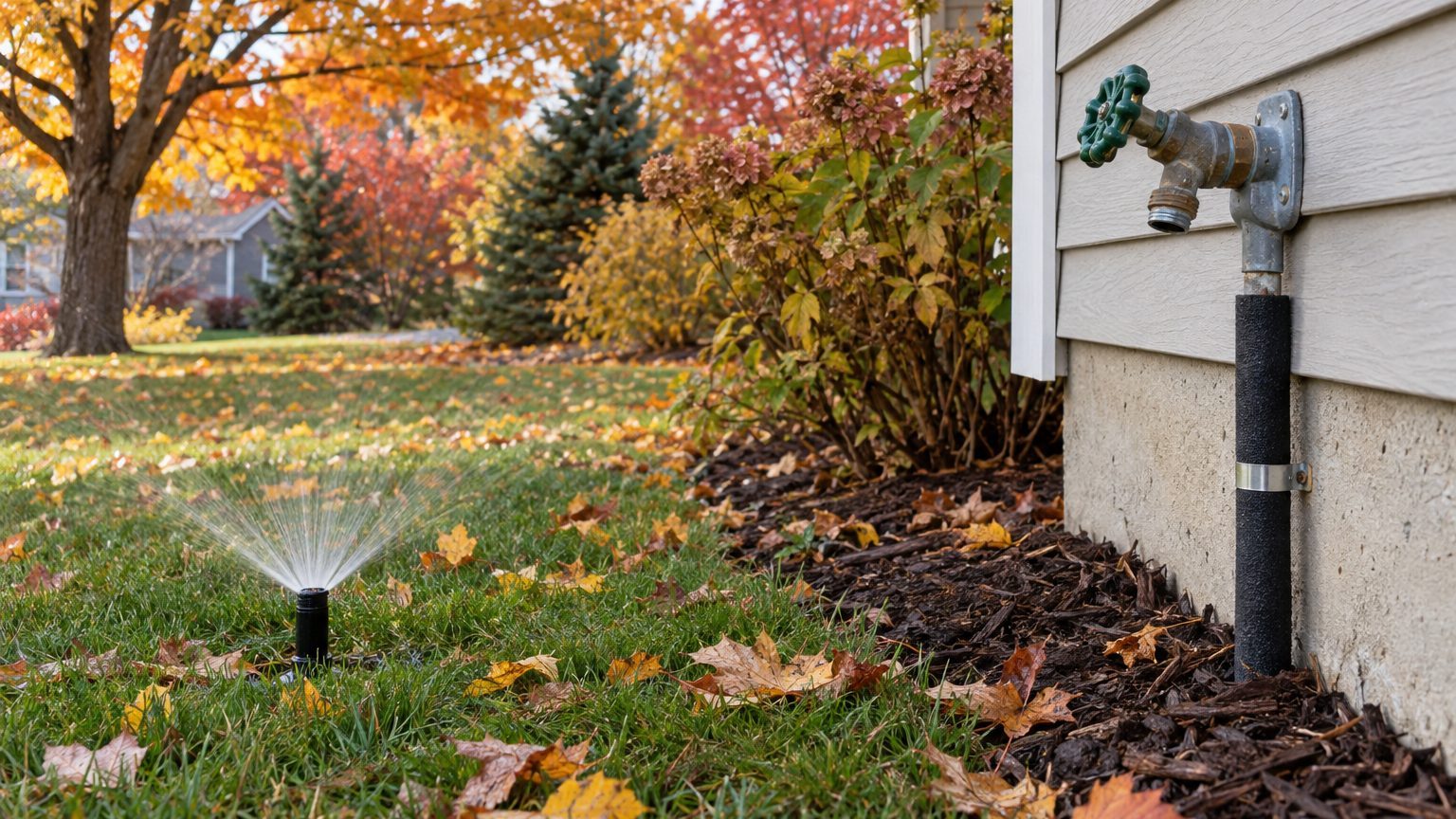

Plan to winterize sprinklers and outdoor faucets west of the Cascades from late October through early November, before the first hard freeze arrives. Portland’s odds of a first 32°F night start to climb in mid-November. Farther east and at higher elevations the cold comes sooner, and the deadline moves up with it. Mild west-side winters often make a full compressed-air blowout optional. Hoses, outdoor taps and exposed valves still need attention every year.
When to do it in Oregon
Finish before the first hard freeze, not after the first light one. For the Portland area, that means late October through early November, ahead of the November 11 to November 27 stretch when NOAA’s 1991-2020 climate normals put the odds of a first 32°F freeze in the 30 to 70 percent band. Some years the first freeze lands before that stretch, so the calendar should have you done early.
A light freeze is a dip to 32°F around dawn. Buried pipe and walls warmed by the house shrug that off. A hard freeze is a clear, still night that stays below freezing. It hits the exposed parts first: hose bibs, above-ground backflow assemblies, and any pipe that sits in open air. Water left in those spots has hours to turn to ice. The window above is set so the work is finished before the first night long enough to matter.
Is a full blowout necessary on the west side?
Often not. The mean daily minimum of the coldest month at the Portland reference station is 36.2°F (NOAA NCEI Climate Normals 1991-2020). The average night in the coldest month stays above freezing, and buried irrigation lines sit in ground that rarely holds frost. Averages hide cold snaps, though. One clear night can still drop well below the monthly figure.
So the useful work is smaller than the northern ritual and still worth doing. Shut off the water supply to the irrigation system and set the controller to its off or rain setting. Open the drain valves so the lines empty. Disconnect every hose and close the interior valve feeding each outdoor tap. Cover the above-ground backflow assembly and any exposed pipe. A blowout on top of that is cheap insurance, not a requirement, for most west-side yards.
How does the window shift in central and eastern Oregon?
Portland sits west of the Cascades. Central and eastern Oregon are high desert with a far shorter season, so Portland’s November window does not apply there. The USDA Plant Hardiness Zone Map (2023), which is built on the average annual extreme minimum temperature, runs from 4a to 9b across Oregon. That spread tells you Portland’s mild numbers say little about a high-desert yard or a mountain lot.
The rule is simple: the colder the spot, the earlier the deadline. Farther east, or higher up on the west slope, start in early to mid October and finish well ahead of Portland’s window. Reading this on October 24 with hoses still attached in the high desert? Do it this week. The county extension office can tell you the local first-freeze pattern.
| Where | Timing | Usual approach |
|---|---|---|
| Portland area and low ground west of the Cascades | Late October through early November, ahead of the November 11 to November 27 band | Drain lines, cover exposed parts, hoses off; blowout optional |
| Higher ground and Cascades foothills | Earlier than Portland’s window | Drain plus blowout is the safer call |
| Central and eastern Oregon (high desert) | Well before Portland’s window; early to mid October | Full blowout, faucets drained, everything covered |
Sprinkler lines: drain or blow out
Why do frozen sprinkler lines split?
Water expands as it freezes. The same thing happens when a full soda can left in the freezer bursts its seam. Inside a sprinkler system, the ice has nowhere to go, so the weakest point gives way. That is usually a fitting, a valve body, a riser or the backflow assembly. Nothing looks wrong in winter. The split only shows when you pressurize the system in spring and water sprays or seeps from a crack you can’t see.
Valves are a common casualty. A manifold of zone valves holds water in every body and diaphragm, and any freeze that reaches it can crack plastic housings. Heads and risers in open lawn are next. The goal of every method below is the same: get the water out of the places where it can sit.
Manual drain, automatic drain or blowout: which fits Oregon?
A manual drain relies on valves at the low points of the system. You shut the supply, open each drain valve, and let gravity empty the lines. An automatic drain works on the same idea, but small valves open on their own when water pressure drops, so the lines empty when you shut off the supply. Both leave a little water in heads and valves. A compressed-air blowout pushes air through each zone and clears nearly everything, including the pockets that gravity misses.
West of the Cascades, where the average coldest-month night stays above freezing, a system with working drain valves usually does fine with manual or automatic draining and an insulated cover on the backflow assembly. A blowout makes sense when lines run flat, when low spots hold water, or when you aren’t sure the drains work. In central and eastern Oregon and at higher elevations, blowout is the standard. Open the drain valves or blow out each zone in late October through early November on the west side, and earlier in colder country.
Blowout safety matters. Use eye protection, stay clear of heads while they spit, and keep each zone’s air time short, only until the mist from the heads stops. Running air through a dry head too long can damage it. Stay within the pressure range set by the pipe type and the system maker, because poly and PVC tolerate different limits. Air volume does much of the work.
When is a professional the sensible choice?
Call one if the system has no drain valves and no blowout port, if you don’t own or can’t borrow a compressor with enough airflow, or if the system is large with many zones. A pro also makes sense when the backflow assembly needs service. Some water providers require testing by a certified tester, so ask yours. Hiring someone for an afternoon costs far less than replacing a cracked manifold in April.
Outdoor faucets and hoses
How do you drain an outdoor faucet?
Start by pulling every hose off the tap. That includes splitters, timers and sprayer attachments, which hold water as stubbornly as the hose itself. Drain the hoses and store them. Next, find the interior shutoff valve for that faucet. It is typically on the pipe near the wall where it passes through, often in a basement, crawlspace or garage. Close it. Then open the outdoor tap fully and leave it open all winter so whatever sits between the interior valve and the spout can drain out.
That is all turning valves. If you can’t find an interior shutoff, if the valve won’t turn, or if the faucet drips after you close it, stop there and call a plumber. Anything involving cutting, soldering or replacing a valve belongs to them. A foam cover over the outdoor tap adds a little protection on the coldest nights, particularly for the outdoor faucets before the first freeze.
Why does a frost-free faucet still fail with a hose attached?
A frost-free faucet has a long stem, so the valve seat sits deep inside the wall while the spout is outside. When you shut it off, the water in the barrel is supposed to run out through the spout. That only works if the spout is free to drain. A hose left on the tap traps water in the barrel and keeps air from entering. On a hard-freeze night the trapped water in the barrel freezes, and the barrel or the pipe behind it can split.
The damage is hidden. You see nothing until spring, when you turn the tap on and water pours inside the wall, into a ceiling or across a basement floor. Details on how these fixtures are built and installed are in the guide to frost-free outdoor taps. Take hoses off and close the interior valves in late October to early November, and earlier in central and eastern Oregon. A frost-free tap still wants the hose removed.
What goes wrong here
What happens when a cold snap arrives before you’ve drained?
Because Portland’s first-freeze odds sit between 30 and 70 percent during November 11 to November 27, some years bring an early clear, cold night before anyone has touched the system. If one is in the forecast, shut off the irrigation supply, take the hoses off, open the outdoor taps and cover the backflow assembly. Drain the lines when the weather turns. In spring, a missed cold snap shows up as a weeping valve, a zone that won’t shut off, or a geyser at a head.
What does a forgotten hose do?
One hose left on one tap is a common failure. The tap seems fine until the spring turn-on. Then there’s a spray inside the wall, a stain on drywall, or a hiss from a closet behind the garage. The fix is a plumber and a repair. The prevention is a habit: do the hose check on the same weekend as the sprinkler shutdown. A cold house wall can be as risky as a bare pipe in the yard. If a pipe does freeze before you catch it, see the guide on frozen pipes.
Why does the valve box flood?
West-side autumn rain fills in-ground valve boxes, especially ones with a cracked lid or sitting in a low corner of the yard. The valves then sit in standing water. A freeze after that cracks housings that looked fine all summer. In spring, you notice a zone that leaks or won’t turn off, or the box is full and the soil around it is soggy. Keep the lid on and intact, make sure the surrounding soil slopes away, and check the box in October. Put a late October valve-box check on the calendar. Leave any digging or replacement to a pro.
Common questions
Can I wait until Portland’s first frost to winterize?
Waiting is risky. The first freeze usually falls between November 11 and November 27 on the NOAA normals, but that is only the middle of a range, and an earlier night can arrive in any year. A light dip below freezing may do nothing, while the hard freeze that follows finds undrained lines. Finish in late October through early November, and you’re covered either way.
Do I need a blowout if winters are mild west of the Cascades?
Not always. The Portland station’s coldest-month mean daily minimum of 36.2°F means most nights stay above freezing. A system with working drain valves, closed supply, covered backflow assembly and hoses off is often fine. A blowout is smart where lines are flat, drains are doubtful or the yard sits in a cold pocket. It is routine for colder parts of the state.
When should I winterize in central and eastern Oregon?
Earlier than Portland, because those areas are high desert with a much shorter season. Start in early to mid October and plan on a full blowout and drained, covered outdoor taps. Since local cold varies a lot, check with your county extension office, and browse the other Oregon guides for regional detail.
Is it too early to shut off sprinklers in October?
West of the Cascades, fall rain often covers lawn watering by October. Newly planted trees and shrubs can still need an occasional soak. You can switch the controller to rain or off and drain the system in the later part of the window. For what else the lawn needs before winter, see winterizing a lawn. Once the lines are drained, one extra step helps: leave the drain valves open until spring turn-on so no stray water collects over winter.