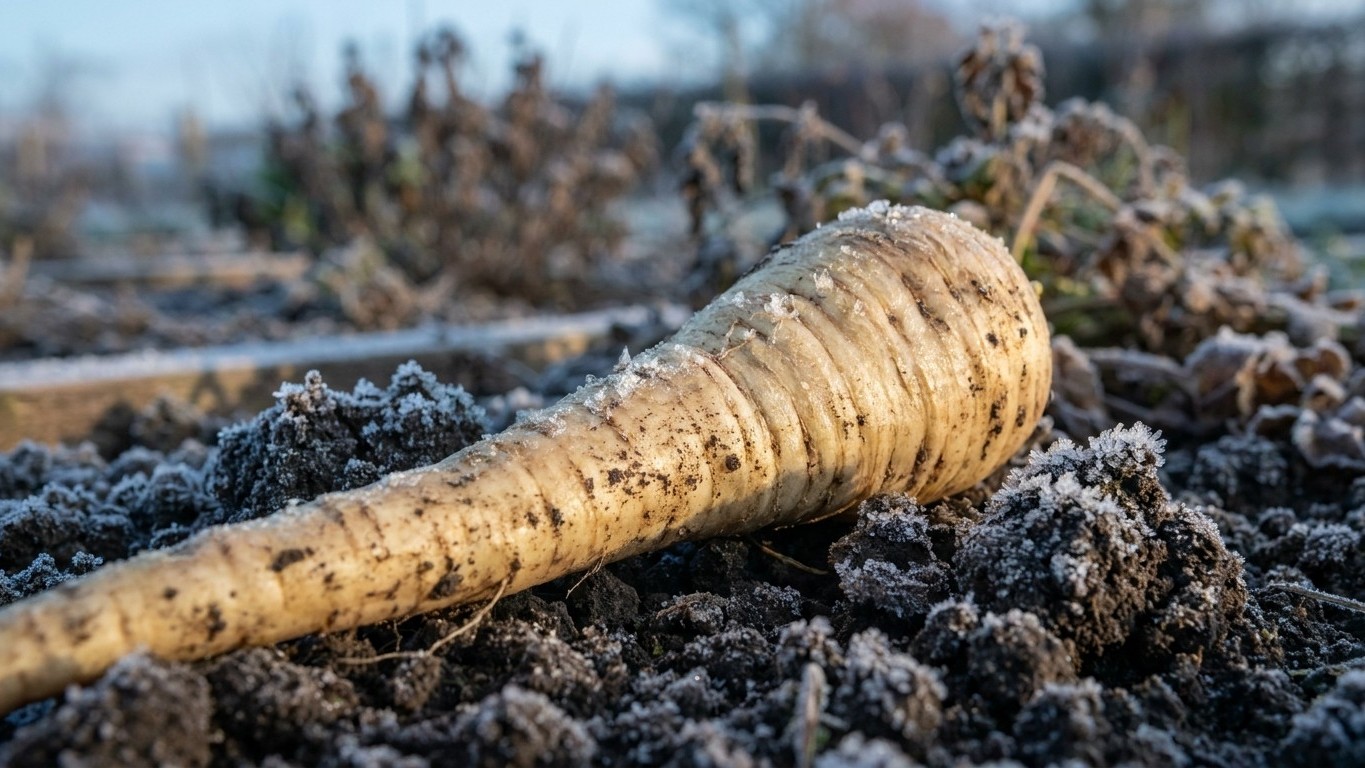

Lift parsnips in New Brunswick after several weeks of hard frost. In most years that means late October into November, and you can keep digging as long as the ground stays workable. A thickly mulched row can also wait out the winter and be dug in early spring. Once out of the ground, topped roots keep four to six months, but only under cold, damp conditions and well away from ripening fruit.
The short answer
The question that decides it is whether the province delivers several frosty weeks, and it does. At the Moncton reference station, the mean daily minimum of the coldest month is -13.9 °C (Environment and Climate Change Canada, Canadian Climate Normals 1981-2010). That is a winter with real, repeated cold, well past the occasional light frost that merely nips the tops.
A parsnip grown here will sweeten, not just grow. Utah State University Extension explains that parsnips taste best after several weeks of cool, frosty weather, which converts stored starch to sugar. The trigger is exposure to frost itself. A mild hardiness zone number does not promise those weeks, and a cold-sounding one does not either. What counts is how many frosty weeks the roots sit through before you dig. The mean first fall frost at Moncton is October 2, so by late October the roots are already well into that cold. For the full picture of how the sweetening works, see Will Parsnips Sweeten in New Brunswick?
That October 2 date is a mean, so in one year out of two the first frost arrives earlier. It also comes from a single coastal-plain station, and northern or upland districts run weeks behind its calendar. Gardeners there get their frost later and their growing season shorter. Treat the date as the midpoint of a window.
The plant itself is the better clock. Wait until the tops have been knocked back by repeated frosts, then pull one root and taste it. If it is still starchy and bland, give the row another week or two. Lift what you plan to eat over the next couple of weeks, and mulch the rest with a deep layer of straw or leaves so the soil does not freeze solid. In spring, dig the remainder before the tops begin to regrow.
Storage is where most gardeners go wrong, and the cause is not cold. A parsnip is not chilling sensitive, so cold storage will not hurt it. The danger is ethylene, the ripening gas given off by apples, pears and other fruit. USDA Agricultural Handbook 66 reports that even low levels of ethylene in cold storage make parsnips bitter. Parsnips themselves give off almost none. A root stored beside a bin of apples will turn bitter even at the right temperature.
The same handbook (USDA Agricultural Handbook 66) puts the storage life at 4 to 6 months at 0 to 1 °C (32 to 34 °F) with 98% relative humidity. Four to six months is a long keeper by any standard, but the figure assumes those conditions hold steady, and almost no house manages that. An unheated cellar or a crisper drawer comes closest. Top the roots after harvest, but do not cut into the crown.
Does the season fit?
Parsnips are sown in place, and the 100 to 120 days run from seeding, not from transplanting. The usual advice is to sow 2 to 3 weeks before the last spring frost. Here is how that plays out against the frost window at the Moncton station, step by step.
- Sow in early May. The mean last spring frost is May 23, so a sowing 2 to 3 weeks ahead lands in the first days of May, as soon as the soil can be worked. May 23 is also a midpoint. In one year out of two the last frost falls later, so a cold, wet spring can push the sowing back a week or more.
- Wait for germination. Bare soil at day ten is normal. Mark the row and resist the urge to dig it over and re-sow.
- Count 100 to 120 days from seeding. From a sowing in the first week or so of May, the roots reach full size between roughly the second week of August and the first week of September.
- Check the frost window. The reference station has about 132 frost-free days between the mean last spring frost (May 23) and the mean first fall frost (October 2). A crop needing 100 to 120 days fits inside that, and it is done growing weeks before the first frost.
- Add the cold weeks. The frost that arrives from early October on is what sweetens the roots. Late October through November is the usual lifting window, after the roots have had several weeks of it.
The season fits comfortably at Moncton, with a margin to spare at both ends. The margin shrinks in northern and upland districts, where spring comes later and fall frost comes earlier. A sowing delayed into late May there leaves little slack, so sow at the first workable moment. The full growing picture is in Growing Parsnips in New Brunswick.
What goes wrong here
Most failures with parsnips in New Brunswick come from the ground and the calendar, not from the cold. Here are the ones that cost gardeners the most roots.
- Forked roots from heavy or stony ground. A root that meets a stone or a layer of packed clay splits around it. Utah State University Extension recommends deep sandy soil, and heavy soil should be double dug.
- Forked roots from overwatering. This is a separate cause and it can happen in perfectly loose soil. Keep the ground evenly moist rather than constantly wet. Water only when the soil a finger deep is dry, and soak deeply when you do.
- A season that runs out. Sowing in late May or June, or in a district where fall frost comes early, leaves the roots small. Sow as soon as the soil can be worked. If the roots are small by fall, leave them in the ground under mulch and lift them in spring.
- Digging too early in a warm fall. A run of mild weeks after October 2 does not give the roots the cold they need. Roots lifted at that point are fine to eat but taste starchy. Wait for repeated hard frosts and taste one before you commit to the row.
- Winter that locks the ground. A solid freeze with no cover makes lifting a pickaxe job and can damage roots. A deep layer of straw or leaves laid before the ground freezes keeps the row diggable.
- Bitter roots in storage. Parsnips stored near apples or other ripening fruit pick up ethylene and turn bitter. Keep them in their own container, away from fruit.
- Pests chewing the roots and foliage. Damage looks different depending on the season. See What Eats Parsnip in New Brunswick, and When.
Common questions
Can parsnips stay in the ground all winter in New Brunswick?
Yes, if the row is mulched deeply enough that the soil does not freeze solid. Dig them in early spring before the tops start to regrow. Roots left after regrowth begins lose quality.
How soon can I lift parsnips after the first frost?
Give them several weeks. The first frost only starts the process of turning starch into sugar. In most years that puts the first real lifting in late October, and a taste test of one root will tell you whether the rest are ready.
How long do lifted parsnips keep?
Four to six months at 0 to 1 °C (32 to 34 °F) with 98% humidity held steady. In a typical home cellar or fridge drawer, expect somewhat less. Top the roots after harvest but do not cut into the crown.
Why do my stored parsnips taste bitter?
Ethylene is the usual cause. Apples, pears and other ripening fruit give off this gas, and even low levels make parsnips bitter in cold storage. Store the roots in their own container, well away from fruit.