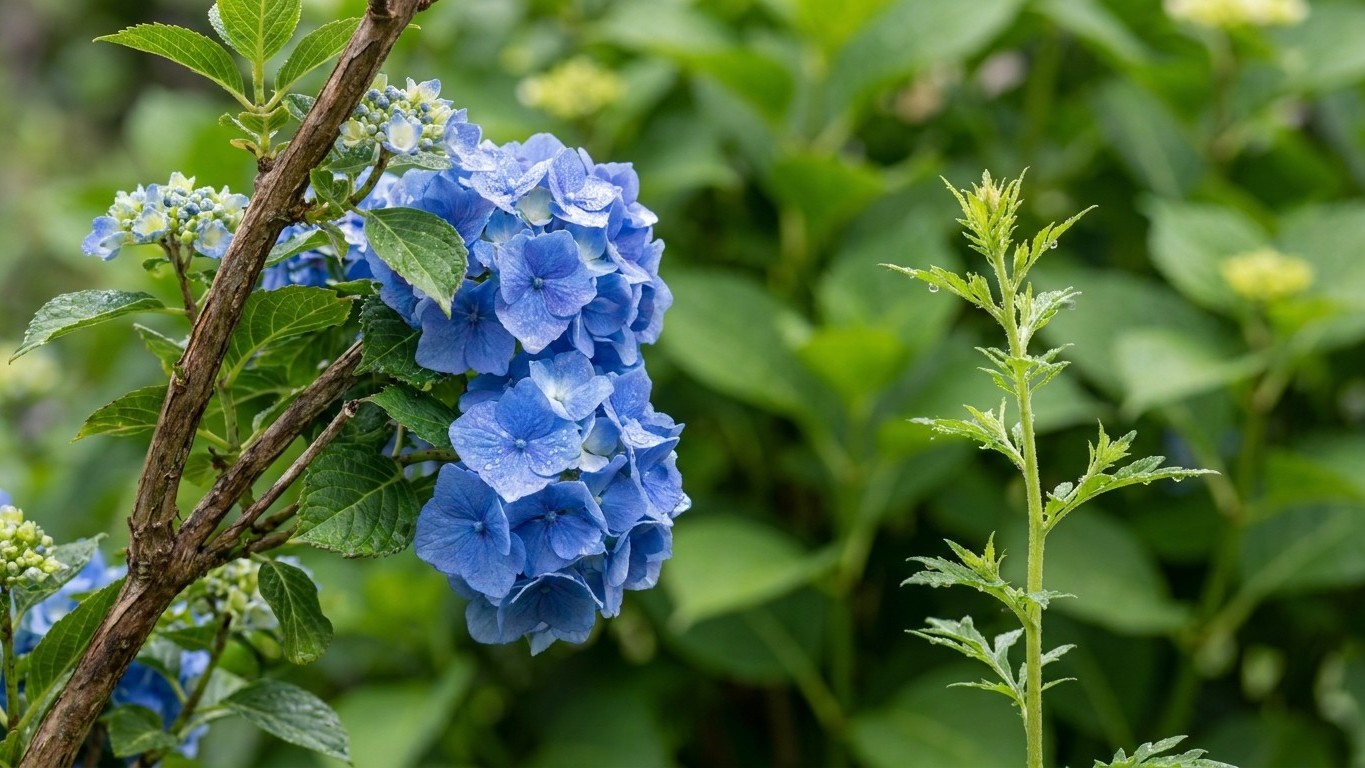

Bigleaf hydrangeas bloom pink in Manitoba because the soil is usually neutral to alkaline, and in that kind of soil the plant can’t take up aluminum. Blue flowers need aluminum inside the plant, and aluminum only dissolves in acidic soil. You can shift the color by lowering the soil pH around the roots, but the effort varies a lot depending on how much lime your ground holds.
What this comes down to in Manitoba

The color fix has to fit inside a short growing season, and at Winnipeg that season runs from a mean last spring frost of May 23 to a mean first fall frost of September 22. Both dates are midpoints: in one year out of two, the last spring frost falls later than May 23, and in one year out of two the first fall frost arrives earlier than September 22.
The reference point is the Winnipeg Richardson International Airport station, using Environment and Change Canada climate normals, and that station’s frost dates are a mean, not a safe date. Winnipeg also sits in Canadian hardiness zone 3b. That is a Canadian zone, built on seven climate variables, and it does not convert to a USDA zone. Treat the dates as the middle of a window that opens earlier and closes later, never as a safe date.
Why does soil pH decide hydrangea color?
The flower pigment in bigleaf hydrangeas is an anthocyanin that looks pink or red by itself. When aluminum ions bind to it inside the petals, the color shifts to blue. A plant can only absorb aluminum that is dissolved in soil water, and that happens in acidic soil. As the pH climbs toward neutral, aluminum forms compounds the roots can’t use, and the pigment stays pink.
| Soil pH (approximate) | Aluminum available to roots | Typical bigleaf flower color |
|---|---|---|
| Below about 5.5 | Plentiful | Blue |
| About 5.5 to 6.5 | Partly available | Purple, or a mix of blue and pink |
| Above about 6.5 | Locked up | Pink to red |
Much of southern Manitoba sits on glacial lake sediments and limestone-rich till, so garden soil is often calcareous, with a pH well above 7. Lime in the ground acts like an antacid. It pushes back against anything you add to acidify. Hard tap water and phosphorus-heavy fertilizer make it worse, because phosphorus ties up aluminum inside the soil even where some is present.
Which hydrangeas can change color at all?
Only bigleaf hydrangeas (Hydrangea macrophylla) and the closely related mountain hydrangeas (Hydrangea serrata) respond to soil chemistry. The smooth and panicle types that handle prairie winters best do not turn blue at any pH. White smooth hydrangeas stay white, and panicle flowers often age from white to pink or burgundy as nights cool, which is a change of season and has nothing to do with the soil.
Bigleaf types are also the marginal ones here. Many bloom on buds formed the previous summer, and cold can kill those buds. If you want the winter side of that story, see Protecting Hydrangeas Through a Manitoba Winter.
Working it out for your own garden
Start with a measurement rather than a guess. The size of the gap between your soil’s pH and the target tells you whether a bed is realistic or whether a container is the better bet.
How do you test your soil pH?
A home test kit gives a rough number, and a lab test through a commercial soil-testing service gives a firmer one. Take samples from the root zone, about 4 to 6 inches down, from three or four spots under the drip line, and mix them. Check the plant itself too. Pink blooms last year suggest a pH above about 6.5. Purple suggests the middle band. Blue means the soil is already doing the work.
Say the test reads 7.5, which is ordinary for lime-rich clay. Moving that to 5.5 means neutralizing a lot of free lime, and the soil will drift back every year. A bed like that calls for a standing commitment, or a large container filled with acidic potting mix. If the test reads 6.5, a modest program may be enough to produce blue or at least purple within a season or two.
How do you turn pink hydrangeas blue?
The timing follows the frost window. Roots take up aluminum once the shrub is actively growing, so treatments start after leaf-out. With a mean last frost of May 23 at Winnipeg, and frost possible a week or two later, leaf-out lands in late May to early June. Plan the first application for that stretch and repeat it through early summer, following the label on whatever product you use.
Stop in midsummer. Counting back from a mean first frost of September 22 gives a target date, and since half of all years bring frost earlier, aim earlier than that midpoint. Acidifying late pushes soft growth and stresses roots right before cold weather.
Four tools do the job, and they work at different speeds:
- Aluminum sulfate, dissolved in water and poured around the root zone, acts within weeks but can burn roots if overapplied.
- Elemental sulfur worked into the soil acidifies slowly over months, so it suits advance work before the season.
- A fertilizer low in phosphorus keeps aluminum from being tied up.
- Rainwater, or a rain barrel, avoids the alkaline buffering of hard tap water.
Pine needles and peat moss are often recommended, but they barely move the pH of lime-rich ground, so treat them as mulch only. Changes usually show the following year, because blooms form on buds already in place.
What changes across the state
A single reference city can’t speak for a province this large, and two things move the numbers: soil and season length.
Does soil pH vary across Manitoba?
It does. The flat Red River Valley and much of the south hold heavy, calcareous clay, which is the pink-producing extreme. Eastern Manitoba toward the edge of the Canadian Shield has sandy, more acidic ground in places, and gardeners there may find their bigleaf hydrangeas leaning blue or purple without any help. Neighborhoods inside one city can differ too, because builders often import fill and topsoil.
Does the growing season change the plan?
Winnipeg is one point on a map. Upland districts such as the hills along the escarpment, and the north generally, run weeks behind it. A first application that fits late May in the city may fit early June farther out, and the midsummer cutoff moves earlier by the same margin. Shelter matters as much as location. A bed against a south-facing wall, or in a yard with a windbreak, warms sooner and holds the season longer than an open exposure a few blocks away.
Lakes nudge temperatures near the big water bodies, but the main swing in this province is from south to north and from lowland to upland. Watch when your own shrub leafs out and let that, rather than the calendar, start your clock.
The mistakes this state punishes

Why do my blue hydrangeas not bloom?
Gardeners chase color and forget that bloom is the first requirement. A bigleaf hydrangea can be perfectly acidified and still flower poorly if winter killed its buds or spring pruning removed them. Cutting stems back in spring, or tidying in fall, takes off the buds that carry the flowers. Read When to Prune Hydrangeas in Manitoba before you pick up the shears.
Another trap is acting too early. A warm spell in April tempts people to dose the bed, but roots in cold, dormant soil can’t use the aluminum, and frost can still arrive into late May or beyond. Wait for the shrub to leaf out.
Can you overdo the aluminum sulfate?
Yes. More product does not make a bluer flower, and strong doses burn roots and can leave leaf edges scorched. In lime-rich soil the temptation is greater, because the first dose seems to do nothing. Pushing harder rarely works. Test again, switch to slow sulfur, or move the plant to a container.
Phosphorus is the quiet saboteur. A general lawn or bloom-booster fertilizer that is high in phosphorus can undo weeks of acidifying, so check the middle number on the bag. Finally, don’t expect a white or panicle hydrangea to turn blue. Spending a season on a shrub that can’t respond is the costliest mistake of all.
Checking this against your county
The Winnipeg frost dates and the soil picture above are a starting point. Your own yard may be weeks different, and your soil may be far more or less alkaline than the regional average. Manitoba Agriculture can point you to local agricultural representatives and soil-testing services, and they know which parts of your area run alkaline. For the broader picture of choosing and caring for these shrubs, see growing hydrangeas in Manitoba.
Common questions
Do coffee grounds turn hydrangeas blue?
Not reliably. Used grounds are close to neutral, and the amount a garden bed can take won’t shift lime-rich soil. Fresh grounds are more acidic but can harm roots in quantity, so they are a weak substitute for a soil test and a proper acidifier.
How long does it take to turn a pink hydrangea blue?
Plan on one to two growing seasons. Flower buds are already formed when you start, so the first year may bring purple or patchy blooms, and a full blue usually appears after a second year of consistent treatment.
Can I turn a blue hydrangea pink?
Yes. Raise the soil pH with garden lime and keep phosphorus generous. In most Manitoba gardens the soil already leans that way, so pink usually needs no help.
Will panicle or smooth hydrangeas turn blue?
No. Their color is not controlled by soil aluminum. Panicle blooms may blush pink as they age, but that comes with the season and cooler nights, and no soil treatment will produce blue.