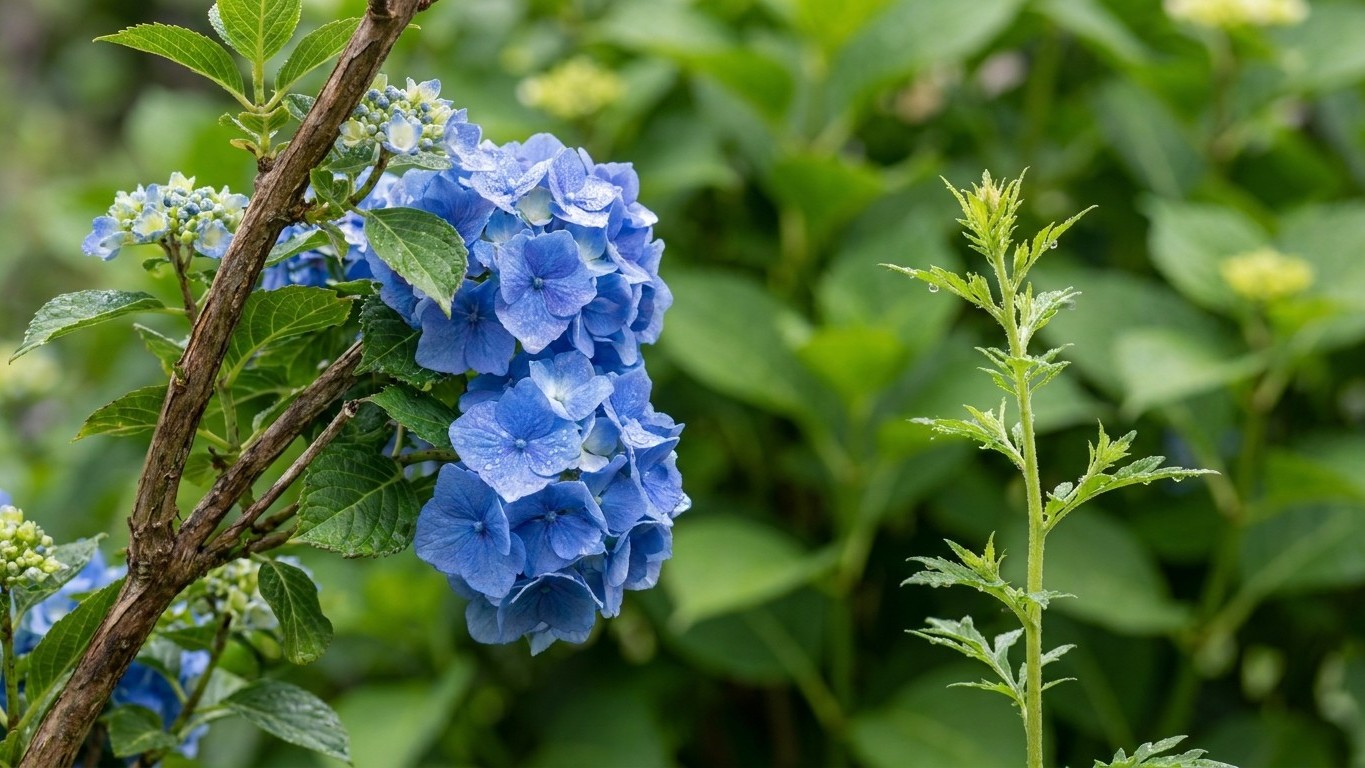

Hydrangeas turn pink in Nevada because the soil and water are alkaline, and alkaline conditions lock up the aluminum that blue flowers need. To get blue, lower the pH in the root zone to roughly 5.0 to 5.5 and keep phosphorus low. In desert ground that is hard to do in a bed, so a large container with acidic mix is usually the most reliable route. Only bigleaf and mountain hydrangeas can change color at all.
What this comes down to in Nevada

Pink is the default across most of Nevada because desert and Great Basin soils are alkaline, usually well above neutral, and the pigment in bigleaf hydrangea flowers only turns blue when it can bind aluminum. The growing season that matters for color work is a long one at the Las Vegas airport reference station, where the average last spring frost falls roughly between late January and mid-February and the first fall frost roughly between late November and mid-December. That is a desert urban-heat-island extreme, and Reno, Carson City and any garden at elevation frost months earlier in fall and later in spring.
Why do hydrangeas turn pink in alkaline soil?
The flower pigment is an anthocyanin that looks pink or red on its own. When aluminum ions are present inside the plant, the pigment forms a complex with them and shifts toward blue. Most soils hold plenty of aluminum already. What varies is whether the roots can take it up.
Below a soil pH of about 5.5, aluminum dissolves in soil water and moves into the plant. Around 6.0 and higher, it forms insoluble compounds that roots cannot absorb. Much of Nevada’s ground sits far above that line, and many soils contain free lime (the white, crusty layer called caliche is the extreme case). Hard irrigation water adds more alkalinity every time you water.
Phosphorus makes it worse. High phosphorus in the soil ties up aluminum and also interferes with its movement inside the plant. A general-purpose fertilizer with a high middle number nudges flowers toward pink even where the pH is borderline.
Which hydrangeas can change color at all?
Bigleaf hydrangea (Hydrangea macrophylla), including the mophead and lacecap types, responds to aluminum. So does mountain hydrangea (Hydrangea serrata). Panicle hydrangeas, smooth hydrangeas such as the white ‘Annabelle’ type, and oakleaf hydrangeas do not. Their color comes from different chemistry and no soil amendment will change it.
White bigleaf cultivars stay white too. They lack the pigment in the first place. If the plant in your yard has never produced anything but cream or white flowers, there is nothing to turn blue. A bigleaf that opens a muddy purple is one with partial aluminum uptake, which is a sign you are close.
Working it out for your own garden
Start with a number, not a guess. A lab soil test (University of Nevada, Reno Extension lists private and university labs that accept home-garden samples) gives you pH and often tells you about salinity and free lime. Take samples near the drip line, where the feeder roots are. A cheap probe or kit gives only a rough estimate, and Extension notes that kit pH readings are rarely accurate above about 7.2, which is too low for many desert soils, so a lab result is the baseline. Test your irrigation water too, since it keeps pushing the pH back up.
What pH do you need for blue, purple or pink?
Match the target to the color you want. These ranges are the commonly cited ones for bigleaf hydrangeas.
| Goal | Root-zone pH | Aluminum | Fertilizer |
|---|---|---|---|
| Blue | about 5.0 to 5.5 | Must be available to roots | Low phosphorus, higher potassium |
| Purple or mixed | about 5.5 to 6.0 | Partly available | Moderate phosphorus |
| Pink | about 6.0 to 6.5 | Locked up | Phosphorus is fine |
Now work an example. Say a soil test comes back at pH 7.8 and the plant opens pink. Blue needs a drop of more than two full points. The pH scale is logarithmic, so that is well over a hundredfold change in acidity, and in soil with free lime a surface application will not hold it. The lime keeps neutralizing whatever acid you add. In that case, grow the plant in a container or a raised bed filled with an acidic, peat-based mix, and stop trying to fix the native ground.
Compare a gardener whose bed tests at 6.4. That is only about one point away from the blue range. Aluminum sulfate dissolved in water and soaked in around the roots, following the label rate, can move the plant to purple in a season and toward blue in the next. Follow the label dose and reapply only while the plant is actively growing. Always water the plant well first, because the product burns dry roots.
Timing follows the plant, not the calendar. Begin when new leaves open in spring, repeat through early summer, and stop well before the first fall frost. Flower buds for the next year form late in the season, and the pigment depends on what the plant absorbed while they were developing. Expect the first change to be partial. A full shift to blue often takes a second growing season.
What changes across the state
Nevada spans the Mojave Desert in the south and the high Great Basin and Sierra Nevada edge in the north. Under the USDA Plant Hardiness Zone Map, which is built on one variable, the average annual extreme minimum temperature, the state runs from zone 4a to zone 10a. A hydrangea in the Las Vegas valley and one near Lake Tahoe are growing in different worlds.
Color follows the soil and water, and those shift with elevation and geology. Soils weathered from granite in the Sierra foothills and around Lake Tahoe tend to run less alkaline than the lime-rich basin soils of the south and the valley floors. Water drawn from mountain snowmelt is generally softer than water pumped from a deep well or pulled from a desert basin. A gardener on a granite-based lot at elevation may find a little aluminum sulfate gets a pink plant to purple, while one on caliche in the south may need a pot to get any result.
Season length changes the schedule. In the warm south, plants start growing early and can take several rounds of treatment. At high elevation, growth starts later, frost returns sooner, and the same plant has fewer weeks to take up aluminum before it goes dormant. Heat matters as well. Intense afternoon sun and dry air in the south scorch bigleaf foliage, so color work there goes hand in hand with shade and steady watering. The broader growing hydrangeas in Nevada guide covers siting and care.
The mistakes this state punishes

A common one is treating the native soil as if it were forgiving. A single application of aluminum sulfate or sulfur to alkaline, limey ground fades within weeks as the free lime and hard water push the pH back up. Elemental sulfur is slower still and can require far more than a home gardener expects. If the plant is in the ground and the soil is caliche-heavy, the better move is a large container or a raised bed with imported acidic mix.
Overdoing it is the second mistake. Heavy doses of aluminum sulfate on dry soil can burn roots, so watch the plant for stunted growth and leaf edges that brown and curl. Follow the label, water before and after, and retest the soil before the next round.
Feeding the wrong fertilizer undoes the effort. High-phosphorus bloom boosters work against blue, so choose a fertilizer with a low middle number.
Timing errors cost bloom as well as color. A warm spell in late winter wakes a bigleaf early, and a late frost then kills the new growth that carries the buds. Most bigleaf types flower on old wood, so a hard spring pruning removes flowers before they open. The When to Prune Hydrangeas in Nevada page explains when to cut, and Protecting Hydrangeas Through a Nevada Winter covers keeping the buds alive. A plant with no buds has no color to change, whatever the pH.
Checking this against your county
A state-wide statement about pH, water or frost is a starting point. The Las Vegas figures describe one hot urban airport, and your own lot may differ by months in either direction. Your county’s University of Nevada, Reno Extension office can point you to labs for soil and water tests, and say how much frost risk to plan for at your elevation. Pair that with the state’s hydrangea guide, growing hydrangeas in Nevada, for siting, watering and care.
Common questions
Can I turn a pink hydrangea blue in one season?
Rarely all the way. Buds that formed last year already carry their pigment, so the first change is usually a purple tint on some flowers. A full blue typically shows in the second season, once new buds develop in acidic, aluminum-rich conditions.
Will coffee grounds or vinegar make hydrangeas blue?
Neither does much. Coffee grounds have a minor and short-lived effect on soil pH, and vinegar acidifies briefly before the soil buffers back to alkaline. Aluminum sulfate or an acidic container mix with low-phosphorus feeding gives a measurable result.
Is it harder to keep hydrangeas blue in a pot or in the ground?
The ground is harder across most of the state. A pot of acidic mix is a small, controllable system, while native soil with free lime resists change. In a pot you still need to watch irrigation water, since hard water raises the pH over time, so retest the mix every season or two.
Do I need to do anything to keep a pink hydrangea pink?
Often nothing. Alkaline soil does the work. If a plant drifts toward purple, a light application of garden lime or dolomite in spring pushes the pH back up, and a fertilizer with some phosphorus helps hold the pink.