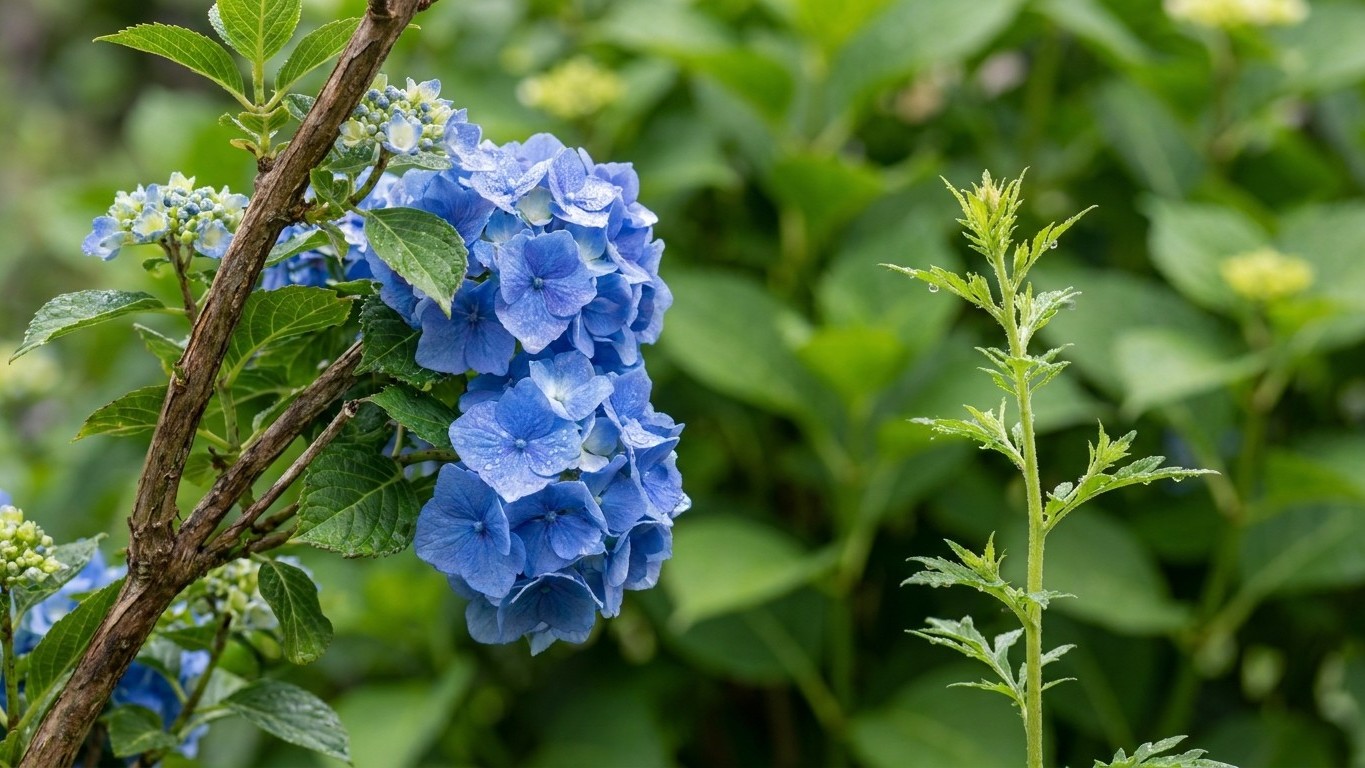

Hydrangeas turn out pink in North Dakota because the soil is alkaline, and alkaline soil keeps aluminum out of the plant’s reach. Blue flowers need aluminum, so the fix is to make that aluminum available: lower the soil pH where the roots grow, or grow the plant in a container with an acidic mix. Some hydrangeas respond to this. The method matters more than the product.
What this comes down to in North Dakota

The reference city for this state is Fargo, where the last spring freeze falls between May 4 and May 15, according to NOAA NCEI climate normals. That stretch is when color work begins, because the soil is thawed and the roots are active. The first fall freeze arrives between September 25 and October 5, so the bloom season you are painting is short, and a color correction has to be in place early to show up before it closes.
Why does alkaline soil turn hydrangeas pink?
The pigment in a bigleaf hydrangea sepal is the same in pink and blue flowers. What changes is whether the plant can take up aluminum. In acidic soil, aluminum dissolves and moves into the roots, where it binds to the pigment and shifts it toward blue. Once the soil pH climbs, aluminum locks into forms the roots cannot absorb, and the flowers stay pink.
Much of North Dakota’s soil sits well above that line. Glacial lake-bed clays and prairie soils here carry free lime (calcium carbonate), which pushes pH up and also resists any effort to push it back down. Municipal and well water is often hard and alkaline too, so every watering nudges the root zone the wrong way. Pink is the usual outcome for a bigleaf planted in an ordinary yard here.
Which hydrangeas can actually turn blue?
Some hydrangeas shift between pink and blue with soil chemistry. White varieties stay white. Smooth hydrangeas such as ‘Annabelle’ and panicle hydrangeas such as ‘Limelight’ ignore soil pH entirely. A panicle that blushes pink in late summer is reacting to cool nights and plant age, and no aluminum treatment will turn it blue.
Bigleafs have a second problem in the North. The USDA Plant Hardiness Zone Map puts North Dakota in zones 3a to 4b, based on average annual extreme minimum temperature, and many bigleaf cultivars set their flower buds on old wood. A hard winter kills those buds, leaving a healthy green shrub with no flowers at all. Color is a moot point if nothing blooms. Reblooming types that also flower on new wood, such as the original Endless Summer, give a gardener something to color. The state guide to growing hydrangeas in North Dakota covers the basics of siting and winter protection.
Working it out for your own garden
Start with a soil test before buying anything. Your county extension office can tell you how to collect a sample, and the lab report gives pH, and many labs can also report phosphorus if you ask for it. Blue flowers generally need acidic soil. Pink does best at higher pH, and purple or mixed blooms show up in between. If the lab reports a high pH, you are looking at a long, uphill job in the ground.
The timing works backward from bloom. Bigleaf flowers open in mid to late summer, and the aluminum that colors them is taken up through the weeks of bud development before that. So treatments start once the soil has thawed and warmed after the May 4 to May 15 frost window at the reference city, and they continue through early summer. Garden sites outside the reference city usually run a week or two later, so wait for the shrub to leaf out fully before the first drench.
A worked example shows where the line falls. Take a reblooming bigleaf like Endless Summer, which flowers on both old and new wood. Planted in late May after the frost window closes, it makes new stems through June, opens flowers in midsummer, and keeps blooming until the first fall freeze in late September or early October. Aluminum sulfate applied in several light doses from late May through June has time to work on that new growth, so some blue can show up in the same season, though in alkaline ground the result is often partial.
Now take a classic old-wood bigleaf such as ‘Nikko Blue’, long grown for its deep blue flowers in milder climates. In zones 3 and 4, winter usually kills most of its buds. If the shrub blooms at all, it does so on whatever stems survived, so the color treatment has little to work on. That is the line: a variety that blooms on new wood can be steered, and one that depends on old wood often cannot be, no matter how well you acidify.
How do you tell why your hydrangea stayed pink?
Work through the likely causes in order. A pH test that still reads high means the soil never changed. A high phosphorus reading may mean phosphorus is tying up aluminum, even if the pH has dropped. A white flower on a smooth or panicle type means the plant was never capable of blue. Yellowing leaves with green veins point to iron chlorosis, a common sign of alkaline soil, and they tell you the pH is still too high. Brown, crisp leaf edges soon after a drench suggest you applied too much aluminum sulfate.
What changes across the state
North Dakota is not one growing situation. The Red River Valley in the east is flat, heavy-clay country, often alkaline and carrying free lime, with a longer and milder season than most of the state. Moving west, the soils vary more: some are alkaline, some are high in salts, and some are thin and well drained. Rainfall drops as you go west, so the garden depends more on irrigation, and irrigation water adds its own alkalinity.
Cold is the other variable. The north and the higher ground, including the area around the Turtle Mountains, run colder than the southern valley. The reference-city dates come from an airport weather station. Suburban and rural gardens typically see the last spring frost later and the first fall frost earlier, often by one to two weeks, and more at elevation. The state’s hardiness range of 3a to 4b reflects the same spread.
For color work, that spread means two different strategies. In the warmer, lower southeast, a gardener with a reblooming bigleaf and patience can try amending the bed. Farther north and west, where winters are harder and soil is less forgiving, a container is the more dependable approach. You fill it with an acidic potting mix, water it with rainwater when you can, and move it into an unheated garage or similar space for the winter. That also protects the buds.
The mistakes this state punishes

Planting too early on the strength of a warm spell is the classic one. April can bring a few mild weeks, and then a late freeze hits tender new growth. Wait until the frost window has passed, then plant, and keep frost cloth or an old sheet handy for a stray cold night. Treat the first week of May at the reference city as a warning, and rural gardens as later still.
Choosing a bigleaf that blooms only on old wood is the second. It will leaf out beautifully and never flower, and the gardener often blames the color treatment. Pick a rebloomer, and do not prune bigleafs in spring, since any buds that survived are on last year’s stems.
Third, treating the soil like a one-time fix. Free lime buffers the pH, and the soil drifts back toward alkaline. Aluminum sulfate works quickly but needs repeating through the early summer, applied to moist soil. Overdoing it burns roots. Elemental sulfur works more slowly, so apply it the season before you want results.
Other habits quietly undo the work. These are the usual culprits:
- High-phosphorus fertilizer, which locks up aluminum (look for a low middle number)
- Wood ash or lime-based products used near the shrub
- Planting beside a concrete foundation, which leaches lime into the soil
- Watering regularly with hard tap water
If any of these apply, change them first, and then go back to the soil.
Checking this against your county
The dates and zones here come from a single reference city, so treat them as a starting point. Your county’s soil, water and frost timing can differ, sometimes a lot. The county office of NDSU Extension can run a soil test, explain the results for your ground, and tell you how late spring and early fall frosts typically behave in your area. Pair that with the state’s hydrangea guide and you have what you need to plan the season.
Common questions
Can you turn a pink hydrangea blue in North Dakota?
Yes, if it is a bigleaf. The change takes lowering the soil pH, applying aluminum, and repeating the treatment through early summer. In heavily alkaline ground the results are often partial or slow, and a container gives more reliable blue.
Will coffee grounds or vinegar turn hydrangeas blue?
They are weak and short-lived. Vinegar changes the surface pH briefly and does not supply aluminum. Coffee grounds have little effect on a limey soil. Soil sulfur or aluminum sulfate, applied after a soil test, does the work.
Why did my hydrangea turn purple instead of blue?
Purple means the plant is taking up some aluminum but not enough. The pH may be in the middle range, or the treatment may have started late. Continue the applications and recheck the soil in a few weeks.
Do panicle and smooth hydrangeas change color with soil?
No. Their white or pink shades come from the variety and from the weather as the bloom ages. Aluminum has no effect on them, so save the treatment for bigleafs.