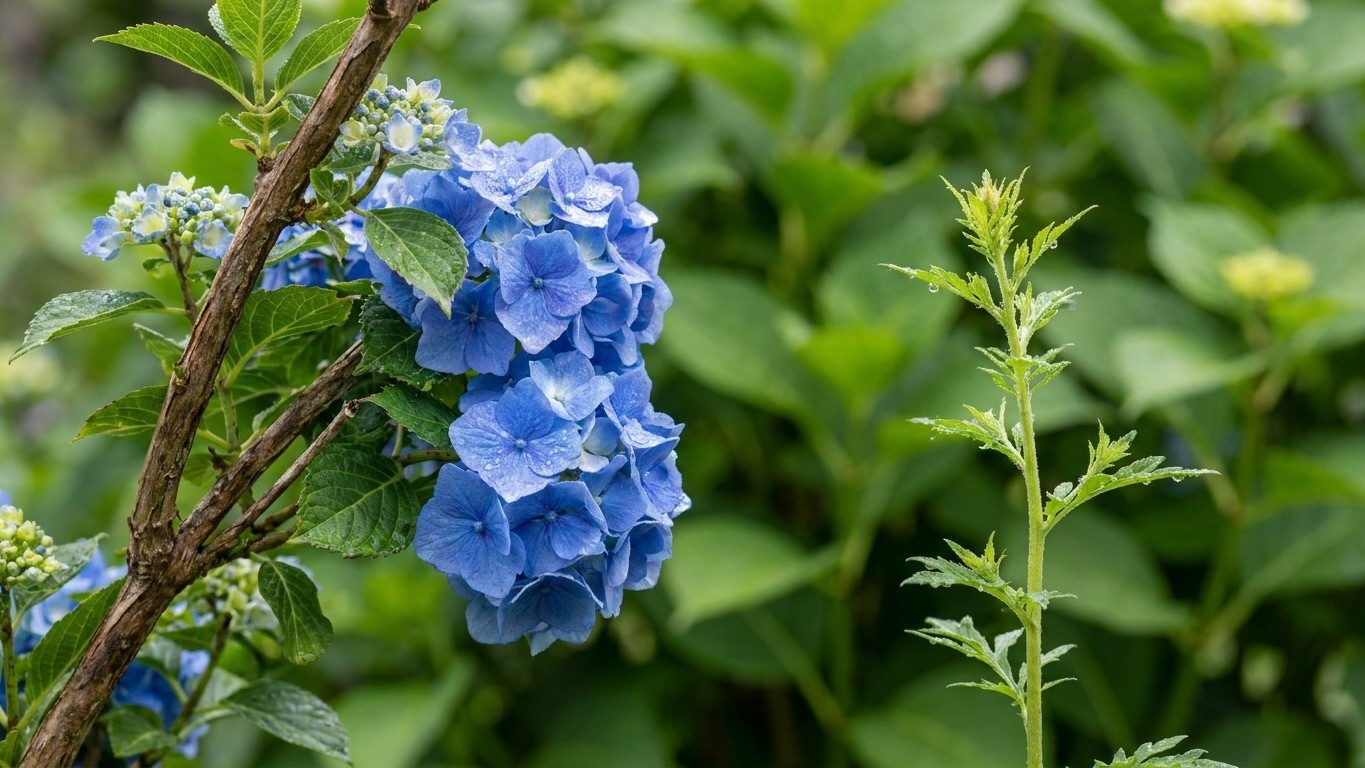

Pink hydrangeas across Ohio are mostly a soil story. Bigleaf hydrangeas turn blue only when the soil is acidic enough for roots to absorb aluminum. Many Ohio yards, especially those on limestone-rich glacial soil, sit near neutral or above, so the blooms come out pink or a muddy purple. Turning them blue means lowering the soil pH and keeping it low, and that takes a season or more.
What this comes down to in Ohio

Hydrangeas open pink in Ohio because much of the garden soil there is near neutral or alkaline, which locks up the aluminum that blue flowers need. The color is set while roots are actively feeding, between the last spring frost (May 5 to May 15 at the zone 6a reference point in the Ohio State University Extension gardening calendar) and the first fall frost (October 5 to October 15).
Why does soil pH change hydrangea color?
Aluminum is present in nearly every soil. Whether a hydrangea can use it depends on pH. In acidic soil, aluminum dissolves in water and the roots pull it up into the flower sepals, which shifts the pigment toward blue. In soil at neutral or above, aluminum stays bound to soil particles and the pigment stays pink. Anything in between gives the purples and two-toned blooms that many gardeners find on a single shrub.
Ohio leans toward the pink side for a few reasons. The glaciers that covered the western and northern parts of the state left behind till rich in ground-up limestone, and that keeps pH high. Well water and some municipal supplies drawn from limestone aquifers are hard, so every watering adds a little more alkalinity. And concrete foundations slowly leach lime into the bed beside them. A hydrangea planted against a house wall often stays pink even when the rest of the yard is acidic.
Which hydrangeas can change color?
Only bigleaf hydrangeas (Hydrangea macrophylla) and their close relatives, the mountain hydrangeas, respond to soil chemistry. Panicle, smooth and oakleaf hydrangeas bloom white or green-to-pink on their own schedule, and no amount of sulfur will make them blue. If a shrub is already blooming white, leave it alone. Pink and blue are the two ends of the range the pH swing can produce, with purples and two-toned blooms in between.
Plant hardiness matters here too. The USDA Plant Hardiness Zone Map, which is based on the average annual extreme minimum temperature, puts Ohio in zones 5b to 7a. Bigleaf types sit at the cold edge of their range across much of that span, so a color project should not trade away winter hardiness. For the broader picture of site and care, see the guide to growing hydrangeas in Ohio.
Working it out for your own garden
A color change is a chemistry problem with a measurable answer, so start with a measurement. Guessing from the flower color alone tells you where the pH is today but not how far you need to move it, or whether the soil will fight you.
How do you test soil pH for hydrangeas?
Take samples from the top several inches of soil in the root zone, a little out from the base of the shrub, since that is where the fine feeder roots are. Avoid spots right beside the foundation or where lime was spread on the lawn. A county extension office can send a sample to a lab for a reading of pH and nutrient levels. A basic meter or strip kit from a garden center works for a quick check, though lab results are more dependable.
Here is how the reading usually maps onto flower color for bigleaf hydrangeas:
| Soil pH | Aluminum availability | Typical bloom color |
|---|---|---|
| Around 5.5 or lower | High | Blue |
| Roughly 5.5 to 6.5 | Partial | Purple, mixed or two-toned |
| Above about 6.5 | Low | Pink to red |
Those bands are approximate, and cultivars differ. A few deep red or deep pink varieties turn only a muddy purple even in acidic soil, so check what the plant was bred for before blaming your soil.
How do you turn pink hydrangeas blue?
If the test shows a pH above the blue range, the usual tools are aluminum sulfate and elemental sulfur. Aluminum sulfate acts fast and also supplies the aluminum. Elemental sulfur works more slowly, because soil bacteria have to convert it to acid, but it lasts longer. Follow the label rate, water the soil thoroughly before and after so the roots are not burned, and never apply either to a dry plant. Mulching with pine bark or shredded oak leaves helps hold acidity down, and a fertilizer low in phosphorus helps too, since phosphorus binds aluminum in the soil.
Plan on a full season before judging the result. Flower buds form the year before and soil pH shifts slowly, so the first real change usually shows on the next flush. Retest after a couple of months to see whether the pH is moving, then repeat the treatment in spring and again in fall if the number drifts back up. In stubborn soil, a large container filled with acidic potting mix is a reliable route to blue.
What changes across the state
Ohio is not one climate or one soil. The USDA zones run from 5b to 7a, and the frost window of May 5 to May 15 and October 5 to October 15 applies to the zone 6a reference point. Gardeners near Lake Erie often get a slightly later spring and a gentler fall, because the lake stays cold into spring and holds heat into autumn. Inland valleys and the open plains of the northwest can run colder at night and see frost on either side of the stated window.
The bigger swing for color is the ground itself. The glaciated western and northern parts of the state sit on limestone-rich till, so soil there starts alkaline and wants steady acidifying to hold blue. The unglaciated hills of the southeast, on the Appalachian plateau, tend toward naturally more acidic soil, and bigleaf hydrangeas there may lean blue with little help. The Ohio River corridor in the south runs warmer overall, which can speed the breakdown of sulfur in the soil.
Local quirks beat the regional pattern. A backyard with a long history of lawn lime, a new house with fill dirt around the foundation, or a well that feeds a drip line can all push a bed several steps away from what its county would suggest. The only way to know is to test the bed itself.
The mistakes this state punishes

The first is trusting a bag of aluminum sulfate to overcome limestone-heavy soil in a single application. In much of Ohio the soil rebuffers the change, and pH creeps back up within months. Gardeners who dose once in spring and skip the retest end up with pink flowers by August and decide the product did not work.
Planting right against a concrete foundation or beside a mortared patio is the second. Lime keeps washing out of that material, so a hydrangea there fights a rising pH every time it rains. Move the bed a few feet out, or grow the shrub in a container.
Heavy phosphorus is the third. A general lawn or bloom-booster fertilizer with a high middle number ties up aluminum and undoes an acidifying program. Choose a formula low in phosphorus and higher in potassium.
The fourth is blaming color treatment for a lack of blooms. Bigleaf hydrangeas set flower buds on old wood, and a hard frost that arrives after a warm spell, during the May window, can kill swollen buds. A shrub with leaves but no flowers is often a frost problem, and no soil change will fix that. Cover the plants on frost nights once buds are swelling, and avoid pruning old stems in spring.
Last, overdoing the acid. Pushing the pH too low can leave aluminum at levels that stunt roots and yellow the leaves. A moderate, tested target beats a heavy hand.
Checking this against your county
A statewide pattern is a starting point. Soil pH, water chemistry and frost dates shift from one county to the next, and sometimes from one side of a property to the other. Your county’s Ohio State University Extension office can run a soil test, tell you what the local ground tends to do, and point you to the state’s own hydrangea guidance for care that fits your site.
Common questions
Why are my hydrangeas pink even though I bought a blue variety?
Nurseries often grow blue-flowering plants in acidic potting mix, then they go into garden soil with a higher pH. Once the roots reach that soil, the new blooms shift to pink or purple. The plant is the same, and only the aluminum supply has changed.
Does coffee grounds or vinegar turn hydrangeas blue?
Neither does much. Used coffee grounds are close to neutral and have little lasting effect on soil pH. Vinegar acidifies only for a short time, and repeated use can damage roots and soil life. Aluminum sulfate or elemental sulfur, guided by a soil test, is more dependable.
Can I turn blue hydrangeas back to pink?
Yes. Raising the pH with garden lime (dolomitic lime also adds magnesium) moves the plant back toward pink, and it works much faster in soil that is already near neutral. Test first so you do not overshoot, and expect to wait a season to see the change.
How long does it take to change hydrangea color?
Plan on one growing season for a first visible shift and often two for a clear blue. Flower buds form the year before and soil pH changes slowly, so treatment applied in spring and fall often shows fully only on the following year’s flush. Container plants usually respond faster than those in the ground.