
Collards go in the ground twice in Alabama: once in spring, when soil is workable and the worst freezes are behind you, and again in late summer for a crop that carries through fall and often into winter. The spring planting has to beat the heat. The late-summer one has to beat the cold. Where you garden within the state changes both dates by a couple of weeks.
When the soil is warm enough in Alabama

What is the last spring frost date for collards in Alabama?
For the reference airport weather station (NOAA station USW00003856), the 1991-2020 Climate Normals put the last spring 32°F freeze between March 19 and April 3. That window is the 30-70% probability band, so a late freeze after April 3 does happen in some years. Those dates describe an airport, not your backyard. Suburban and rural gardens usually see the last spring frost one to two weeks later, and hillsides and higher ground run later still. Check your own county’s dates before you mark a calendar. The NOAA normals data are public if you want to see how the band is built.
Why does soil temperature matter more than the frost date?
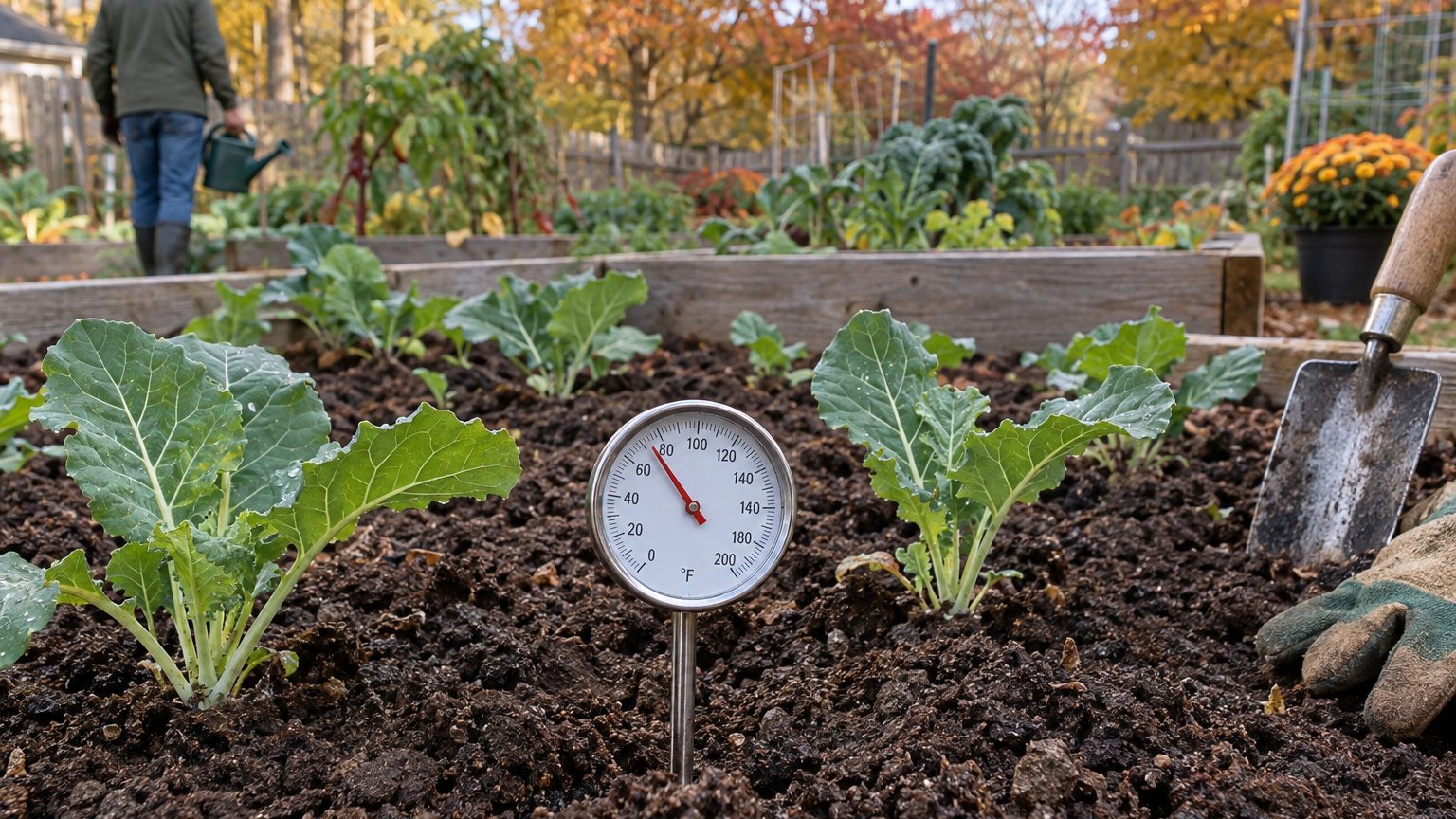
The frost date tells you when the risk of a killing night fades. Soil follows behind it. Ground that held winter cold and rain stays chilly and heavy for a while after the last freeze, and young collards sit in it without growing much. A soil thermometer pushed into the ground in the morning is a better guide than the calendar. When the reading is climbing steadily and a handful of soil crumbles instead of balling up, the bed is ready.
Collards are hardy brassicas and shrug off light frost, so gardeners in the warmer parts of the state often set out transplants a few weeks ahead of the frost band, with a sheet or row cover ready for cold nights. Seed can go in once the bed is workable. Waiting for perfect warmth costs you something, because spring in Alabama is short and the heat arrives fast. A plant that is established by the time the first hot spell hits will carry on far longer than one still sulking in cold ground.
Frost dates also shift with elevation. The northern part of the state sits in the Tennessee Valley and the uplands, and the Gulf Coast sits in a much milder climate. The USDA Plant Hardiness Zone Map (2023) spans zones 7a to 9a across Alabama, which shows how different the two ends of the state are. A gardener near the coast may be planting in February while someone in the hills is still watching the forecast in late March. Neither is wrong. Both are reading their own ground.
How long the season lasts here
How many months can you grow collards in Alabama?
At the reference station, the mean last spring frost and the mean first fall frost leave roughly seven to eight months between them, with the last spring freeze falling between March 19 and April 3 and the first fall freeze between November 2 and November 16. The fall dates carry the same caution as the spring ones: garden sites away from the airport usually see that first fall freeze one to two weeks earlier, and more at elevation.
What does a long window allow?
A window that long allows two sowings. The first goes in as soon as the soil is ready in spring and gets picked through early summer. The second goes in during mid to late summer, timed so the plants have real size before the first fall freeze arrives. Fall collards are the better crop of the two for most Alabama gardeners. They grow through cooling weather instead of into heat, they have fewer aphids and caterpillars to fight as temperatures drop, and the leaves sweeten after frost.
With time to spare, direct seeding works well in both seasons. The case for transplanting is the late-summer sowing, when soil is hot, seed can bake in a crusted bed, and a seedling started in a shady spot or a cool corner of the house gets a better launch. Water the seed row or tray steadily, and shade the young plants from the worst afternoon sun for the first couple of weeks.
Gardeners in Growing Collards in New Brunswick have only a few frost-free months and a single sowing. Alabama gardeners have room to correct a bad first attempt. A neighboring Southern climate, covered in Growing Collards in Arkansas, offers a similar double window with a somewhat colder winter edge.
For how to space repeat plantings so the harvest rolls on instead of arriving all at once, see Growing Collards: One Planting, Months of Harvest. In Alabama the practical version is simple: sow a small block every couple of weeks in the early part of each season, then stop once the next heat wave or freeze is close enough that the plants could not reach picking size.
Heat and water in Alabama

How do Alabama summers affect collards?
Summers are hot and humid across the state, with frequent storms and long stretches of heat. Collards are among the more heat-tolerant greens, but they do not like it. Leaves get tougher and stronger-flavored, growth slows, and aphids, cabbage loopers and imported cabbageworms build up on the undersides of leaves. Humid weather also favors fungal and bacterial leaf spots, which spread when leaves stay wet for long periods.
A few habits keep a summer bed going. Water at the base of the plants in the morning so foliage dries during the day. A couple of inches of mulch holds moisture and shades the root zone, which matters more than shade over the leaves. Give plants room so air moves between them. Check the undersides of leaves weekly and hand-pick caterpillars, or cover young plants with fine insect netting from the start. Humid heat rewards prevention far more than rescue.
Rain in Alabama is generous but uneven. A week of downpours can be followed by two dry weeks, and sandy and clay soils behave very differently. A raised bed or a slightly mounded row sheds water in wet spells, and steady watering is a reasonable target when the sky is not doing the job. Soggy soil around the crown invites rot, so drainage is worth fixing before planting rather than after.
Does winter decide how you plan the bed?
It does. The mean daily minimum of the coldest month is 33.1°F at the Huntsville reference station (NOAA Climate Normals, 1991-2020), barely a degree above freezing. That is mild for a state in the northern half of the South. Where winter lows stay in that range, collards become a standing crop: fall plants stay in the bed and you pick leaf by leaf, taking the lower leaves and leaving the growing center, from about November into March.
Where the coldest nights drop harder, in the upland north and in colder pockets and low spots, the crop behaves more like an autumn one. A hard freeze well below 32°F can burn leaves and, if it is severe enough, kill the plants. A row cover or a layer of straw over the bed offers some protection and often carries plants through the coldest nights. Near the Gulf, where the hardiness zone reaches 9a, collards often keep producing nearly all winter with little help. Hardiness zones, for what it is worth, measure the average annual extreme minimum temperature, so they show how cold the worst night usually gets and not how many ordinary cold nights you will see.
Which collards suit Alabama
What type of collards should you grow in Alabama?
Choose by type, and let local trial results settle the specifics. Three conditions shape the choice here. A hot, humid summer favors plants that tolerate heat and hold up under disease pressure, so disease resistance is the first thing to look for on a seed packet or plant tag, particularly resistance to leaf spots and black rot. For the spring sowing, which has to finish before the heat, a type described as fast-maturing or slow to bolt is the safer bet. For fall and winter, a vigorous open-leaf type that keeps producing after repeated frosts is the one to look for.
Airflow matters as much as genetics in humid weather. Even a resistant plant fails if it is crowded, so follow the spacing on the packet and thin seedlings firmly. Mulch to keep the root zone cool and to stop soil splashing onto lower leaves, which is how many leaf diseases get started.
Where do you find the varieties that work locally?
The Alabama Cooperative Extension System is the place to ask. Its county offices and publications reflect what has been grown and trialled in the state’s soils, and a variety that thrives in the Tennessee Valley may sulk on the coast. Seed catalogs are written for the whole country. A named variety recommended in one without local evidence behind it is a guess, and naming one here would be the same. Extension advice, built on trials near you, is worth more than any list from a distance.
Rotation deserves a word here too. Collards share their troubles with cabbage, kale, mustard, turnips and rutabagas, since all are brassicas, so a bed that held any of them last year is not a fresh start. Black rot, clubroot and cabbage worms carry over. Plan several years between brassica crops in the same ground, and the Growing Collards: One Planting, Months of Harvest guide covers how to lay out beds to make that easy.
Common questions
When should I plant collards in Alabama?
For spring, plant once the soil is workable and warming, a few weeks before to just after the last freeze, which falls between March 19 and April 3 at the reference airport station and often one to two weeks later in rural and higher gardens. For fall, sow in mid to late summer so plants have size before the first freeze, which at that station comes between November 2 and November 16.
Can collards survive an Alabama winter?
Usually yes. Collards tolerate frost and often taste better after it. A hard freeze well below 32°F can damage leaves, so keep row cover or straw on hand for the coldest nights, especially in north Alabama and at elevation.
Why are my collards bitter or tough in summer?
Heat and dry spells make leaves tougher and sharper in flavor. Consistent water, mulch and picking younger leaves help. A fall crop grown through cooling weather generally tastes milder than a summer one.
How do I find the best varieties for my county?
Contact your county office of the Alabama Cooperative Extension System and ask which types have performed well locally. Look for resistance to leaf spots and black rot, and match the growth habit to the season you are sowing for.