
Alabama gardeners can ripen a full pepper crop in one season, but the window isn’t as simple as counting frost-free days. Two temperature thresholds decide whether flowers turn into fruit at all, and one of those thresholds isn’t something this site can hand you as a number for your yard. Here’s what actually shapes the calendar.
The short answer

Huntsville’s reference station logs 58.5 days a year at or above 90 F, based on NOAA NCEI Climate Normals covering 1991-2020. That’s not a handful of scorching afternoons in July. That’s nearly two full months, scattered across summer, where daytime highs climb past the point where pepper flowers start to abort. Fruit set in peppers stalls out once daytime temperatures push above 90 F, according to Utah State University Extension’s guidance on growing peppers, and Alabama racks up enough of those days that a gardener planting a slow-to-ripen variety can watch blossoms drop through most of a July heat spell without a single pepper forming.
That’s one end of the failure zone. The other end matters just as much, and it’s the one growers tend to forget because it happens at night, while they’re asleep and not checking a thermometer. Pepper fruit set also fails when nights drop below 55 F, per the same Utah State Extension guidance. In Alabama that’s rarely a summer problem, since the state’s ridge-and-valley and gulf coastal climates keep summer nights warm. But it’s a real spring and fall problem, especially for gardeners who transplant early or who are trying to squeeze a second flush of fruit out of a fall planting before the season closes.
Here’s the part this site can’t do for you. This page carries days-above-90-F counts because that figure is measured and published at the reference station level. Summer night minimums aren’t part of that same dataset here. If you’re transplanting early, running a fall crop, or gardening at higher elevation in the northern part of the state where nights run cooler than the valley floor, you need to track your own overnight lows with a simple min-max thermometer in your own yard. Don’t guess at that number from your county’s latitude on a map, and don’t assume the coldest month of the year tells you anything about a single summer night. Microclimates, tree cover, and how close you are to pavement or open field all shift that number by several degrees from what a regional average would suggest.
Put those two thresholds together and the real answer to “will peppers ripen here” isn’t a single yes. It’s yes, provided you dodge both ends: heat load that Huntsville’s 58.5 days above 90 F shows is substantial, and cool nights that no station count on this page can tell you about your specific plot.
When to start seed here
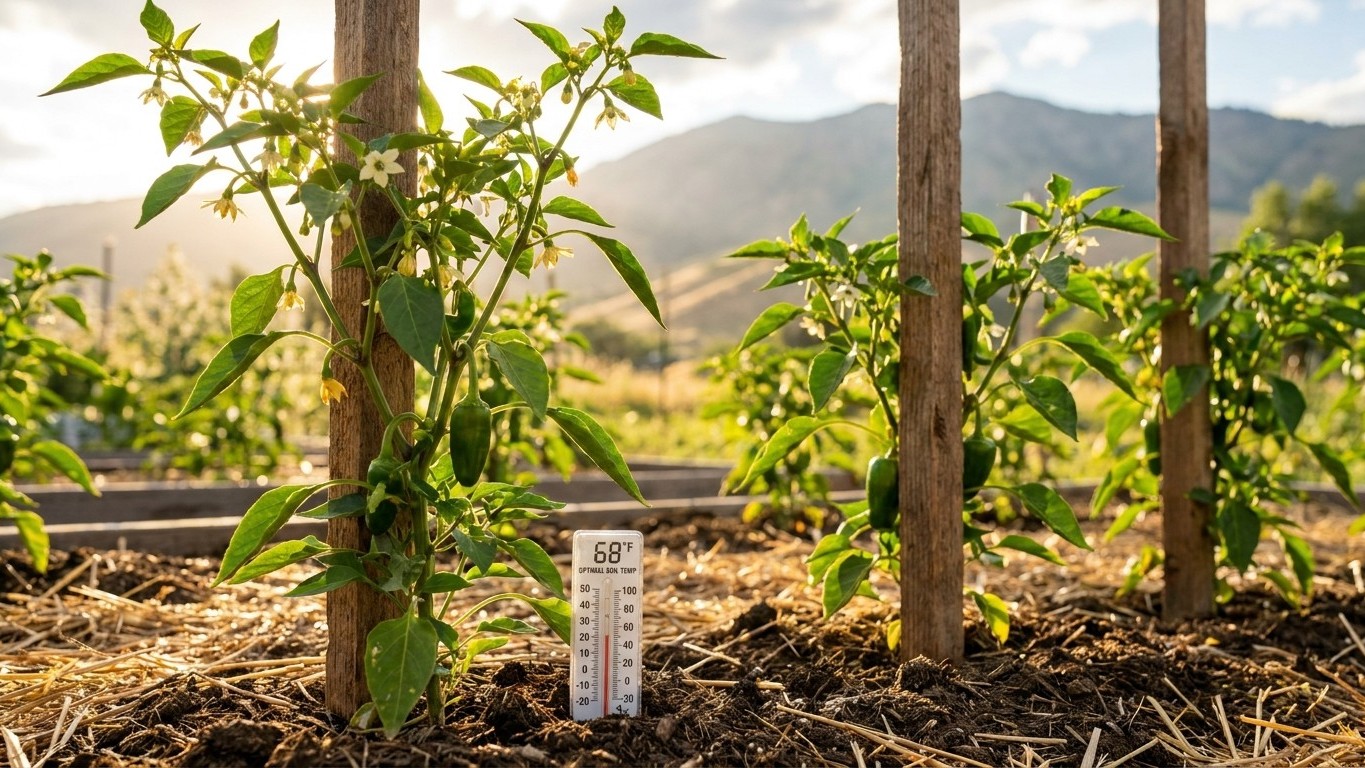
Peppers need 8 to 10 weeks indoors before they’re ready to go in the ground, and they shouldn’t go in the ground until two conditions are both met: the danger of frost has passed, and the soil itself has warmed to 60 F, according to Utah State University Extension. Soil temperature lags air temperature, sometimes by two or three weeks, so a warm afternoon in March doesn’t mean your beds are ready. The only way to know for sure is a soil thermometer pushed a few inches down, checked in the morning before the sun has warmed the surface.
Here’s how the backward count works, using Alabama’s own frost data as the anchor point.
- Start with your last spring frost date. At the reference station tracked by NOAA NCEI (station USW00003856), the last spring 32 F freeze falls somewhere between March 19 and April 3, based on the 30 to 70 percent probability band in the 1991-2020 Climate Normals. That’s a range, not a guarantee, and it comes from an airport weather station, not from your backyard.
- Push that date later for your actual garden. Suburban and rural gardens typically see their last frost land one to two weeks after the airport station’s date, and gardens at higher elevation can lag even further behind. If you garden outside the immediate Huntsville area, or anywhere with more open exposure or lower ground that collects cold air, plan around a later date than the station range shows.
- Confirm soil temperature before you plant, not just the calendar date. Even after the frost risk has passed, wait until a soil thermometer reads a steady 60 F. Peppers set into cold soil sit stalled for weeks and rarely catch up to plants started a little later into warmer ground.
- Count backward 8 to 10 weeks from your planned transplant date to find your seed-starting date. If your adjusted frost-safe, soil-warm date lands in mid-April, for example, that puts seed-starting somewhere in early to mid-February, depending on which end of the 8-to-10-week window you use.
- Build in a buffer week. Seeds germinate unevenly indoors, and a slow batch can push your transplant-ready date later than planned. An extra week of cushion at the start costs you nothing and protects the whole schedule.
Run this same math with your own county’s frost data if you garden outside the Huntsville reference area. The arithmetic doesn’t change. Only the starting date does.
What goes wrong here
Alabama’s climate creates a specific set of pepper failures, and most of them trace back to the same two thresholds covered above. Knowing the symptom helps you catch the cause before you lose the whole flush of flowers.
- Blossom drop during a hot spell. Flowers form, then fall off the plant without setting fruit, usually during a stretch of days pushing past 90 F. This is exactly the failure mode Utah State Extension describes on the hot end. There’s no fix once it’s happening except patience: the plant will resume setting fruit once temperatures moderate. Afternoon shade cloth over the hottest rows can reduce how often this hits, and keeping soil moisture even (not soaked, not bone-dry) reduces the added stress that pushes plants over the edge during a heat run.
- Blossom drop during a cool night. The same symptom, opposite cause: temperatures dipping below 55 F overnight, most likely in early spring or a cool fall snap. Since this site doesn’t carry night-minimum data, the only real defense is watching your own thermometer during shoulder-season weeks and covering plants with row cover on nights that look likely to dip.
- Sunscald on exposed fruit. Alabama’s strong summer sun can scorch pale, papery patches onto fruit that’s lost its leaf cover, often after aggressive pruning or after a storm strips foliage. The fruit itself is usually still edible if you cut the scalded patch away, but prevention beats cutting: leave enough foliage on the plant to shade developing peppers, and avoid stripping leaves for “better air flow” during the hottest stretch of summer.
- Blossom-end rot. A sunken, leathery brown-black patch on the bottom of the fruit, usually showing up during uneven watering swings, heavy summer rain followed by a dry stretch, or vice versa. It’s a calcium-uptake problem triggered by inconsistent moisture, not a soil-calcium shortage in most gardens. Even, regular watering, particularly through Alabama’s humid but unevenly-rained summer stretches, does more to prevent it than any additive poured on afterward.
Common questions
How many pepper varieties will actually ripen before frost in Alabama?
That depends on the variety’s own days-to-maturity, a figure not published on this page for any specific name. What is established here is the frame you need to check that figure against: your adjusted last-spring-frost date, the roughly two months a year of 90-plus-degree days that can stall fruit set mid-summer, and your own fall frost timing. Match a variety’s stated maturity window against that frame before you commit a full row to it.
Does Alabama’s heat mean I should skip hot peppers for sweet ones?
Both types face the same fruit-set thresholds, since the 90 F ceiling and 55 F floor described by Utah State University Extension apply to peppers generally, not to one type over another. Neither the FACTS available here nor the source they come from separate hot varieties from sweet ones on heat tolerance. Choosing between them comes down to taste and use, not to a documented difference in how they handle Alabama’s summer.
Should I start seeds earlier if my county runs colder than Huntsville?
Yes, and the adjustment moves your whole schedule later, not earlier. If your last frost historically lands later than the March 19 to April 3 range from the Huntsville station, both your transplant date and your indoor seed-starting date shift back to match, using the same 8-to-10-week backward count.
Can I plant a second round of peppers for fall in Alabama?
The same two thresholds apply to a fall planting: watch for nights dropping below 55 F as the season turns, since that’s when fall flowering runs into trouble first. This page doesn’t carry a published fall-frost date or overnight low figures, so track your own local conditions closely once flowering starts in late summer and be ready to cover plants if a cool night is forecast.