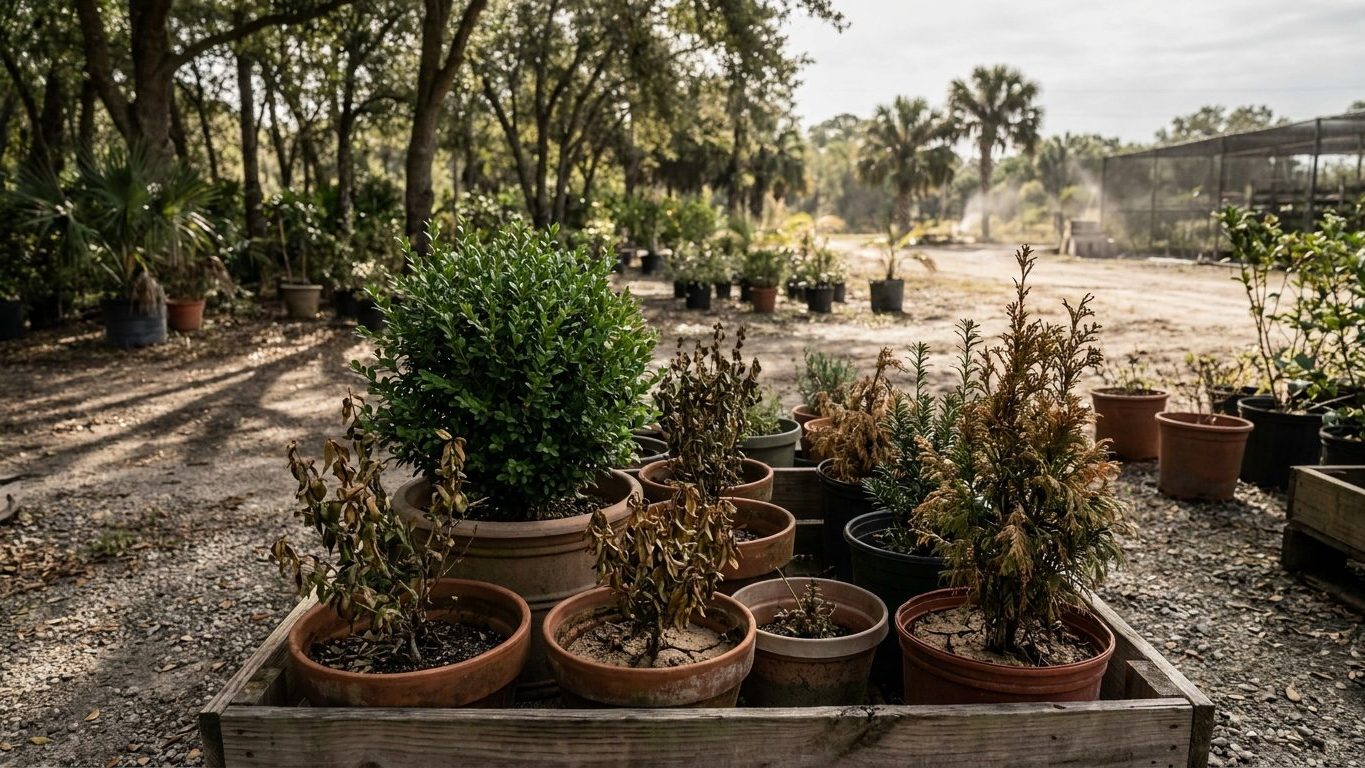

The honest answer is that no single hedge species covers Alaska, because Alaska itself covers USDA zones 1a through 8a, a spread wider than almost anywhere else on this site. In the coldest interior and arctic zones, none of the standard hedge species hold at all. In milder south-central and coastal pockets, evergreen broadleaf hedges become possible, but only barely, and only with the right variety in the right spot.
What actually holds in Alaska
Start with the number nobody likes to lead with: of the 12 hedge species documented on this site, zero are hardy across the entire state, and zero are ruled out everywhere. All 12 fall into the middle bucket, hardy in part of Alaska only. That sounds like a technicality until you look at where the “part” actually sits.
The USDA Plant Hardiness Zone system is built on one measurement, the average annual extreme minimum winter temperature. Nothing about summer heat, rainfall, or soil enters into it. Alaska’s own range runs from 1a to 8a, and the lowest zone any of these 12 species reaches is 2a. That means zones 1a and 1b, the coldest interior and northern parts of the state, have no match on the standard hedge list at all. If you garden there, a woody hedge in the conventional sense is not really on the table, regardless of species.
Only two species reach as low as 2a: Eastern red cedar (Juniperus virginiana) and arrowwood viburnum (Viburnum dentatum). Everything else on the list needs at least a zone 3a, and several need a zone 4 or warmer just to survive the winter, let alone thrive.
The upper end is a heat limit, not a cold one
It’s easy to assume the top of a hardiness range (say, 8a) means “does well in warm winters.” For a handful of these plants, boxwood, Leyland cypress, cherry laurel, that upper number is really the point where the plant starts failing from too much cold in the other direction, and 8a is simply as cold as it can go and still make it. In practice, that confines those three species to the mildest coastal pockets of the Panhandle, and even there the margin is thin.
The growing season compounds the problem. Using Anchorage, one of the mildest inhabited parts of the state, as the reference point, the last spring frost falls between May 3 and May 12, and the first fall frost arrives between September 22 and October 1, per NOAA NCEI 1991-2020 climate normals. That’s roughly 143 frost-free days. The Interior and the north run considerably shorter. Long summer daylight makes up for some of that lost time, but it doesn’t lengthen the calendar window a newly planted hedge has to root in before winter arrives.
The hedges you can never cut back down
Three of the twelve species on this list share a trait that matters more in Alaska than almost anywhere else: they do not regrow from old wood. Cut past the green growth on the outside of the plant, and that spot stays bare permanently. There’s no coming back from a hard renovation cut.
- Eastern red cedar (Juniperus virginiana): hardy to zone 2a, the widest cold range of any species here alongside arrowwood viburnum. Grows 12 to 24 inches a year. Prune only in late winter, and only light cuts.
- Arborvitae (Thuja occidentalis): hardy to zone 3a. Grows 6 to 9 inches a year, the slowest of the three. Prune late winter before growth starts, or midsummer.
- Leyland cypress (x Hesperotropsis leylandii): hardy only to zone 6a, so it’s confined to the state’s mildest edges. Grows 3 to 4 feet a year, by far the fastest on this entire list. Prune late spring to midsummer.
The mechanism is straightforward. These are conifers that only carry live buds near the branch tips. Cut into the older wood further in, and there’s no dormant bud sitting there to push new growth. The hedge doesn’t recover from a hole cut into the middle, it just carries that hole for the rest of its life.
That’s a real problem for Alaska specifically, because the two species with the broadest cold tolerance, red cedar and arborvitae, are both in this no-regrow group. They’re also the plants most likely to get planted in the state’s colder, more populated zones precisely because so little else survives there. The practical takeaway is to size the planting site correctly from day one and stay on top of light annual shaping, rather than letting the hedge get away from you and planning to fix it later with a hard cutback. There is no later fix.
Compare that with the nine species that do regrow from old wood, boxwood, American hornbeam, both hollies, privet, cherry laurel, yew, Eastern hemlock, and arrowwood viburnum. Those can be renovated hard if they get overgrown or damaged. It’s a meaningful trade, because most of those nine also need milder zones than red cedar or arborvitae, so gardeners in the coldest usable zones have the least forgiving plants to work with.
Matching the plant to the job
Once the zone rules a species in or out, the remaining question is what job the hedge is doing, a fast privacy screen, a low formal edge, or a wildlife hedge that feeds birds through winter.
| Common name | USDA zones needed | Height as hedge | Growth rate | Regrows from old wood |
|---|---|---|---|---|
| Eastern red cedar | 2a-8a | 8-20 ft (screen) | 12-24 in/yr | No |
| Arrowwood viburnum | 2a-8a | 6-10 ft | 12-24 in/yr | Yes |
| American hornbeam | 3a-8a | 6-15 ft | 12 in/yr | Yes |
| Winterberry holly | 3a-8a | 5-15 ft | 6-12 in/yr | Yes |
| Arborvitae | 3a-7b | 4-15 ft | 6-9 in/yr | No |
| Eastern hemlock | 3a-7b | 10-20 ft | 12-24 in/yr | Yes |
| Inkberry holly | 4a-8a | 5-15 ft | 6-12 in/yr | Yes |
| Privet | 4a-7b | 4-12 ft | 2-3 ft/yr | Yes |
| Yew | 4a-7b | 3-8 ft | 6-12 in/yr | Yes |
| Boxwood | 5a-8a | 2-6 ft | 3-6 in/yr | Yes |
| Leyland cypress | 6a-8a | 15-25 ft (screen) | 3-4 ft/yr | No |
| Cherry laurel | 6a-8a | 6-15 ft | 1-2 ft/yr | Yes |
For a fast, tall privacy screen, Leyland cypress is the outright growth-rate leader at 3 to 4 feet a year, but it only survives from zone 6a up, so it’s really an option for the mildest coastal gardens alone. In the more typical zones where Alaskans actually garden, Eastern red cedar covers similar screening duty at 12 to 24 inches a year and tolerates far more cold.
For a low, formal edge, boxwood is the classic choice everywhere else in the country, but it needs zone 5a or warmer, ruling it out for most of the state. Yew, hardy to 4a, is the more realistic formal option in milder south-central gardens.
For a hedge that also feeds birds through the cold months, arrowwood viburnum and winterberry holly both hold berries into winter and both reach down to zone 2a to 3a, making them among the few options that work in genuinely cold Alaska gardens without asking for a mild microclimate.
The ground you are planting into
Alaska’s representative state soil, the Tanana series, is a Gelisol, meaning permafrost sits within reach of the soil profile. Its surface horizon runs strongly acid at a pH of about 4.7, with a texture around 30 percent sand, 7 percent clay, and 63 percent silt, and it’s poorly drained. Organic matter in that surface layer averages about 90 percent, which signals a natural organic layer, peat, muck, or forest litter, rather than anything resembling a worked garden bed.
That last point matters for anyone reading their own yard into this data. A soil survey represents mapped, undisturbed ground, not a cultivated flower bed, and definitely not the compacted fill around a newer house. If a builder scraped or filled your lot, none of these Tanana series numbers will describe what’s actually under your hedge. The only way to know your own dirt is a soil test, and Alaska gardeners can get one through the UAF Cooperative Extension Service.
Where the Tanana series profile does hold true, strongly acid and poorly drained, it actually favors several species on this list. Both hollies, arborvitae, and yew all tolerate or prefer acidic soil, which lines up well with the state’s natural baseline pH. The bigger obstacle is drainage. Permafrost close to the surface keeps meltwater from moving down through the profile, so roots can sit wet through spring thaw even in a soil that’s technically loam to silt in texture. Planting on a slight mound or raised bed, rather than at grade, is the more reliable fix in Interior gardens where that shallow permafrost table is common, and it costs far less than losing a young hedge to standing water its first spring.
Common questions
Can I grow a boxwood hedge in Alaska?
Only in the mildest coastal pockets. Boxwood is hardy from zone 5a to 8a, which excludes most of the state outright. Even in the warmer parts of the southern Panhandle where zone 8a exists, it’s operating at the cold edge of what it can survive, not a comfortable margin.
What’s the fastest-growing hedge that survives Alaska winters?
Leyland cypress grows fastest at 3 to 4 feet a year, but it’s only hardy to zone 6a, limiting it to the mildest coastal areas. For colder zones, Eastern red cedar, growing 12 to 24 inches a year and hardy to zone 2a, is the more realistic fast option across most of the populated state.
When should I prune my hedge in Alaska?
It depends on the species: arborvitae and red cedar want late winter, light cuts only, while boxwood and cherry laurel prefer late spring after the last frost. Since the last spring frost in Anchorage runs May 3 to May 12, hold off on spring pruning until that window has passed, and stop cutting well before the first fall frost, which arrives September 22 to October 1, so new growth has time to harden before cold sets in.
Does Alaska’s soil affect which hedge I should plant?
Yes, in two ways. The state’s representative soil runs strongly acid, which actually suits hollies, arborvitae, and yew. But it’s also poorly drained where permafrost sits close to the surface, which is a bigger risk to young roots than the acidity. A soil test through the UAF Cooperative Extension Service will tell you where your own yard actually stands.