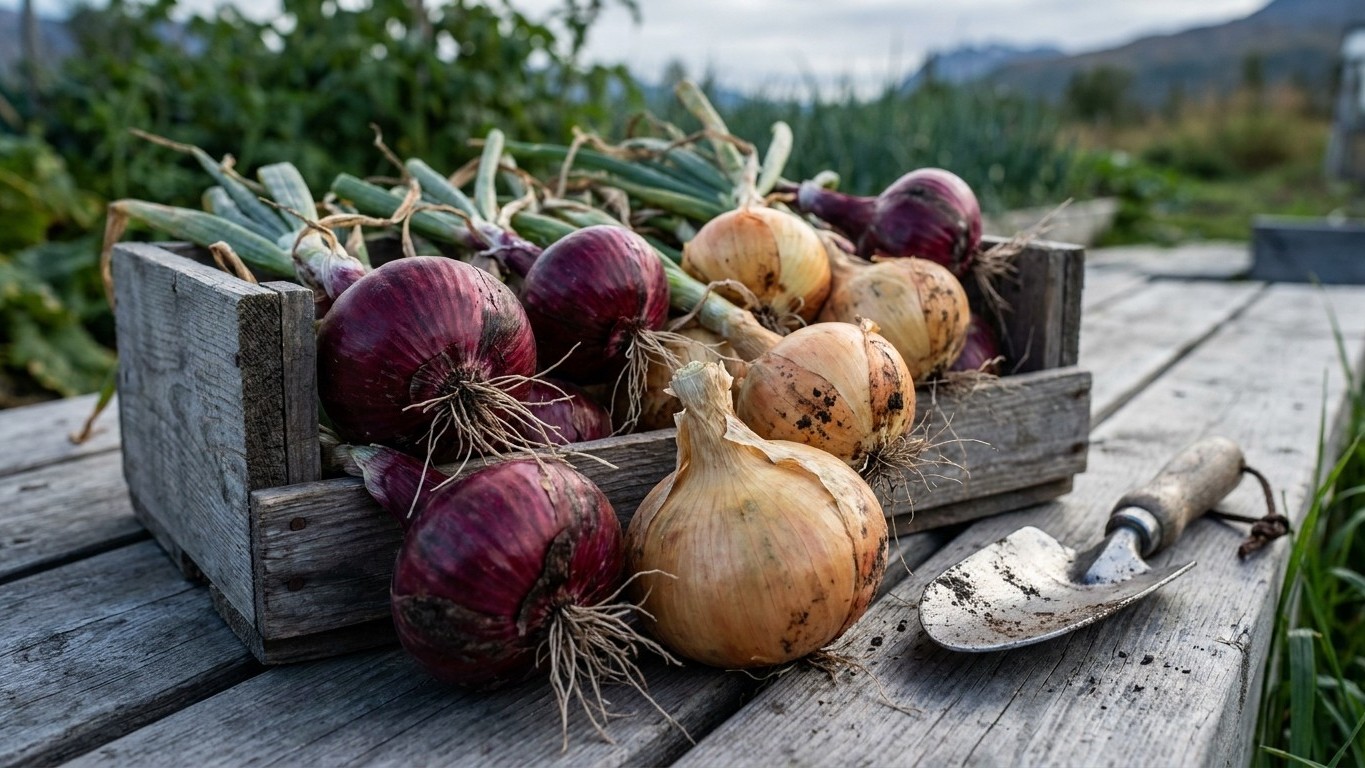

Anchorage sits at 61.17 degrees north, and on the longest day of the year the sun gives the city 18 hours and 56 minutes of daylight. That number decides everything: onions bulb on day length, not warmth, and only the long-day group is built to wait for a summer that bright. In Alaska, that means Redwing, whose published range runs 43 to 65 degrees north and covers the state’s reference latitude with room to spare. Ailsa Craig sits right at the edge of its own range and deserves a closer look before you commit a full bed to it.
The short answer for Alaska

At 61.17N, the day-length group that matters is long-day. Long-day onions need roughly 14 to 16 hours of light before they’ll stop building leaves and start building a bulb, and Anchorage’s 18-hour-56-minute summer clears that bar with hours to spare. That’s not a marginal fit, it’s the only fit: nothing shorter than long-day has a reason to be planted this far north.
Within that group, the picture narrows fast once you check published ranges rather than assuming “long-day” is one uniform club. Redwing is rated 43 to 65 degrees north, which puts Anchorage comfortably inside its documented range rather than at a limit. That’s the variety to plant with confidence if you want a straightforward yes.
Ailsa Craig is rated 38 to 60 degrees north, one degree short of Anchorage’s latitude. A degree of latitude is not a wall, and catalogue ranges are drawn from field trials that cluster around a center, not a hard cutoff, so treat Ailsa Craig as a variety that may bulb here rather than one that’s guaranteed to. If you plant it, do it as a trial row alongside something proven, not as your main crop.
The takeaway for a gardener shopping seed catalogues this winter: look for the words “long-day” first, then check the northern number in the range, not just the label. A long-day onion rated up to 50 or 55 degrees north is still the wrong onion for Anchorage, even though it shares the same day-length category as Redwing. The category gets you in the door; the specific range tells you whether the door actually opens this far north.
What will not work here
Twenty-six varieties in wide circulation are published for latitudes below 61.17N, and none of them belong in an Alaska garden. The reason isn’t the same for every group, and lumping them together as “won’t grow” hides what actually happens in the ground.
Short-day and intermediate-day types
Short-day onions are built to bulb at around 12 hours of daylight, and intermediate-day types wait for roughly 13 to 14 hours. In Anchorage, the growing season blows past both thresholds early, while the plants are still small. The bulbing switch flips on schedule, and the plant obeys it, it just hasn’t had time to grow first. The result is a full crop of undersized bulbs, not a failed crop. That’s a variety mistake, not a feeding or watering mistake, and no amount of fertilizer fixes it.
- Gabriella (short-day, 20-35N), bulbs weeks before the plant has any size to it
- Madalyn (short-day, 20-35N), same early trigger, same undersized result
- Red Rock (short-day, 30-36N), built for a day length Anchorage passes in early summer
- White Castle (short-day, 30-38N), bulbs before the leaf canopy is established
- Candy (intermediate-day, 33-40N), triggers too soon for the local season
- Sierra Blanca (intermediate-day, 32-45N), same early-trigger problem
- Elsye (intermediate-day, 32-45N), undersized bulbs by design, not by neglect
- Expression (intermediate-day, 32-45N), bulbs before full leaf growth
- Scout (intermediate-day, 32-46N), rated for a shorter summer day than Alaska provides
- Cabernet (intermediate-day, 35-45N), same mismatch
- Calibra (intermediate-day, 35-45N), same mismatch
- Monastrell (intermediate-day, 35-46N), same mismatch
- Red Long of Florence (intermediate-day, 38-50N), bulbs too early at this latitude
- Red Long of Tropea (intermediate-day, 35-48N), same result
Long-day varieties bred for milder places
The other twelve are long-day like Redwing, but their published ranges top out well south of 61.17N. That points to a different limit: a growing season too short for these particular varieties to size up before local frost, even though Anchorage’s daylight would eventually trigger bulbing correctly.
- Walla Walla Sweet (long-day, 35-55N)
- Patterson (long-day, 38-55N)
- Barolo (long-day, 38-55N)
- Blush (long-day, 38-55N)
- New York Early (long-day, 38-50N)
- Rossa di Milano (long-day, 38-50N)
- Frontier (long-day, 40-50N)
- Red Carpet (long-day, 40-45N)
- Safrane (long-day, 42-50N)
- Talon (long-day, 42-50N)
- Bridger (long-day, 35-50N)
- Powell (long-day, 43-47N)
What changes across Alaska
Anchorage is the reference point for the figures above, but Alaska stretches from the southern edge of the Panhandle, well south of Anchorage’s latitude, up past the Arctic Circle to the North Slope, several degrees north of it. A state that size doesn’t have one onion answer, it has a gradient.
| Region | Latitude vs. Anchorage | What it changes |
|---|---|---|
| Southeast Panhandle (Ketchikan, Juneau area) | Several degrees south | Summer days are shorter than Anchorage’s 18h56; long-day onions still bulb, but with a bit less daylight margin |
| Anchorage (reference city) | 61.17N | Baseline: 18h56 on the longest day, long-day varieties fit comfortably |
| North Slope (above the Arctic Circle) | Several degrees north | Continuous or near-continuous daylight at the solstice, but a much shorter frost-free window to size the bulb before harvest |
A gardener near Ketchikan should treat Ailsa Craig’s edge-of-range status with a little more caution than an Anchorage gardener would, since less daylight margin makes an already-marginal variety more marginal still. A gardener above the Arctic Circle gets daylight to spare but should watch the calendar closely, since the growing season there closes earlier than Anchorage’s. Planting dates in either region can run one to two weeks apart from Anchorage’s schedule, and that gap is worth checking locally rather than assumed.
Sweet now, or onions that last
Alaska gardeners don’t actually get to pick sweet, and that’s not a loss, it’s a side effect of the same day-length math that ruled out short-day and intermediate-day varieties. Sweetness in an onion comes from having fewer volatile sulfur compounds, and those compounds happen to be the same ones that protect a bulb in storage. Fewer of them means a milder bite raw and a shorter shelf life in the pantry. More of them means sharper on the cutting board, but still solid in March.
University of Missouri Extension puts it plainly: as a rule, sweet onions do not store as well as the more pungent types, because pungency and storage life ride on the same chemistry. Short-day varieties, the ones grown in the Deep South, tend to be the sweet, short-keeping types. Long-day varieties, the only ones that work in Anchorage’s daylight, tend to run sharper and keep longer.
That’s a fair trade for a northern grower. A Panhandle or Lower 48 gardener growing a sweet short-day onion is eating a milder onion sooner, and using most of it up by midwinter. An Anchorage gardener growing Redwing is starting with a sharper bulb, but that same sharpness is what lets it sit in a cool, dark spot through the winter without going soft. Open the pantry in March and the difference shows: the sweet varieties are long gone or spoiling, while a well-cured long-day onion is still firm enough to slice.
Checking this against your own garden
Anchorage’s numbers are a starting point, not a guarantee for every yard in the state. Before you commit a bed to Redwing or take a chance on Ailsa Craig, a few things are worth confirming on your own.
- Look up your own latitude if you garden well south, in the Panhandle, or well north, above the Arctic Circle, since either direction shifts your day-length numbers away from Anchorage’s
- Check your local last-frost and first-frost dates rather than borrowing Anchorage’s, since a shorter frost-free window changes when you can safely start and finish bulbing
- Contact your nearest University of Alaska Fairbanks Cooperative Extension Service office for planting windows specific to your community
- Track your own daylight hours near the solstice if you’re unsure how far your garden sits from the 18h56 baseline
- Treat any edge-of-range variety, like Ailsa Craig here, as a trial row until you’ve seen it bulb in your own soil for a season