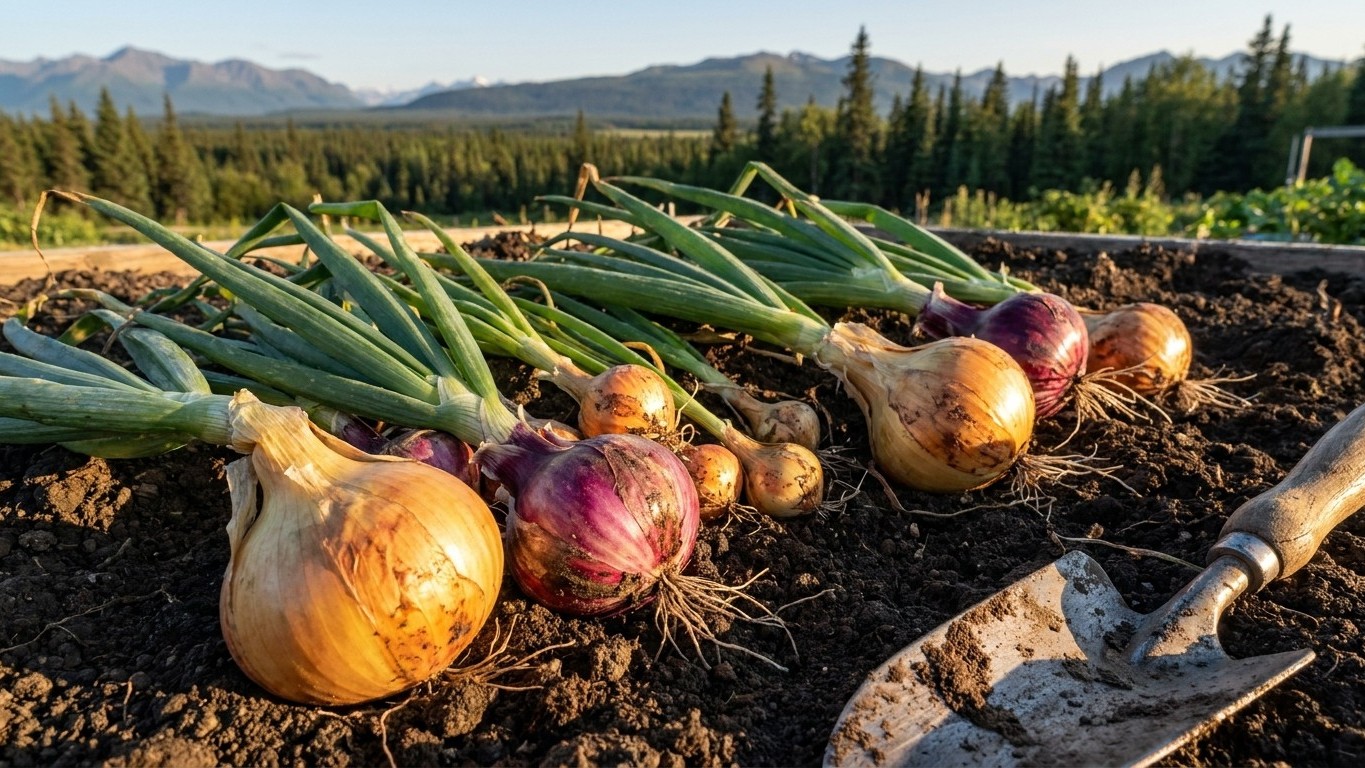

At 61.17 degrees north, Anchorage gets 18 hours and 56 minutes of daylight on the longest day of the year. That single number decides almost everything about growing onions in Alaska: it puts you solidly in long-day territory, which means long-day onion varieties are your only real option. Short-day and intermediate-day types will not work here, no matter how well you feed or water them. Everything below explains why, and which varieties actually deliver a bulb by fall.
How long your longest day is

Onions don’t bulb because of heat. They bulb because of light, specifically the number of daylight hours a plant experiences as summer progresses. Each onion type carries a genetic trigger tied to a day-length threshold, and once the days reach that threshold, the plant switches from making leaves to making a bulb. Get the match wrong and you get a beautiful stand of green tops and nothing underneath.
At the reference station near Anchorage (61.17 degrees north), the longest day of the year runs 18 hours and 56 minutes. That’s a huge number by national standards. Long-day onion varieties typically need 14 to 16 hours of daylight to start bulbing, and Anchorage clears that bar with hours to spare. Short-day varieties, which trigger at around 12 hours, hit their threshold so early in an Alaska summer that the plant is still tiny when it starts bulbing. The result is a marble-sized onion, not the storage-size bulb a gardener is hoping for. Intermediate-day types, built for the 13-to-14-hour middle ground of the mid-latitude states, don’t fare much better this far north; they trigger too early relative to how much leaf growth the plant has managed.
So the rule for this territory is simple to state and easy to remember: long-day onions, and only long-day onions, are worth planting. For exact sowing and transplanting dates tailored to your area, check a Planting calendar onions Alaska.
One caution worth repeating. Alaska is enormous, and 61.17 degrees is the latitude of one city, not a blanket figure for the whole state. Communities in the Interior and along the Arctic Circle sit at noticeably higher latitudes and get even more summer daylight, while parts of the Panhandle sit further south. If you garden well north or south of Anchorage, it’s worth checking your own latitude before betting a season on a single variety, since the daylight math shifts as you move.
Which varieties bulb in Alaska
Among the Best varieties onions Alaska with a published latitude range, only one has a range that clearly covers 61.17 degrees north:
- Redwing (long-day, 43-65N), its range comfortably spans Anchorage’s latitude, making it the safest documented choice for this territory.
One more variety sits close enough to the edge of its range that it deserves a mention, with a caveat attached:
- Ailsa Craig (long-day, 38-60N), its upper bound falls about 1.5 degrees south of Anchorage. That’s close enough to call this a blurred zone rather than a flat no. It may bulb here, particularly in a warm, long summer, but a gardener planting it is working at the edge of what the variety was bred to do, not in the middle of its comfort range.
Now the more useful list, because this is the one that saves a wasted season. The following 26 varieties are published for latitudes below Anchorage’s, and none of them are a good bet in this territory:
- Long-day types: Barolo, Blush, Bridger, Frontier, New York Early, Patterson, Powell, Red Carpet, Rossa di Milano, Safrane, Talon, Walla Walla Sweet
- Intermediate-day types: Cabernet, Calibra, Elsye, Expression, Monastrell, Red Long of Florence, Red Long of Tropea, Scout, Sierra Blanca
- Short-day types: Candy, Gabriella (no page of its own on this site), Madalyn (no page of its own on this site), Red Rock (no page of its own on this site), White Castle (no page of its own on this site)
If a gardener has ever bought a bag of onion sets at a hardware store or grocery garden center and ended up with tall green tops and pencil-thin onions come September, this is almost certainly what happened. Short-day and intermediate-day varieties hit their daylight trigger while the plant is still small, so the bulb that forms is undersized. Worse, the plant often keeps trying to push leaf growth after the trigger point, and the bulb it did start can rot in the ground before harvest, especially in a wet Alaska fall. It isn’t a fertilizer problem or a watering mistake. It’s the wrong variety for the latitude, and no amount of care fixes that.
When to plant onions in Alaska
Planting time follows from the same day-length logic, and it’s why onion planting calendars differ so much from one state to the next. In mild-winter regions farther south, growers often plant onions in the fall and let them overwinter. In a territory like this one, the frost-free window is short and the growing plan has to work around it rather than against it.
At the Anchorage-area reference station, the last spring frost typically falls between May 3 and May 12, and the first fall frost arrives between September 22 and October 1. That works out to roughly 143 frost-free days, a season that’s short by national standards but not as short as Alaska’s reputation suggests. Anchorage is actually one of the mildest inhabited parts of the state; the Interior and points north run considerably shorter seasons, so a gardener there should expect an even tighter window.
Those frost dates come from NOAA’s 30-year climate normals, and they describe a probability range, not a guarantee. A late-May frost or an early-September one both fall well within normal variation for this station. Treat the early-May date as a general marker for when the ground is workable, not a green light to set out tender transplants without protection.
Given the short season, most Alaska onion growers start seed indoors in late winter, typically 10 to 12 weeks before the last expected frost, then move hardened-off transplants outside once the soil has warmed and frost risk has dropped. Direct-seeding onions outdoors is possible in theory but leaves little margin, since the plant needs enough leaf growth before the long June daylight triggers bulbing. The nearly 19 hours of summer light do a lot of the heavy lifting here, compensating for a season that would otherwise be too short to finish a bulb crop at all.
Sweet onions or onions that keep
Here’s the trade-off every onion grower eventually runs into, and it isn’t about luck or variety marketing. It’s chemistry. The bite in an onion comes from volatile sulfur compounds, and those same compounds are what protect the bulb once it’s in storage. A variety bred to be mild and sweet simply has fewer of those compounds, which makes it pleasant raw but short-lived in a root cellar or pantry. A variety built with more of them tastes sharper on a cutting board but holds up for months.
This lines up directly with day length. Short-day varieties, grown in the South, tend to run sweeter and store poorly. Long-day varieties, the only kind that actually bulb at Anchorage’s latitude, tend to run more pungent and keep considerably longer. University of Missouri Extension puts it plainly: sweet onions do not store as well as the more pungent types, because pungency and shelf life share the same chemical root.
For a gardener growing onions in Alaska, that means the realistic harvest isn’t a soft, sweet salad onion best eaten within weeks. It’s a firmer, sharper bulb that can sit in a cool, dark spot through the winter without going soft or sprouting. Redwing, the variety whose range clearly covers this latitude, fits that long-day, longer-keeping profile rather than the sweet, short-storage type grown farther south.
Practically, that shapes what the pantry looks like by late winter. A southern garden growing Candy or Walla Walla Sweet is eating its onion harvest within a couple of months of digging it, because those bulbs won’t hold. A northern grower working with a long-day variety suited to Anchorage’s daylight can reasonably expect onions still in good shape come March, sharper on the tongue than a sweet onion, but still solid, still usable, and still months away from the compost pile.