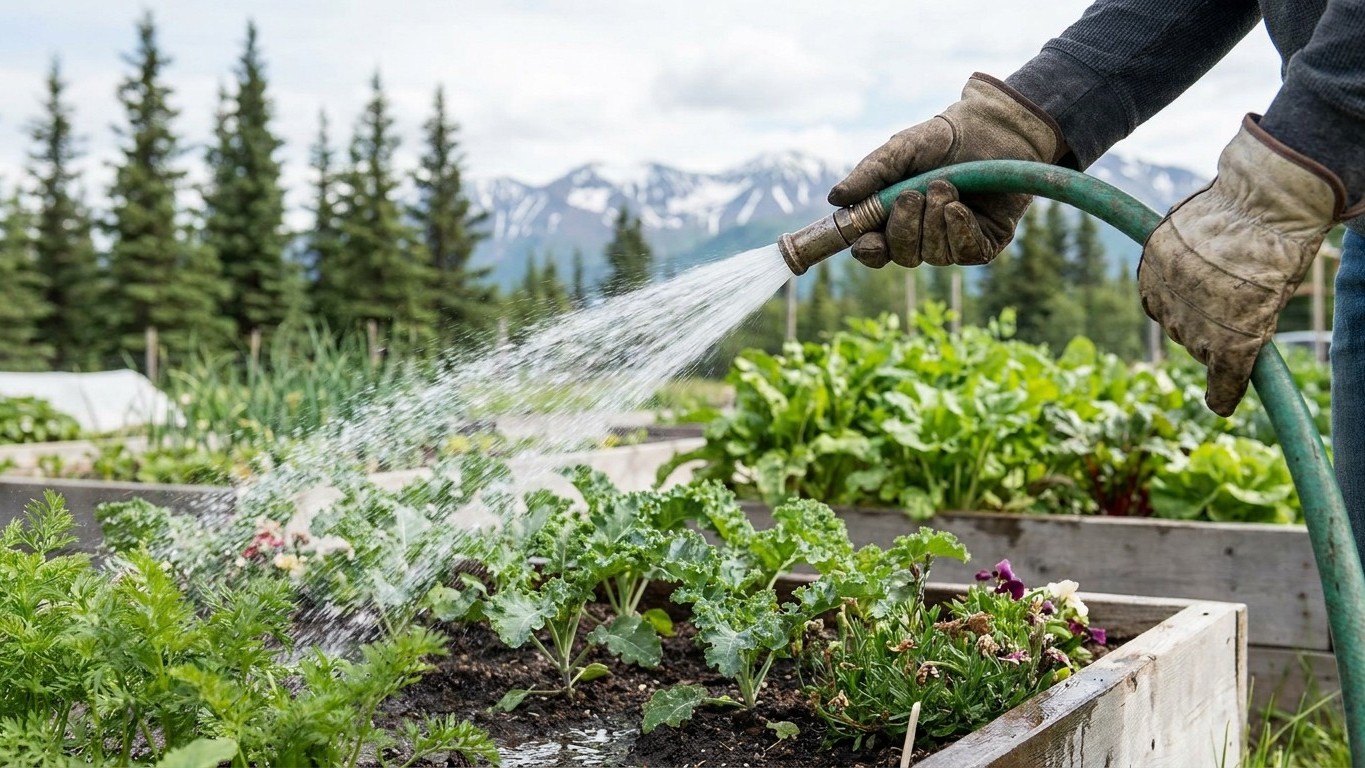

Alaska’s growing season runs cool and short, but the numbers that matter most for a hose in hand are rainfall and heat. June, the driest summer month here, brings just 1.02 inches of rain. Days above 90F average 0.0 a year. That combination changes everything about how and when you water.
What changes here

Start with the two figures that define summer watering in this state: 1.02 inches of rain in June, the driest summer month, and 0.0 days a year that reach 90F. Read together, they tell a gardener something specific: the ground here doesn’t dry out from heat, it dries out from simple lack of rain. There’s no scorching sun pulling moisture out of the soil by mid-afternoon. There’s just not much falling from the sky to begin with.
Do the arithmetic and the gap becomes concrete. A vegetable bed or a perennial border generally wants about an inch of water a week to keep roots supplied. In an average week of June, that 1.02 inches spread across roughly 30 days works out to about 0.24 inches arriving naturally in any given seven-day stretch. That leaves close to 0.76 inches the gardener has to supply by hand or by hose, every single week, if June runs true to its normal pattern.
July and August ease the pressure somewhat: 1.82 inches and 2.93 inches respectively across those months, meaning the shortfall shrinks as summer goes on. But early summer, right when transplants are settling in and root systems are still shallow, is exactly when the deficit is largest and the plants are least equipped to handle it.
Why the heat number still matters
Zero days above 90F means evaporation from leaves and soil surface stays modest compared to hotter states. That’s a real advantage: water applied here tends to stay in the root zone longer than it would in a climate with regular heat spikes. It doesn’t mean watering is optional. It means the job is about replacing a rainfall deficit steadily, not about racing to keep pace with a sun that’s baking the ground dry by noon.
How to water when it matters
The method that works in this climate is deep, infrequent watering at the base of the plant, done in the morning. Each part of that has a reason rooted in what the plant is actually doing underground and above it.
Deep watering pushes moisture down several inches, which trains roots to grow downward chasing it. Shallow, frequent watering does the opposite: roots stay near the surface where the thin layer of moist soil sits, and that’s the layer most exposed to drying between waterings. Watering at the base rather than overhead keeps foliage dry, which matters because wet leaves sitting overnight in cool Alaska air are an open invitation to fungal disease. Morning watering gives any moisture that does land on leaves time to dry before evening temperatures drop and humidity lingers.
Checking soil moisture at root depth, not just at the surface, is the only reliable way to know if it’s time to water. A dry crust on top can sit over damp soil below, or the reverse. Push a finger two inches into the ground near the plant, or use a trowel to lift a small scoop: if it’s dry at that depth, water; if it’s still moist, wait.
Soil texture changes the rhythm of all this. Sandy soil drains fast and holds little, so it needs shorter, more frequent soakings to keep up. Heavy clay holds water for a week or more but turns waterlogged and starves roots of oxygen if it’s watered again before it’s had a chance to dry out. Knowing which kind of ground is under a given bed changes the schedule more than any calendar ever will.
Here’s a sequence to start from, adjusted against actual soil checks rather than followed blindly:
- Check soil moisture two inches down before watering, using a finger or trowel.
- Water only at the base of the plant, avoiding the leaves entirely.
- Apply enough to soak the top six to eight inches of soil, roughly one inch of water per session on average ground.
- Water in the early morning, before mid-day, so any splashed foliage dries out fast.
- Space sessions two to three days apart on sandy soil, five to seven days apart on clay, then adjust based on how quickly the two-inch check dries out again.
That one-inch, once-or-twice-a-week starting point is a baseline, not a rule. Every yard’s soil drains differently, and the only way to know for certain is to keep checking at root depth and adjusting from there.
What goes wrong
Watering a little every day
A quick daily sprinkle feels responsible, but it wets only the top inch or so of soil. Roots follow the water they can reach, which means they stay shallow and close to a surface layer that dries out fastest between waterings. The plant ends up more vulnerable to any dry stretch, not less.
Wetting the leaves at night
Evening watering that lands on foliage leaves it wet for hours in cool, still air. Fungal spores thrive in exactly that window. Watering the base, in the morning, avoids handing disease that overnight head start.
Trusting a rain shower
A passing summer shower can look like it solved the problem while wetting only the top half-inch of soil, especially since June’s 1.02-inch monthly total often arrives in scattered, light events rather than one soaking rain. Checking with a finger two inches down after any rain, rather than assuming the sky did the job, is the only way to know if supplemental watering is still needed.
Skipping the mulch
Bare soil left uncovered loses moisture to open air fast, giving back a share of whatever was just watered in. A two- to three-inch layer of mulch around the base of plants slows that loss and stretches the interval between waterings, which matters most in a state where the rain itself is already scarce through the driest month.
Local help
The University of Alaska Fairbanks Cooperative Extension Service offers region-specific guidance for gardeners working with local soils and short growing seasons. Watering restrictions, where they exist, are set and changed by individual water districts and municipalities, so check with a local water provider for current rules before planning a summer watering schedule.
Common questions
How often should I water a vegetable garden in Alaska during June?
Given June’s average of 1.02 inches of rain, most gardens need supplemental watering roughly two to three times a week on sandy soil or once a week on heavier clay, checked against actual soil moisture two inches down rather than a fixed calendar.
Does the lack of 90F days mean I can water less?
It means evaporation loss is lower than in hotter states, so water tends to stay in the soil longer once applied. It doesn’t remove the need to water; June’s low rainfall still creates a real deficit that has to be made up by hand.
Is it better to water in the morning or evening in Alaska?
Morning. It gives any moisture on leaves time to dry before cool evening air sets in, cutting the risk of fungal disease that wet foliage invites overnight.
How do I know if my soil is sandy or clay-heavy?
Squeeze a moist handful: sandy soil falls apart immediately and drains within a day of watering, while clay holds its shape and can stay damp for a week or more, which changes how often it needs a soak.