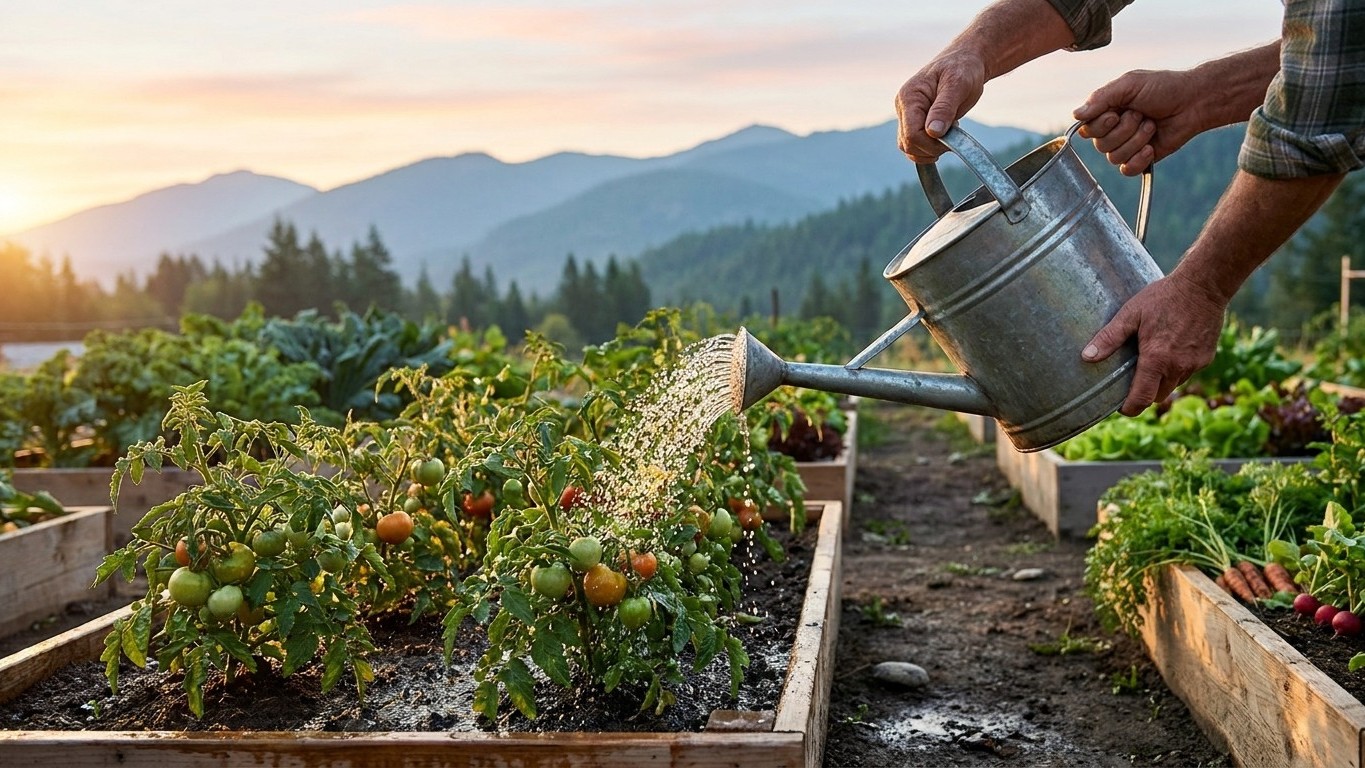

Alaska’s watering math looks nothing like the Lower 48’s. With zero days a year hitting 90F and a frost-free season that barely tops four months in even the mildest parts of the state, the challenge isn’t drought stress from heat. It’s timing a short, cool, sun-drenched window so roots get water when they can actually use it.
What the climate asks of you

Start with the number that changes everything about Alaska gardening: 0.0 days a year reach 90F, according to NOAA’s 1991-2020 Climate Normals for the Anchorage reference station. Compare that to almost any state in the continental U.S., where summer heat drives evaporation and turns a garden bed into a bowl of dust by August. In Anchorage, that heat stress simply doesn’t happen. The plant stays cooler, the soil surface dries more slowly, and a missed watering day rarely means a wilted tomato by dinnertime.
What replaces heat as the limiting factor is season length. The frost-free window runs from around May 3-12 (last spring frost) to September 22-October 1 (first fall frost), a span of roughly 143 days. That’s the entire growing season, start to finish, and it puts pressure on a gardener in a different way than heat does: every week of irrigation neglect eats into a season that’s already tight. There’s no long shoulder season to make up for a rough July.
Long daylight partly offsets the short calendar. Anchorage summer days stretch close to 19 hours of light in June, which means plants are photosynthesizing and drawing water for far more hours per day than a garden at the same latitude further south would ever see. That’s a real advantage, but it also means a plant’s daily water draw can be higher than the day length alone would suggest for a “cool” climate. A cool-season crop growing under near-round-the-clock light still needs consistent moisture at the root zone, even if the air temperature never threatens to bake it.
The takeaway for a gardener standing in an Anchorage yard: heat isn’t your enemy, but a short, intensely lit season means there’s very little room to let soil moisture swing wildly. Consistency matters more here than in a hot climate where you’re mainly fighting evaporation, which is why Watering Through a Dry Spell in Alaska requires a different mindset than watering through a heat wave.
How much, how often
Deep, infrequent watering beats a light daily sprinkle almost everywhere, and Alaska’s long-daylight, cool-summer growing season doesn’t change that logic. Shallow, frequent watering trains roots to stay near the surface, which is exactly the wrong place for them to be when a stretch of dry, sunny days shows up during the short growing window. Deep watering pushes roots downward, into soil that holds moisture longer and buffers the plant against a missed day or two. The same principle applies to Watering Pots and Containers in Alaska, where the smaller soil volume dries out faster and demands even closer attention to depth and consistency.
The test for whether it’s time to water again is simple and doesn’t require a gauge: push a finger, or the tip of a trowel, about two inches into the soil near the plant’s base. If it comes out dry at that depth, water. If it’s still cool and damp, wait. This matters more in a short-season climate than almost anywhere else, because guessing wrong in either direction (overwatering into cool, slow-draining soil, or letting a bed dry out during the only 143 days of the year it has to produce) costs the gardener a real chunk of the growing season, not just a few disappointing tomatoes.
A watering routine that fits the season
- Check soil moisture at the two-inch depth every two to three days rather than watering on a fixed daily schedule.
- Water early in the morning, giving the soil surface time to dry before evening cools things down further and invites fungal issues.
- Apply water directly at the base of the plant, not overhead, since wet foliage in a cool, long-daylight climate stays damp longer and encourages disease.
- Soak deeply enough that moisture reaches several inches down, then let the surface dry out before the next watering rather than topping it off daily.
- Increase the check frequency during any stretch of clear, sunny days, since the extreme daylight hours (near 19 hours in June) push plant water use higher than air temperature alone would suggest.
Soil type still matters just as much in Anchorage as anywhere else, even without extreme heat to punish a mistake. Sandy soil drains fast and holds little reserve, so it needs shorter, more frequent soakings to keep pace with plant demand. Heavy clay holds water far longer, sometimes for a week or more, but working or watering it while it’s still wet compacts it and starves roots of oxygen. The two-inch finger test settles the question either way: dry sandy soil needs water sooner and more often, while clay that still feels cool and damp should be left alone even if it’s been several days.
Restrictions and rules
Formal watering restrictions are far less common in Alaska than in drier Western states, largely because the state’s water utilities aren’t managing the kind of chronic summer shortage that drives mandatory rationing elsewhere. That said, rules can and do shift by municipality and by utility, and they’re set locally rather than by any single statewide authority. A gardener in Anchorage should check directly with the local water utility before assuming there are no rules at all, since even municipalities without chronic shortages sometimes issue temporary guidance during an unusually dry stretch.
The safest move is also the simplest: contact the local water provider or the University of Alaska Fairbanks Cooperative Extension Service before setting up any irrigation timer or drip system for the season. Extension offices track local conditions county by county and can flag anything a state-level search would miss, including guidance specific to well water versus municipal supply, which matters a lot in more rural parts of the state where private wells are the norm rather than the exception.
Don’t assume a rule from another state applies here, and don’t assume the reverse either. Alaska’s watering rules are a local matter, not a statewide mandate, and the only way to know what applies to a specific address is to ask the entity that actually delivers the water.
Using less
Cutting water use in an Alaska garden isn’t about surviving drought the way it might be in Arizona or Nevada. It’s about making every gallon count during a growing season that’s already short, so the plant spends its limited days growing instead of recovering from moisture swings. A few techniques do most of the work, and they’re worth adopting even in a climate that isn’t fighting chronic scarcity.
- Mulch a two- to three-inch layer of straw, wood chips, or shredded leaves around plants to slow evaporation and keep soil temperature more stable, which matters when the growing window is only about 143 days long and every degree of soil warmth helps.
- Drip irrigation or soaker hoses deliver water directly to the root zone instead of the air or the leaf surface, cutting waste from overspray and reducing the fungal issues that come with wet foliage in a cool, damp climate.
- Group plants by water need so thirsty vegetables aren’t sharing a zone with drought-tolerant perennials, which stops the gardener from either overwatering the tough plants or shortchanging the needy ones.
- Work organic matter into the soil each spring, since compost and aged manure improve both sandy soil’s ability to hold moisture and clay’s ability to drain, softening the extremes at either end of Alaska’s soil types.
- Rain barrels where local rules allow them: a rough industry rule of thumb puts one inch of rain falling on a 1,000-square-foot roof at about 600 gallons of runoff, so even a modest roof can fill a barrel fast during a rainy stretch. Anchorage doesn’t have official monthly rainfall figures cited here, so a gardener relying on a barrel should check it regularly rather than assuming it refills on any fixed schedule, and should have a backup plan ready for a dry spell.
None of these techniques require special equipment or a big budget. Mulch and grouping plants by need cost nothing but a little planning at the start of the season, and they do more to reduce a garden’s total water draw than any timer or gadget.
Common questions
Does Alaska’s cool summer mean I can skip watering entirely some weeks?
No. Zero days above 90F removes heat stress, but the long daylight hours (close to 19 hours in June around Anchorage) still drive real plant water use. Check soil moisture at two inches deep every few days rather than assuming cool air means dry soil doesn’t matter.
How short is the growing season, really?
Around Anchorage, the frost-free window runs roughly May 3-12 to September 22-October 1, about 143 days. Other parts of the state, especially the Interior and points further north, have noticeably shorter seasons, so a gardener outside the Anchorage area should treat that 143-day figure as a mild-climate benchmark, not a statewide number.
Are there statewide watering restrictions in Alaska?
There’s no single statewide mandate. Restrictions, where they exist, come from local water utilities and can change from year to year, so check with the local provider or the UAF Cooperative Extension Service before assuming any rule applies.
Should I water overhead or at the base of the plant?
At the base, always. Overhead watering wets the foliage, and in a cool climate with long daylight hours, that moisture lingers on the leaves longer than it would in a hot, breezy climate, raising the risk of fungal disease.