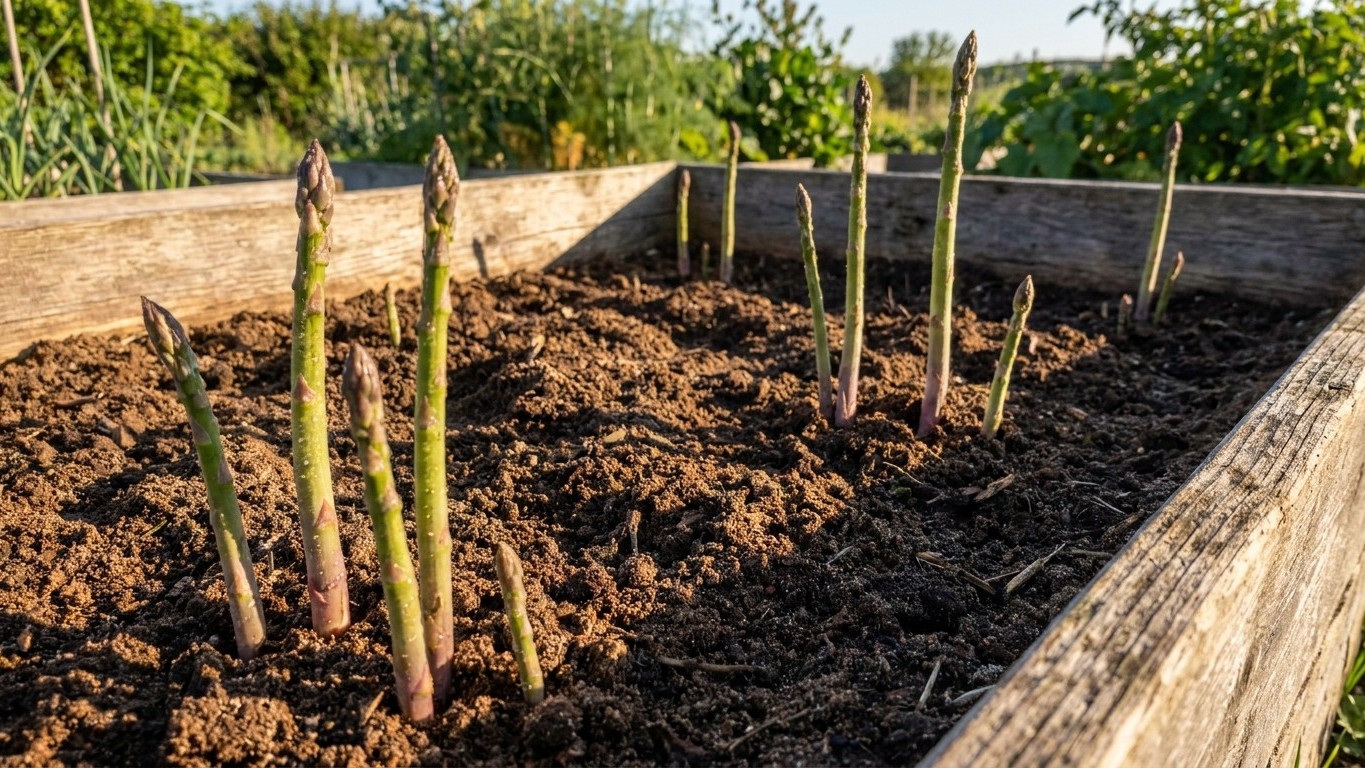

Yes, mostly. Alberta’s most common soil, a Chernozem, drains well by nature, and drainage is the only condition asparagus actually asks for over a ten-to-fifteen-year bed. That’s good news for most prairie gardens, but the provincial figure is a median pulled from more than two thousand mapped soil profiles, not a reading of the ground behind one particular garage. A test of the actual planting spot, ideally after a heavy rain, is what turns that average into a real answer for one bed.
The short answer
Utah State University Extension keeps the asparagus commitment simple: crowns go into an 8-inch furrow and, once established, the bed keeps producing for ten to fifteen years. The source names exactly one soil condition for that entire run: drainage. No favorite pH, no minimum fertility, no texture requirement. Just drainage.
On paper, Alberta’s ground answers that condition well. The dominant soil across the province’s mapped, agricultural land is a Chernozem, the dark grassland soil covering roughly 40 percent of the surveyed surface, ahead of Luvisolic soils in second place. The median Chernozem profile runs close to loam, at 37 percent sand, 21 percent clay and 42 percent silt, with a fairly rich organic matter content, about 5.2 percent at the surface. Agriculture and Agri-Food Canada’s Canadian Soil Information Service classifies this profile as well drained, which happens to be the exact box asparagus needs checked.
That same median also runs slightly acid, with a surface pH around 6.5. Utah State University Extension’s guidance never mentions pH at all, so there is no published threshold to weigh that 6.5 against, and no reason to treat it as either a problem or an advantage here. What matters for a bed meant to outlast a couple of roof replacements and most of a car’s working life is drainage, and on Alberta’s typical Chernozem ground, that answer tends to land on yes.
Tends to, not always. A provincial median describes thousands of sampled locations across the farmed part of Alberta; it says nothing about one backyard, one low corner of a lot where water pools every spring, or ground a builder scraped and refilled during construction. River bottoms and old sloughs in particular can hold water for days after a Chernozem profile nearby has already dried out. Since no spear gets cut until the third year, and the bed then keeps producing for a decade or more beyond that, a spot that turns out poorly drained isn’t a one-season disappointment. It’s a decision that’s genuinely hard to undo.
The practical fix, if a test hole stays wet a day or two after a downpour, is to raise the bed rather than fight the native ground. A mounded row, built six to eight inches above grade with extra organic matter worked in, gives roots the drainage the crop demands even where the underlying soil runs heavier than the provincial median. Checking that one spot, rather than leaning on the provincial figure alone, is what actually settles the question for fifteen years.
Will the summer here water it for you?
Utah State University Extension’s watering target changes as the bed ages: 1 to 2 inches every other week for the first two years while roots establish, then every three weeks once the plant is mature. Set against Calgary’s climate normals, that target only gets partly answered by the sky.
- June arrives generous: the month averages 3.7 inches, which works out to roughly 0.85 inches a week, comfortably inside the two-year establishment target on its own.
- July eases back: average rainfall drops to 2.58 inches for the month, close to 0.6 inches a week, sitting near the low end of what a first- or second-year bed needs.
- August turns thin: at 2.24 inches, it’s the driest of the three summer months, averaging about half an inch a week, right at the bottom edge of the establishment target and often below it during a hot stretch.
- Added together, the three months bring about 8.5 inches across the whole summer, out of 16.5 inches for the year. That total looks close to adequate for a new bed on paper, but it front-loads in June and thins out exactly when evaporation runs highest.
- A new bed, in practice, needs a hose in July and August most years, topping off whatever the sky hasn’t delivered rather than assuming the monthly average showed up on schedule.
- Once the bed passes its second year, the target eases to watering every three weeks instead of two, and established roots reach deeper for moisture, so an average Alberta summer covers a larger share of that need on its own.
- None of this replaces a rain gauge on the actual plot. These are normals from a single Calgary station over 1981-2010, and a rain shadow, a slope, or a hot paved yard nearby changes the real number for one garden.
When to put the crowns in
Utah State University Extension’s timing instruction is simple: early spring, once the ground can be worked. Crowns go into an 8-inch furrow, and that furrow doesn’t get filled all at once. It’s backfilled gradually across the season, about 2 inches every other month, rather than flush on planting day.
For an Alberta calendar, “early spring” needs an anchor, and the only one available is the average last spring frost recorded at the Calgary Int’l A station: around May 21. That figure is a mean pulled from the 1981-2010 Canadian Climate Normals, not a guarantee, which means in roughly half of all years frost actually arrives later than that date. Treat it as the middle of a window rather than a green light, and remember that one station can’t speak for a whole province; northern districts and higher ground typically run weeks behind Calgary’s numbers. Working the crowns in a few weeks around that midpoint, once soil is workable and the sharpest freeze risk has passed, matches the “early spring” instruction without pretending May 21 is a hard line.
Seed is the other entry point some gardeners choose instead of crowns, usually started indoors ahead of that same frost window so seedlings have some size before going into the ground. Whichever start point is used, no spear gets cut the first two seasons. Harvest itself doesn’t begin until year three, and even then the schedule is specific: about four weeks of cutting that first harvest year, stretching to roughly six weeks the year after, and eight weeks once the bed is fully mature. The stopping point each year isn’t tied to the calendar either. It’s a look at the spears themselves: once most of them are coming up thinner than a pencil, cutting stops for the season no matter what the date says.
Varieties, sorted by sex only
Utah State University Extension names four varieties without ranking any of them on flavor, yield, or suitability to a particular garden, listing only whether each is all-male or a male/female mix:
| Variety | Sex |
|---|---|
| Jersey Giant | All-male |
| Jersey Knight | All-male |
| UC 157 F1 | Male/female mix |
| Purple Passion | Male/female mix |
Nothing else about these four is published in that source: no taste notes, no yield numbers, and no stated reason to plant one over another in an Alberta bed specifically.
Common questions
Does Alberta’s soil pH matter for asparagus? Utah State University Extension’s guidance never sets a pH requirement for the crop, so there’s no published threshold to compare against the province’s median surface pH of about 6.5. Drainage, not acidity, is the condition that decides whether a bed lasts.
Can any spears be cut the first year? No. Harvest doesn’t start until year three of the bed, regardless of how vigorous the crowns look in year one or two.
What if a test hole stays wet after rain? Raise the row. Mounding the bed six to eight inches above grade and mixing in extra organic matter gives roots the drainage the crop needs, even on ground heavier than Alberta’s typical Chernozem profile.
How long should a well-drained Alberta bed actually produce? Ten to fifteen years, per Utah State University Extension, provided drainage holds up at that specific spot for the life of the bed, not just at planting.