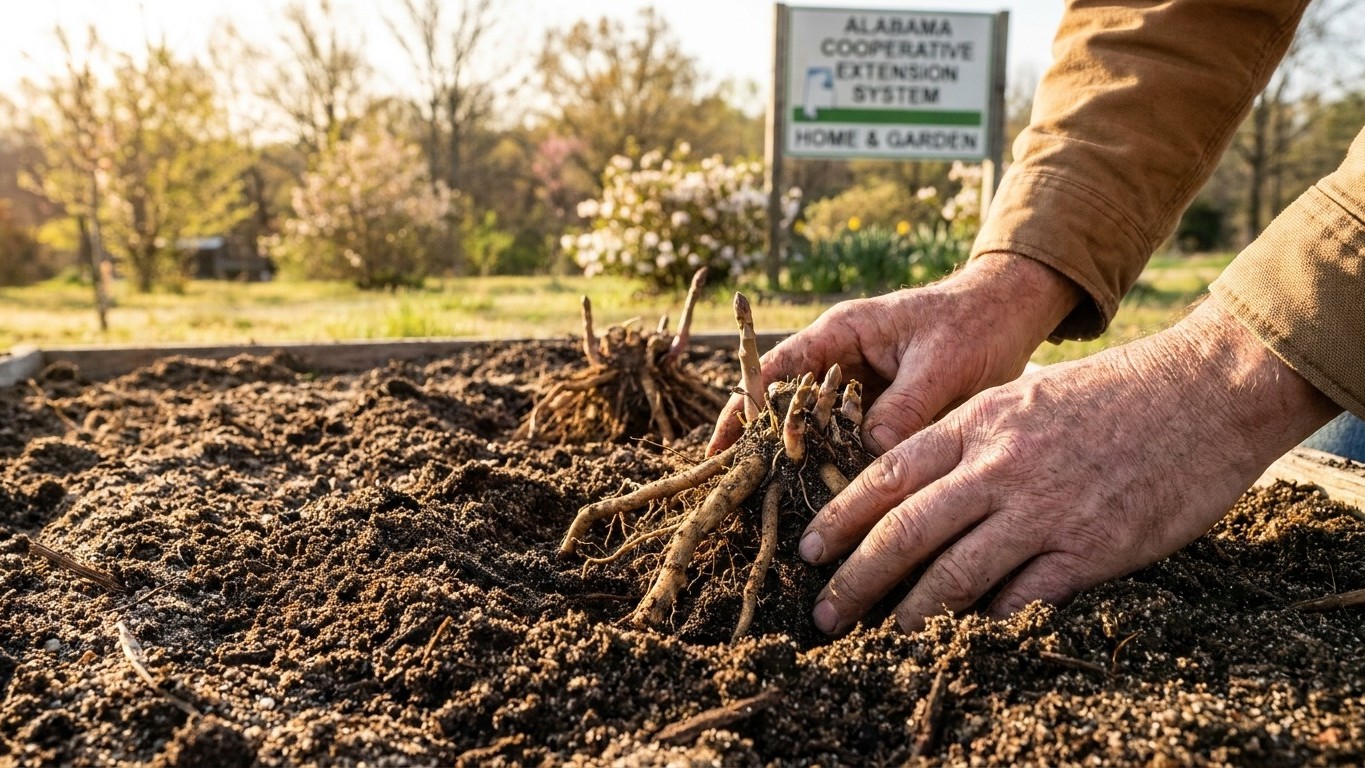

The short answer: Plant Asparagus Crowns in early spring, once the ground has thawed and worked but before the last frost date has firmly passed, and put them into soil that drains well. In the Calgary area, that frost date lands around May 21 on average. The soil question matters more here than the calendar does, because this bed will still be producing spears a decade from now.
The short answer
an Asparagus Bed is not a plant you swap out next spring if it disappoints. Utah State University Extension notes that crowns go into the ground once and, if the site is right, keep producing for 10 to 15 years. That single fact should shape where you dig, because the only soil requirement the source gives is that the ground drains. Not that it’s rich, not that it’s a particular pH, just that water doesn’t sit in it.
Alberta’s agricultural land is dominated by Chernozem, the dark, organic-rich prairie soil that covers about 40 percent of the province’s mapped surface (Luvisolic soils come in second). Data from Agriculture and Agri-Food Canada’s Canadian Soil Information Service puts the median texture at 37 percent sand, 21 percent clay and 42 percent silt, a loam-to-silt mix with roughly 5.2 percent organic matter and a median surface pH near 6.5. Classified drainage on this profile is described as well drained, which is good news for a crop that spends the next decade in the same eight inches of soil.
That province-wide figure is a starting point, not a verdict on any one backyard. The survey behind it covers agricultural regions, so it says nothing about the far north, and it can’t account for a low spot that collects meltwater every April, a yard where a builder scraped and refilled the topsoil, or a river-bottom lot with its own drainage story entirely. A Chernozem profile being well drained on paper doesn’t mean the particular sixty square feet you’ve picked for asparagus behaves the same way in a wet spring.
If your ground holds water after a rain instead of soaking it in, don’t fight it for fifteen years. Build a raised bed, or work in enough coarse organic matter to loosen a heavy patch before the crowns go in, not after. A perennial planting is the one place on this site where amending soil each season isn’t really an option, since you won’t be tilling deeply again once the roots are established. Test your own drainage with a simple hole-and-water check before you commit a corner of the yard to something you’ll be harvesting for over a decade.
Will the summer here water it for you?
an Asparagus Bed asks for 1 to 2 inches of water every other week through its first two growing seasons, then eases to about every three weeks once it’s established. Calgary’s summer rainfall, drawn from Environment and Climate Change Canada’s 1981-2010 normals, averages about 8.5 inches across June, July and August combined, with August running driest at 2.24 inches. Whether that’s enough depends on doing the arithmetic month by month rather than trusting the season total.
- Start with demand: 1 to 2 inches every two weeks works out to roughly 2 to 4 inches a month during those first two establishment years.
- Set that against supply: June brings about 3.7 inches on average, July about 2.58, and August about 2.24, so June alone can meet or beat the target while July and especially August fall short.
- Add up the gap: across a full summer, the bed’s low-end need runs close to what the rain typically delivers, but the higher end of the range, and any dry August, leaves the crowns short by a meaningful margin.
- Once the bed passes its second season, the every-three-weeks pace is easier for local rainfall to keep up with, especially in a wetter June, though August still tends to be the month to watch.
- Rely on a rain gauge in your own yard rather than the seasonal average. A normal is a 1981-2010 mean for one station, not a forecast, and a slope, a fence line, or a particularly hot week can shift what your bed actually receives.
Soil texture changes this math too. A sandy patch drains that inch of rain through within a day, while the clay fraction common in Chernozem loam holds moisture longer, which can work in the bed’s favor during a dry stretch but also means standing water is more of a risk after a heavy storm. Either way, plan to supplement by hand or with drip irrigation during July and August rather than assuming the sky will handle it.
When to put the crowns in
Crowns go into the ground in early spring, planted in furrows about 8 inches deep, once soil can be worked and the hard freeze risk has mostly passed. In the Calgary area, the mean last spring frost falls around May 21, according to Environment and Climate Change Canada’s 1981-2010 normals for the Calgary Int’l A station. That date is an average, not a guarantee: frost arrives later than the mean in roughly half of all years, so treat it as the midpoint of a planting window rather than a green light on the calendar. Districts north of Calgary, or at higher elevation, typically run behind this date by weeks, so adjust accordingly rather than planting by a fixed day.
Once the crowns are set into their furrow, the trench isn’t filled in all at once. It’s backfilled gradually over the season, adding about 2 inches of soil back in every other month as the new growth pushes up, rather than covering the roots completely on planting day. That gradual fill is part of what gives the roots room to establish before they’re carrying the full weight of the following seasons.
Starting from seed is the alternative route, and some gardeners prefer it for cost or variety choice. It asks for its own timeline indoors, well ahead of the crown-planting window, followed by a transplanting stage of its own; the specifics of that schedule aren’t part of what’s covered here, so if you’re going the seed route, plan on an extra season of patience compared with starting from crowns. Either way, the plant won’t be ready to pick from for a while yet, no matter which spring you start it in.
Common questions
When can I actually harvest my asparagus? Not in year one, and not in year two. Utah State University Extension is specific that harvest doesn’t begin until the third year, and even then it’s brief: about 4 weeks of cutting the first harvest year, extending to roughly 6 weeks the following year, then about 8 weeks once the bed is fully established. Rather than stopping at a set week count, the rule is to stop cutting once most of the spears coming up are thinner than a pencil, which signals the plant’s energy reserves need to go back into foliage instead of spears.
Which variety should I plant? The source names four: Jersey Giant and Jersey Knight, both all-male varieties, and UC 157 F1 and Purple Passion, both male/female types. That’s the extent of what’s published about them here, sex only, with no data on flavor, yield, or a reason to favor one over another, and no nursery named. Choosing between them isn’t a matter this source settles.
| Variety | Type |
|---|---|
| Jersey Giant | All-male |
| Jersey Knight | All-male |
| UC 157 F1 | Male/female |
| Purple Passion | Male/female |
Does my soil’s pH matter for asparagus in Alberta? The source used here is silent on pH requirements for the crop, so no target number is offered. The province’s median surface pH of about 6.5, slightly acid, is a description of the dominant Chernozem profile, not a reading of your own garden bed. A soil test remains the only way to know where your ground actually sits.
Does asparagus need a certain amount of winter cold to produce well here? That’s not addressed in the source material either, and it shouldn’t be assumed from the hardiness zone alone. Winter chilling requirements for asparagus simply aren’t published here, so treat any specific chill-hour figure you come across elsewhere as unverified against this data.