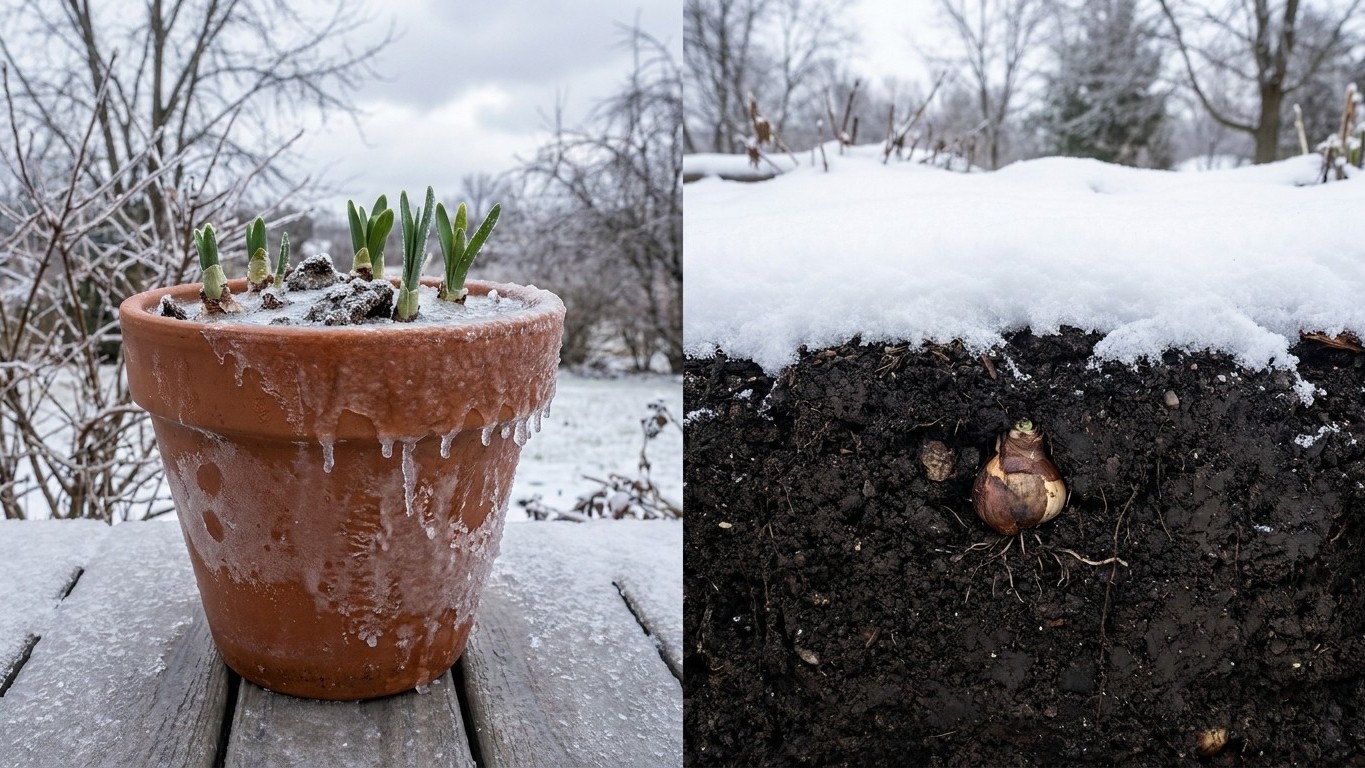

Dig them after the first frost that blackens the foliage, within a week or two of that frost. At Calgary, the first fall frost arrives on average September 16, so in a typical year the lifting window runs from late September into early October, and later when autumn stays mild. Alberta soil freezes too hard for dahlia tubers, canna rhizomes or gladiolus corms to sit out the winter. All three come up, get dried, and spend the cold months indoors.
Do you have to dig them up in Alberta?
Where the ground does not freeze deeply, dahlias, cannas and gladiolus can stay in place under a layer of mulch. Alberta is not that place. Lift all three every fall, once frost has blackened the foliage. Calgary is the only Alberta station in the data cited here, and nothing in it puts any part of the province on the mild side of that line. Northern and upland districts run colder still, so the verdict only gets firmer as you move north or up in elevation.
What the winter numbers say
Natural Resources Canada places Calgary in Canadian hardiness zone 4a, using 1991-2020 normals. That is a Canadian zone, not a USDA one. The Canadian system is built from seven climate variables, and NRCan itself says the two systems have no simple conversion: Canadian 4a overlaps nine USDA zones, from 3a to 7a. So a plant tag or forum post that hands you a USDA number for Alberta is working from an approximation.
The more useful figure is the coldest month. According to Environment and Climate Change Canada’s 1981-2010 normals for Calgary, the mean daily minimum in the coldest month is -13.2 °C (8.2 °F, for readers used to US charts). That is an average of nightly lows, which means plenty of nights fall well below it. Frost then works down into the soil.
Dahlia tubers and canna rhizomes are fleshy and full of water. Gladiolus corms are firmer but no more tolerant of a solid freeze. When ice forms inside the tissue and then thaws, the storage organ collapses into mush, and you find out about it in May when nothing comes up.
Can mulch do the job?
Some gardeners try a thick mulch on a sheltered bed, especially with cheap gladiolus corms. In a mild winter under a steady snow blanket, a few will come through. Nobody can promise it, though, and southern Alberta’s chinook winds make the odds worse by driving quick thaws and hard refreezes that bare or thinly covered soil feels immediately. The stakes are lopsided. A single large dahlia clump holds a whole season of growth, and one bad winter erases it.
Hardy bulbs are a different matter. Tulips and daffodils belong in the ground all winter, and Which Spring Bulbs Survive Your Winter sorts out which ones do well in cold country.
When to lift them
The calendar gives you a rough window, but the frost gives you the actual signal. Wait for a frost that turns dahlia, canna and often gladiolus foliage black and limp. That blackening tells you the top growth is finished and the plant has shifted its stored energy downward. Then lift within a week or two.
Reading the frost
Environment and Climate Change Canada’s 1981-2010 normals for the Calgary International Airport station put the first fall frost on average at September 16. That is a mean date, not a safe date. In one year out of two, the frost arrives later. Treat it as the midpoint of a window, and treat the blackened foliage as the real trigger. Counting a week or two forward from that average puts the digging window in late September into early October. The decision to write down is to lift a week or two after the first frost that blackens the foliage, which in an average Calgary year means late September into early October.
The window shifts with your location. A garden in the foothills or farther north sees frost sooner than the airport station does, so the same job lands earlier there, sometimes by weeks. A sheltered city yard against a south wall may hold on longer. For a broader look at how dates vary, see First and Last Frost Dates in Alberta.
Why wait at all? Tubers dug while the plant is still green and growing are immature. Their skins are thin, their tissue carries extra water, and they have not finished stocking up on stored starch. Put those in a box in November and they rot, usually from the cut stem end or a bruise, and often before you have checked on them even once. The week or two after frost gives the skins time to toughen. It is a cheap wait for a large payoff.
If a hard freeze is forecast while the foliage is still green, cover the plants overnight with a sheet or frost cloth rather than digging early. One night of protection often buys another stretch of mild weather.
Lifting without bruising
Cut the stems back to a short stub, since the hollow stems of dahlias can channel water down into the crown. Choose a dry day and push a garden fork into the soil well outside the clump, not near the stems. Lever the whole mass up gently. Never pull on the stub, because dahlia necks snap easily and a tuber that has lost its neck will not sprout.
Cannas form dense mats of rhizomes that can be heavy, so expect to loosen a wide circle of soil. Gladiolus corms sit shallower and come up easily with a spade or a fork. Gladiolus foliage sometimes yellows and browns on its own before the first frost, and corms can be lifted then without waiting for a killing freeze. The Alberta guides cover other seasonal timing across the province.
Storing them over winter
Three steps decide whether the tubers survive: cure, clean lightly, and store cool, dark and slightly moist. The moisture is the tricky part. Too little and the tubers shrivel into wrinkled husks. Too much and they rot from the inside. Aim for a spot where the air is damp enough to keep them plump but never wet.
Curing and packing
After lifting, shake off loose soil and let the clumps dry in a sheltered, airy place out of direct sun and rain, such as a garage bench or covered porch, until the surfaces feel dry to the touch. Skip the hose. A light brushing is enough, and heavy washing pushes water into wounds. Dahlia and canna clumps can stay whole or be divided in spring, when the eyes are easier to see.
The storage spot needs to stay above freezing all winter, and here Alberta punishes assumptions. An attached garage or an unheated cold room that is fine in October can dip below freezing during a January cold snap when nightly lows average -13.2 °C in the coldest month at Calgary. A basement corner or an insulated closet along an inside wall is safer. A cheap min-max thermometer left beside the boxes tells you the truth in a way guessing does not.
Packing material varies by gardener: dry peat moss, vermiculite, wood shavings, even shredded paper. What matters is that it holds a hint of moisture without dripping. Cardboard boxes or ventilated crates work better than sealed plastic tubs, which trap humidity and invite mold.
How the three differ
They do not want the same treatment, and mixing them into one box is a common cause of loss.
| Plant | What you store | Packing | Moisture | What to look for |
|---|---|---|---|---|
| Dahlia | Fleshy tubers on a crown | Boxes with lightly damp peat, vermiculite or shavings; crown up | Slightly moist, never wet | Wrinkling, soft spots at the neck, mold |
| Canna | Thick rhizomes | Boxes with lightly damp medium, or wrapped loosely in paper | Slightly moist; more prone to drying out than gladiolus | Shrivelled ends, mushy patches |
| Gladiolus | Firm corms plus tiny cormlets | Paper or mesh bags in open trays, no damp medium | Dry, with good airflow | Soft or moldy corms, any that sprout early |
For gladiolus, snap off the old, withered corm at the base and keep the plump new one, along with the cormlets if you want to grow more. Dahlias and cannas tolerate a little more humidity because they are fleshier, and both go into storage with less fuss about airflow than glads do.
Check every box once a month all winter. This is the step that saves the collection. A single rotting tuber can spread mold to its neighbors within weeks. Remove anything soft or moldy, and mist very lightly if the rest look wrinkled. Dry out the packing if you see condensation on the box walls. The check takes a few minutes and often decides whether you replant a full collection or half of one.
What goes wrong
Rot shows up as soft, dark patches, a sour smell, and gray or white mold. It usually starts at a wound or at the cut stem. Prevention begins before storage: dig gently, cure until dry, and store with airflow. If you catch it early, cut away the bad tissue back to clean flesh, let the cut dry, and repack. Discard anything that has gone to mush, because it will contaminate the rest.
Shrivelling is the opposite problem. Tubers turn wrinkled, light and leathery, and eventually no longer sprout. It happens in storage that is too warm, too dry, or too airy for dahlias and cannas. Add lightly dampened packing, move the box to a cooler spot, and rethink the location. Gladiolus corms may look a little dry in storage, and that is normal for them.
Lifting too early gives thin-skinned, water-heavy tubers that fail even in good storage. The remedy is waiting for the frost signal and then a week or two of patience. If green foliage still stands at the end of September, wait for the blackening rather than lifting on a date.
The last mistake is geographic. Leaving tubers in the ground because a neighbor from a milder climate did it, or because a US chart lists a zone number, is how gardeners lose them. Canadian zone 4a does not translate into a USDA zone, and the colder your district within Alberta, the less forgiving the soil.
Common questions
What if a hard freeze or heavy snow is forecast before the foliage has blackened?
Cover the plants overnight with a sheet, blanket or frost cloth if you can. If the freeze looks like it will last, or the ground itself may freeze, lifting slightly immature tubers beats losing them. Handle them gently, cure them a little longer than usual, and check them more often through the winter, since thin skins are the weak point.
Do I need to wash the tubers before storing them?
No. Brush off loose soil after curing, and leave the rest. Washing adds moisture at exactly the moment you want surfaces dry, and it can push water into small wounds. If you do rinse a heavily muddy clump, dry it thoroughly before it goes in a box.
When do I plant them again?
After the last spring frost has passed and the soil has warmed. Timing runs later in colder northern and upland districts, the opposite direction from fall lifting, which moves earlier there. Frost-sensitive tubers set out too soon can be blackened by a single cold night, and that costs you the season.
Do spring bulbs need the same treatment?
No. Tulips, daffodils and other true spring bulbs are planted in fall and stay in the ground through winter. Details on the whole group are in Spring Bulbs, and Planting Spring Bulbs in Alberta covers the local timing. The tender plants above are the reverse: planted after the last spring frost and lifted after the first fall one.