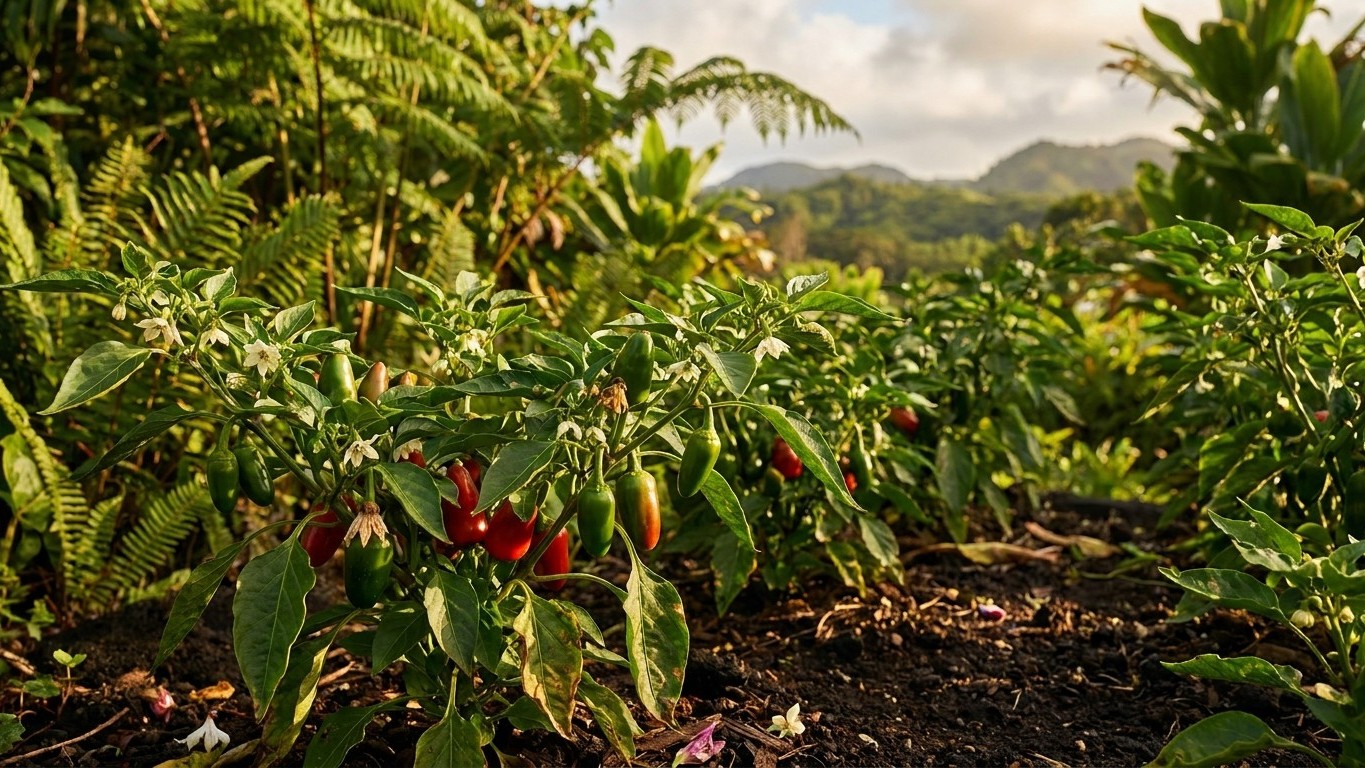

Pick peppers once the fruit is full size and firm. In Alberta that usually means 70 to 85 days after transplanting, so late summer for a late-May planting. Then keep them out of the fridge. A domestic refrigerator runs colder than peppers tolerate, and below about 45 °F (7 °C) they pit and soften. A cool room at 45 to 50 °F (7 to 10 °C) treats them far better.
The short answer
Heat and cold at flowering
At Calgary Int’l A, the reference station for this page, the climate normals count 1.37 days a year reaching 32 °C (the exact equivalent of 90 °F). Utah State University Extension says pepper fruit set fails at both ends of the thermometer, and days above 90 °F are the hot end. In an average year at this station, that end barely comes into play. Environment and Climate Change Canada also publishes a 30 °C count, the more familiar one here: 5.1 days a year.
That number needs careful reading. It counts extreme days. It does not measure the growing season. What decides whether a pepper plant thrives is how long the frost-free period lasts and what the summer averages look like, and a handful of scorching afternoons says little about either. Airport stations also sit outside the city, so your own yard can read warmer or cooler than the figure above.
The other end matters more to many Alberta gardeners. The same Extension guidance puts the cool limit at nights below 55 °F, about 13 °C. This site does not carry summer night minima, and guessing them from latitude or from how cold winter gets would be a mistake. Put a min-max thermometer next to the bed in June and July and read it each morning. Several nights under that line during flowering is your warning sign, whatever the daytime highs did.
When to pick
Clemson Cooperative Extension says peppers should be ready for harvest about 70 to 85 days after transplanting. That range comes from South Carolina, so treat it as a guide and not a promise. Plants set out around the last week of May would start yielding in August, and plants set out in early June a little later. Fruit left to turn red, yellow or orange takes longer than that, and this site has no verified figure for how much longer. Watch the forecast in September and pick before a frost.
The 35 to 45 days some seed packets quote count from flowering, not from sowing or transplanting. A plant that sits through a cold June without setting fruit has not lost those days, because the clock hasn’t started yet.
Why the fridge ruins them
Clemson puts the best storage at 45 to 50 °F with 80 to 90 percent relative humidity, for two to three weeks. That is the maximum under ideal conditions, not a guarantee. It is also warmer than a household fridge. Peppers kept in the crisper drawer develop pitted, sunken patches and go soft, a condition called chilling injury, and nearly everyone causes it at least once. A cool basement, a cold cellar or an unheated back room does better. For more on growing them, see Growing Peppers in Alberta.
When to start seed here
The dates come from counting backward from transplanting. Here is the arithmetic in words, so you can redo it for your own county:
- Pick the transplant date first. Peppers go out after the last frost and once the soil reaches 60 °F (about 16 °C). At Calgary Int’l A, the average last spring frost is May 21. That is a mean, so in one year out of two the frost falls later. Treat it as the middle of a window, never as a safe date, and check the soil with a thermometer before you plant.
- Subtract 8 to 10 weeks. Transplants need that long indoors. Eight weeks is 56 days, and counting back from May 21 lands on March 26. Ten weeks is 70 days, which lands on March 12. So for a May 21 transplant, sow between March 12 and March 26.
- Swap in your own frost date. The Calgary figure comes from one airport station, and a province is not one climate. Northern and upland districts run weeks behind it. Take your local last-frost date, add a few days if the soil is still cold, then subtract the same 56 to 70 days. Note also that Canadian normals cover a different 30-year period than the US figures used elsewhere on this site, so don’t mix the two sets when you compare.
- Add the harvest window. Take your transplant date and add 70 to 85 days (Clemson’s range for readiness after transplanting). Transplant on May 21 and you land between July 30 and August 14. Transplant on June 1 and it shifts to August 10 through August 25. A delayed transplant pushes the harvest later by the same number of days, and a cool spell can stretch it further.
- Leave room at the far end. This site does not publish a first-fall-frost date for Alberta, so look up your local one. A sowing date that works on paper but sends the harvest into frost risk means moving everything earlier or choosing quicker plants.
Starting much earlier than the 10-week mark rarely helps. Plants outgrow their pots and sit waiting for warm soil, and a pepper that is rootbound and flowering in a cell tray is not the one you want in the ground. For the problems that follow when flowers come at the wrong moment, see Why Peppers Fail to Set Fruit in Alberta.
What goes wrong here
Alberta’s climate produces a short, predictable list of pepper problems. Most can be reduced with small changes.
- Blossom drop in a hot spell or a cool night. Flowers fall off without setting fruit when days climb past 90 °F (32 °C) or nights dip below 55 °F (about 13 °C). The hot version is uncommon at Calgary Int’l A, where 1.37 days a year reach 32 °C, but it can happen in a sheltered yard against a south wall. The cool version is likelier, and you have to track it yourself, since this site carries no summer night minima. Remedy: lay row cover over the bed on cold evenings and take it off in the morning, and put shade cloth over plants in a heat wave. New flowers usually open once the weather settles.
- Sunscald. Fruit exposed to strong direct sun develops pale, papery, sunken patches on the side facing the sky. The long summer days make this easy to get, especially after pruning or leaf loss. Remedy: keep the leaf canopy intact, skip heavy pruning, and shade fruit-heavy plants during a hot afternoon spell. Damaged fruit is usually still edible once the patch is cut away.
- Blossom-end rot. A dark, leathery, sunken spot forms at the bottom of the fruit, opposite the stem. It is linked to uneven watering, which disrupts how the plant moves calcium into developing fruit. Remedy: water on a steady schedule, mulch to hold moisture, and test your soil before adding any calcium, since most prairie soils already carry plenty.
- Chilling injury after picking. Not a garden problem but a kitchen one. Peppers kept below about 45 °F develop pits and soften. Remedy: store them at 45 to 50 °F with 80 to 90 percent humidity, and use them within the two-to-three-week limit.
Insects and animals also take a share of the crop. See What Eats Pepper in Alberta, and When for what to watch and when.
Common questions
Can I pick peppers while they are still green?
Yes. Green fruit that has reached full size and feels firm is fine to eat. Leaving it on the plant to turn red, yellow or orange takes more time, and this site has no verified number for how much more. In a short season, ripening is often a bet against the first fall frost, so if the forecast turns, pick what you have.
Where should I keep harvested peppers if not the fridge?
Look for a spot at 45 to 50 °F (7 to 10 °C) with high humidity, such as a cool basement or cold cellar. Clemson Extension gives 80 to 90 percent relative humidity and two to three weeks as the maximum under optimal conditions. Check them often, since the limit is a ceiling and not a promise. If your only cool spot is the fridge, use the peppers within a few days.
Does 1.37 days above 32 °C mean peppers struggle in Alberta?
No. That figure counts only extreme days at Calgary Int’l A. It says little about whether peppers get enough warmth across a season. The frost-free period and the summer averages decide that. If anything, 1.37 days means the hot end of fruit-set failure is rare in an average year. The cool-night end is the one to watch.
Is May 21 a safe planting date?
No. It is the average last spring frost at Calgary Int’l A, so frost arrives after it in about one year out of two. Districts to the north and higher up run weeks behind that station. Plant when the frost risk has passed and the soil reaches 60 °F (about 16 °C), and keep row cover on hand for the stragglers.