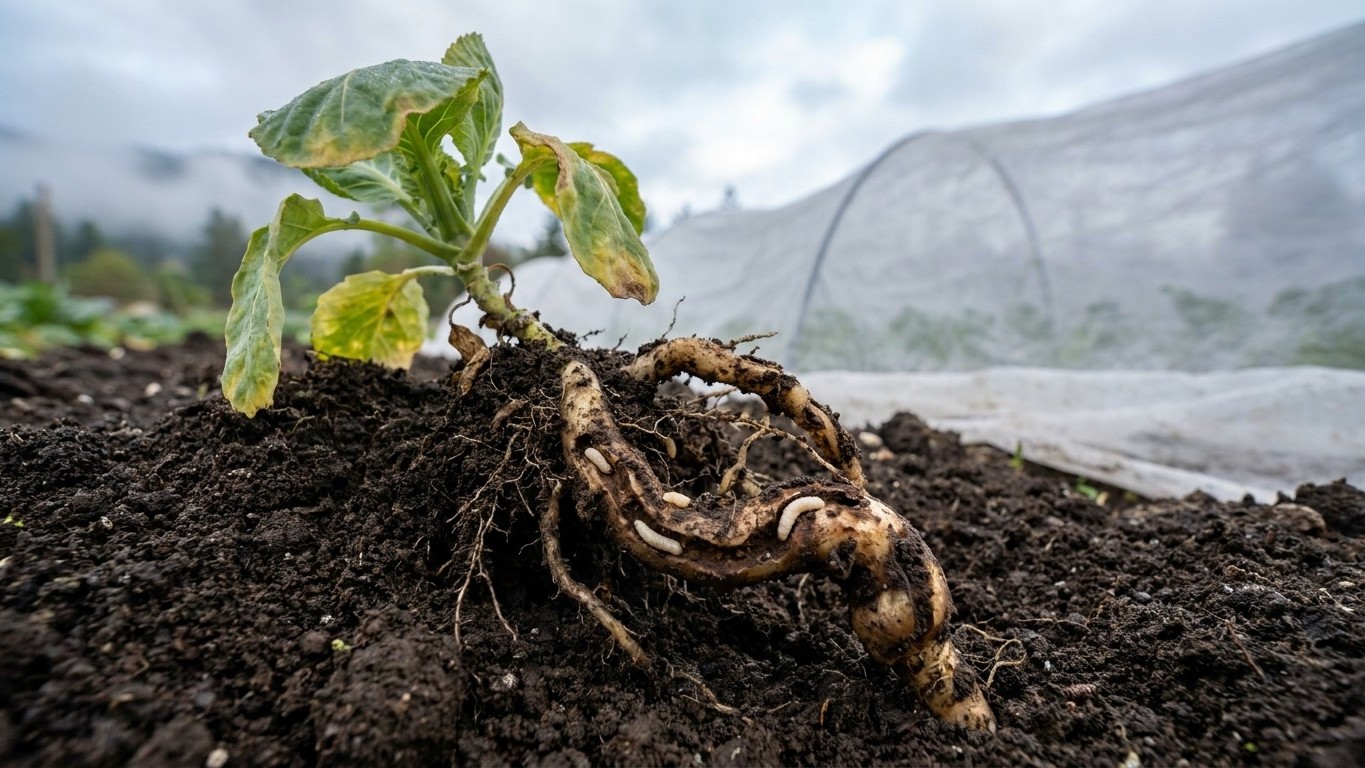

In Alberta gardens, the insects most likely to actually feed on potato are grasshoppers and thrips, with brown marmorated stink bug showing up on occasion later in the season. That answer comes from the closest documented pest list available for this region, since Alberta itself doesn’t publish an equivalent inventory here. Timing follows the frost-free window, not the calendar month, and that window moves every growing season.
Which pests attack potato in Alberta

The reference list for this territory comes from Montana State University Extension, Urban IPM, a bordering-state program used here because Alberta doesn’t have its own equivalent list documented on this site. That program names five insects for the region: Brown marmorated stink bug, Grasshoppers, Miller moths, Social wasps, and Thrips. That’s the full list, and it’s short on purpose. It’s also an urban pest list, not a field-crop list, which matters for what follows.
Not every insect on a documented pest list feeds on a garden crop, and treating for one that doesn’t just wastes a season’s effort. Two of the five belong nowhere near a potato patch. Miller moths are the adult stage of the army cutworm, and once they’re flying, they feed on nectar, not foliage. The moth in a porch light isn’t the life stage that damages a crop. Social wasps are predators and scavengers. They hunt other insects and raid picnics; they don’t chew leaves or tubers, so a wasp nest near the garden is a nuisance, not a potato problem.
That leaves three worth watching. Grasshoppers chew foliage directly and are among the most reliable defoliators on this list once populations build. Thrips feed on leaf tissue with a rasping mouthpart that leaves a distinctive silvery texture behind, and potato foliage is well within their host range. Brown marmorated stink bug is the least predictable of the three on potato specifically. It has a wide host range across vegetables and fruit, and it can turn up on potato foliage or pods, but it tends to do more damage on tomatoes, peppers, and tree fruit than on potato in most reports.
So the working list for a potato bed in Alberta is grasshoppers first, thrips second, and brown marmorated stink bug as an occasional third. Miller moths and social wasps stay off the list, and no other species gets added here, because none is documented for this territory in the source used on this page.
When each one shows up, and what it does first
Alberta’s average last spring frost falls near May 21 at the Calgary Intl. A station, but the real date lands later than that in one year out of two, so treat it as a midpoint of a window, not a green light to plant. That mean date also comes from a Canadian climate-normals record covering an older 30-year period than the US figures used elsewhere in this series, and a single station never speaks for a whole province; districts to the north or at higher elevation run behind Calgary’s numbers.
Grasshoppers build through the growing season rather than arriving on a fixed date. Nymphs hatch from soil after the ground warms past the frost-free window, and they feed first on field margins, roadside grass, and weeds before moving into garden rows once that vegetation dries out or gets mowed. The first sign in a potato patch is usually ragged, notched leaf edges working in from the margin, worse on the side of the garden closest to open grass or a fence line.
Thrips show up as foliage expands and the canopy starts to close in over the row. The first visible clue is a silvery or bronzed sheen on the upper leaf surface, sometimes with fine black specks of insect waste on the underside. Populations tend to build during warm, dry stretches, and damage is cosmetic at low numbers but can affect vigor if it climbs.
Brown marmorated stink bug, when it does appear on potato, tends to show up later in the season as adults move between host plants looking for food before they seek overwintering sites. First signs are small discolored or dimpled patches where the insect has pierced the plant tissue to feed, more often near where potato borders a fruiting crop like tomato than in an isolated potato bed.
Telling the damage apart from everything else
Check for the insect itself, or its cast skins and waste, before deciding what caused a mark on the leaf. Potato foliage takes a beating from more than insects in a short-season climate, and the marks overlap enough to fool a quick glance.
| Symptom | Possible causes | What distinguishes it |
|---|---|---|
| Ragged, notched leaf edges | Grasshoppers, hail, mechanical damage from cultivation | Hail damage is scattered across the whole garden the same day; grasshopper damage worsens gradually near grassy edges |
| Silvery or bronzed leaf surface | Thrips, spider mites, magnesium deficiency | Thrips leave dark speck waste on the underside; deficiency symptoms show evenly across older leaves without any insect residue |
| Small dimpled or discolored spots on tissue | Stink bug feeding, mechanical bruising, early disease lesion | Feeding spots stay dry and localized; disease lesions usually spread and often come with a distinct margin or odor |
| Wilting despite damp soil | Root or stem disease, drought stress, insect feeding below ground | Wilting from feeding is patchy plant to plant; drought stress is uniform across the whole bed |
None of this replaces a direct look. A county agricultural office can confirm what’s actually on a leaf far faster than guessing from a description, and that’s the right next call whenever a symptom doesn’t clearly match one line in that table.
What actually works here, and what is a waste of time
A physical barrier put in place before the pest arrives outperforms almost anything applied after damage is already visible. On a growing season this short, timing does more work than the product itself. Floating row covers set over young potato plants right after emergence keep grasshoppers and stink bugs off the foliage during the weeks they’d otherwise be moving in from field margins, and they can come off once plants are large enough to tolerate some feeding without yield loss.
Keeping grass and weeds mowed short along garden edges removes the staging ground grasshoppers use before they move onto crops, and it costs nothing but time. Watching for the first silvery leaf sheen from thrips, rather than waiting for a heavy infestation, gives more options for a light response before populations peak during a hot, dry stretch.
What’s a waste of time on this list: treating for miller moths or social wasps in a potato bed. Neither one feeds on the crop, so any effort spent there is effort not spent watching for grasshoppers or thrips. Broad, calendar-based spraying without checking foliage first is also a poor use of a short season, since it treats a symptom that may not even be present yet and misses the actual feeding window. This site doesn’t name products, rates, or active ingredients; what’s registered for use on potato changes and only a state or provincial extension service and its label guidance can confirm what’s currently allowed.
Where to check this for your own county
A species documented for a whole territory doesn’t confirm what’s actually in one garden. Pest pressure shifts county to county and even yard to yard depending on nearby grassland, shelterbelts, and what’s growing on the other side of the fence.
The reference source used on this page, Montana State University Extension, Urban IPM, covers a bordering jurisdiction, not Alberta itself, and it’s used here because it’s the nearest documented list available. For a confirmed read on what’s actually present in a specific Alberta county, the next step is a call to the local county agricultural office or provincial crop specialist, who can speak to what’s been reported nearby this season rather than what’s documented at a broader regional level.
That local contact also matters for timing questions the frost date alone can’t answer. The Calgary Intl A mean of May 21 is one station’s average from an older climate-normal period, and a county further north, at higher elevation, or in a different microclimate can run its frost-free window weeks later. Anyone planning a row-cover date or a first-scouting date around that figure gets a far better answer from a local office than from a single provincial average.
Common questions
Do grasshoppers actually damage potato yield, or just the leaves?
Heavy feeding on foliage can reduce a plant’s ability to bulk up tubers if it happens early and repeatedly, but light, scattered chewing on a few outer leaves usually isn’t enough to affect yield. The county agricultural office is the right place to gauge whether a given level of feeding is worth a response.
Should social wasps near the garden be removed even if they don’t eat potato?
That’s a separate decision based on sting risk around people, not a crop-protection question, since wasps don’t feed on potato foliage or tubers.
Is brown marmorated stink bug common on potato in Alberta specifically?
It’s documented for the broader bordering region through the Urban IPM source used on this page, but it tends to show a stronger preference for tomatoes, peppers, and fruit crops than for potato, so its appearance on potato specifically is the least predictable of the three pests worth watching here.
Why does this page use a frost date from Calgary instead of a province-wide figure?
Because no single date is true for the whole province, naming the reference station keeps the figure honest. Environment and Climate Change Canada’s normal is measured at that one location, and any garden further from it should treat the date as a starting point to check locally, not a fixed rule.