
In Alberta gardens, spinach faces two real leaf-eaters documented for this bordering region: grasshoppers and thrips. Grasshoppers show up as the season warms and chew ragged holes straight through the leaf. Thrips arrive earlier, while plants are still small, and leave a dry, silvery stippling instead of holes. Everything else on the regional pest list either skips spinach entirely or isn’t a crop feeder at all.
Which pests attack spinach in Alberta

Montana State University Extension, Urban IPM documents five insects active in this bordering region: Brown marmorated stink bug, Grasshoppers, Miller moths, Social wasps, and Thrips. That’s the full list this source carries for the area, and it doesn’t get padded out here just because five names looks thin.
Not all five belong on a spinach page, though, and sorting them out matters. The brown marmorated stink bug feeds with piercing-sucking mouthparts aimed at fruiting structures, things like tomatoes, peppers, and tree fruit, where it punctures the developing fruit itself. Spinach has no fruit to puncture at the stage anyone eats it, so this insect has nothing to do here. Miller moths, the adult stage of the army cutworm, feed on flower nectar as adults and are mostly known for swarming porch lights and slipping into houses in late spring. They aren’t chewing leaves at that stage. And social wasps are predators and scavengers, hunting other insects and scavenging sugars, not grazing on plant tissue. None of these three leave a mark on a spinach bed.
That narrows the working list to two: grasshoppers, which chew visible holes and can skeletonize a leaf once numbers build, and thrips, tiny slender insects that rasp at the leaf surface and leave a silvery, papery look rather than an actual hole. Both are generalist feeders, meaning they don’t specialize in spinach and will move onto it simply because it’s green, tender, and available. That also means neither one is unique to spinach beds. A garden with grasshoppers in the lettuce or thrips on the onions is a garden where spinach is at risk too, and the reverse is just as true.
The short list here isn’t a sign that spinach is safe in this region. It reflects what one documented source tracks for a bordering area, not a full inventory of every insect that has ever landed on a leaf in Alberta. A local extension contact remains the better source for anything not covered by this list.
When each one shows up, and what it does first
Alberta’s frost-free stretch runs from an average last spring frost on May 21 to an average first fall frost on September 16, a window of a little under four months at the Calgary Int’l A station used for these normals. Everything spinach does, including getting eaten, happens inside that stretch, and both ends of it move around from year to year rather than landing on those exact dates.
Thrips tend to show up early, often within the first couple of weeks after seedlings put out their true leaves. What you notice first isn’t an insect at all, it’s the leaf surface turning dull and silvery, almost like it’s been lightly sanded, sometimes with tiny dark specks scattered across it. That’s thrips feeding and their fecal spotting, not disease.
Grasshoppers generally build later in the frost-free window, closer to the back half of summer, as nymphs hatched earlier in nearby grassy or weedy ground grow larger and start ranging into garden beds once surrounding vegetation dries out. The first sign is usually chewed leaf margins, notched and ragged rather than smooth, and it can progress fast once a few grasshoppers settle in.
Timing a fall planting adds another layer. A fall crop is sown 50 to 75 days before the date you want to harvest, which for this region’s frost dates lands the sowing somewhere in the mid to late part of summer. Spinach germination drops once soil passes 80°F, but Alberta rarely gets there, the same weather station averages only 1.37 days a year reaching 32°C, so warm soil is far less of a barrier to a second planting here than it would be farther south. That means fall-sown spinach in Alberta often germinates cleanly and can also miss the worst of the grasshopper build-up, since cooler nights later in the season tend to slow grasshopper activity before it slows spinach.
Telling the damage apart from everything else
A chewed or discolored spinach leaf has more than one possible cause, and guessing wrong wastes a season. The table below lines up what shows up on the leaf against what’s actually behind it.
| Symptom | Likely cause | What distinguishes it |
|---|---|---|
| Dull, silvery, papery patches with tiny dark specks | Thrips | Held to light, damage follows a scarred, streaky pattern; no actual holes |
| Ragged holes, chewed margins, leaves stripped to the vein | Grasshoppers | Insects visible hopping in the bed; damage spreads across many plants quickly |
| Even yellowing between the veins, pale overall color | Nutrient shortfall (iron or nitrogen) | No chewing or scarring at all; affects the whole plant uniformly |
| Wilting, crisp brown leaf edges | Drought or heat stress | Tracks with dry spells and recovers after watering; no insects present |
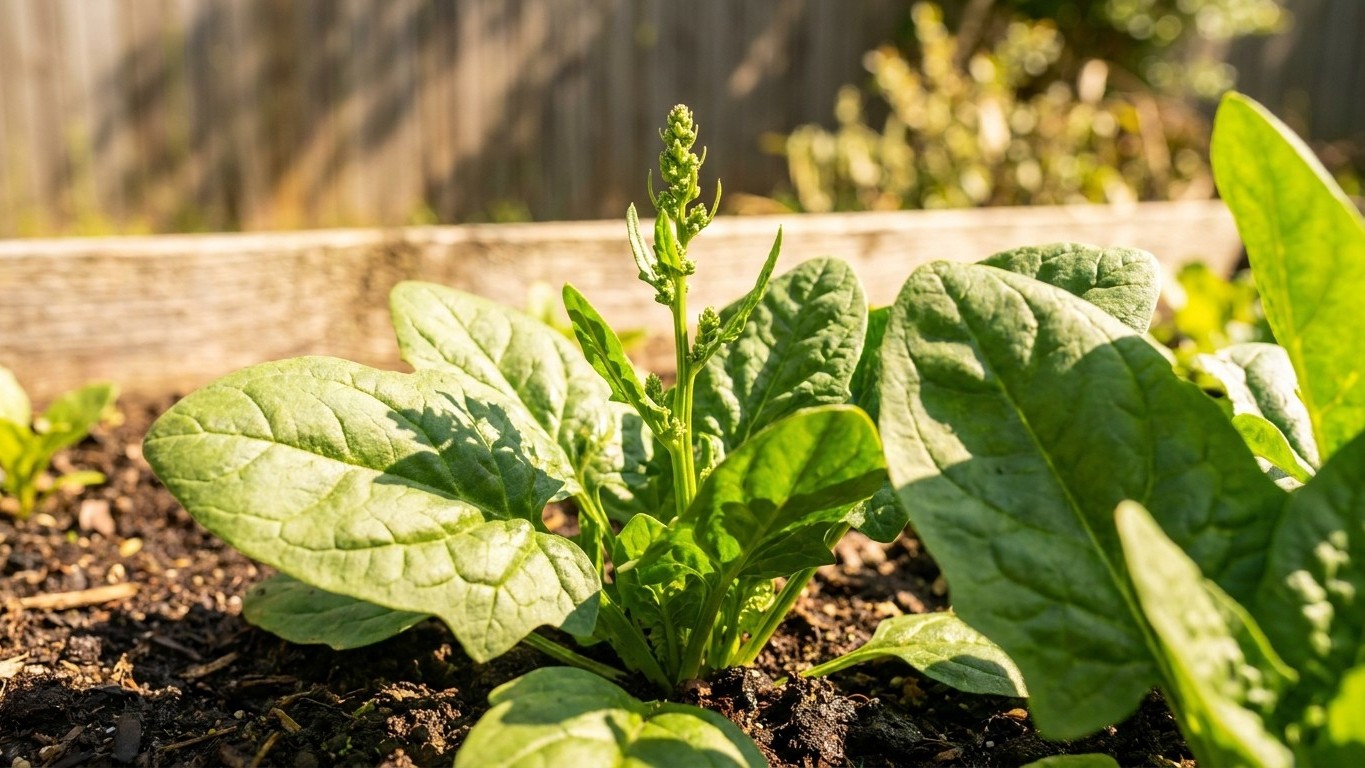
| Sudden tall central stalk, narrow bitter leaves | Bolting | Not an insect at all; triggered once long days and heat past 75°F push the plant to flower, the same threshold that turns the leaves bitter |
| Torn, shredded tissue after a storm | Hail or mechanical damage | Matches storm timing exactly; edges are torn, not chewed |
Bolting deserves its own mention because it’s so often mistaken for a pest or disease problem. It isn’t. Once day length and warmth push past what the plant tolerates, spinach shifts into flowering and the leaves turn bitter on their own, with no insect involved. A local extension office remains the better judge of anything ambiguous. This page can narrow down what to look for, not confirm what’s actually growing in a specific bed.
What actually works here, and what is a waste of time
Physical exclusion beats almost everything else on a short season. Laying floating row cover over the bed the same day seeds go in or transplants go out keeps both thrips and young grasshoppers off the plant before they ever land on it, and it costs nothing in terms of days-to-harvest restrictions that come with sprayed products. Getting the cover down before the pest arrives, not after damage shows up, is the decision that actually matters.
Handpicking grasshoppers works better than it sounds, provided it happens early. Young nymphs without developed wings are slow and easy to knock into a bucket; adults with full wings simply hop or fly away. Checking the bed every few days during the back half of the frost-free window catches the problem while it’s still small.
Encouraging birds and predatory insects around the garden edges gives a second line of defense against both pests without any product involved.
What tends to waste time is reaching for a broad insecticide once damage is already visible. By the time chewed leaves or silvery patches show up, a chunk of the harvest window is often already gone, and many products carry a waiting period before the leaves are safe to pick, which eats further into a season that’s already short. Spraying also does nothing for thrips hiding folded inside young leaves, where cover works better than contact treatment. This page doesn’t recommend specific products or active ingredients; anything registered for use on spinach in Alberta is a question for a local extension office, not a general gardening page.
Where to check this for your own county
The pest list used here comes from Montana State University Extension, Urban IPM, a bordering region’s documentation rather than an Alberta-specific source. That matters because a province, like a state, is not one climate. A garden in a river valley behaves differently from one on an open, windswept plot even a short drive away, and the pests that actually show up in a given yard can differ from what’s documented at a regional level.
Montana’s county extension offices are the model for the kind of hyper-local check that matters here, confirming what’s active in a specific area rather than what’s simply been recorded across a wider region. Alberta gardeners are better served checking with their own local agricultural services office for anything county-specific, since this page can only point to what’s documented for the bordering area, not confirm what’s in a particular yard.
The next useful step isn’t more reading. It’s bringing an affected leaf, or a clear photo of one, to that local office before treating anything. A leaf in hand settles a guess a description never can.
Common questions
Do grasshoppers and thrips attack spinach at the same time?
Not usually. Thrips tend to show up earlier in the frost-free window, while plants are still young, and grasshoppers build later as nymphs mature. Some overlap can happen in a long season, but the two rarely peak together.
Is bolting a sign of pest damage?
No. Bolting is triggered by long days combined with warmth pushing past the plant’s growth ceiling. It shows up as a tall central stalk and bitter, narrow leaves, with no chewing or scarring involved.
Can row cover be left on all season?
It can stay on as long as the crop doesn’t need pollinator access, which spinach grown for leaves doesn’t. Removing it briefly to check for damage or weeds is reasonable, but it should go back down promptly.
Why isn’t the brown marmorated stink bug a spinach pest even though it’s on the regional list?
It feeds on fruiting structures with piercing-sucking mouthparts, targeting things like tomatoes and tree fruit. Spinach is grown and eaten for its leaves, which gives this insect nothing to feed on.