
Alberta gardens do best on 1 to 1.5 inches of water a week, applied in one or two deep soakings rather than short daily sprinkles, from roughly the last spring frost in mid-May through the first fall frost in mid-September. Exactly how that plays out on your plot depends on soil type, on whatever watering rules your municipality currently has on the books, and on how the province’s dry summer stretch behaves in a given year — see Watering Through a Dry Spell in Alberta for how to adjust when things get particularly dry.
How much, how often

A daily five-minute sprinkle feels productive, but it does the opposite of what a plant needs. Water that never gets past the top inch or two of soil trains roots to stay shallow, right where the surface heats up fastest and dries out first. A deep soak that pushes moisture down 6 to 8 inches pulls roots down with it, and those deeper roots are the ones that survive a hot, dry stretch without wilting.
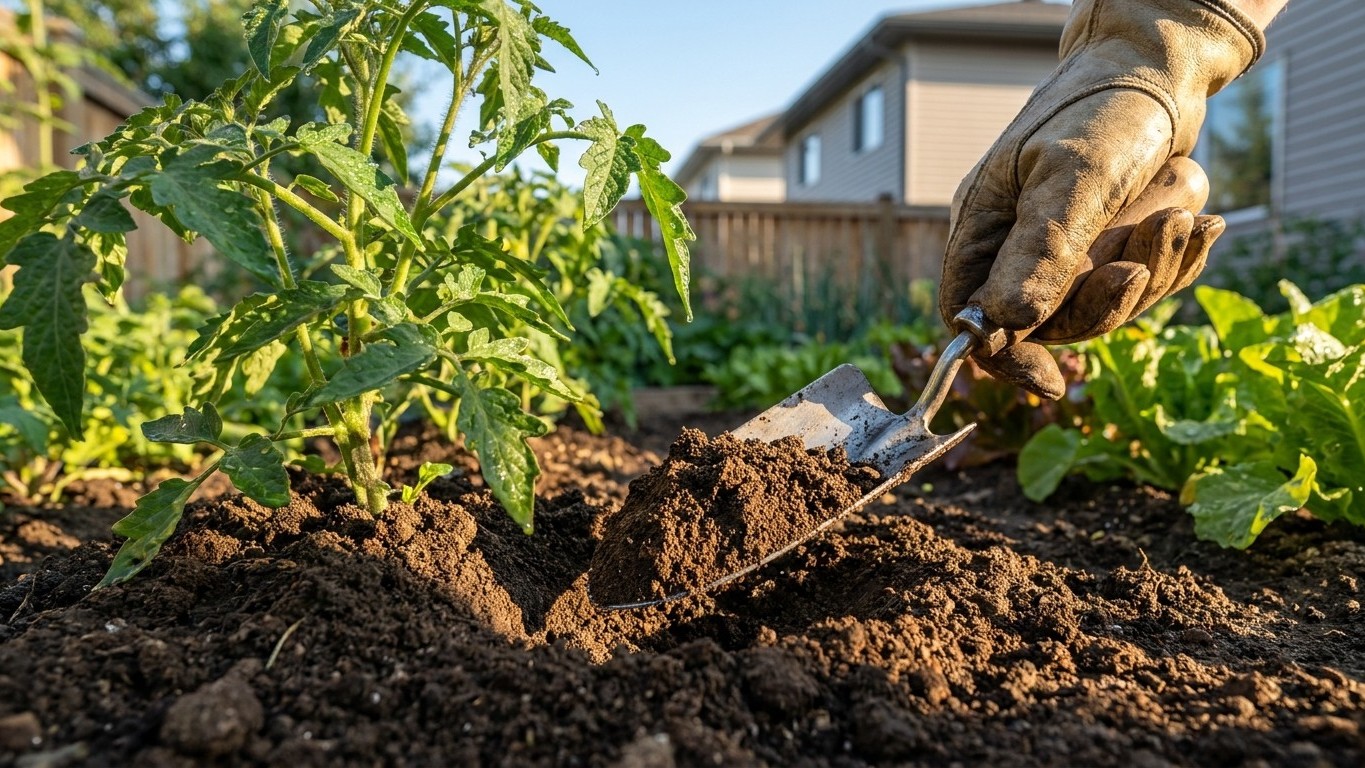
The way to know it’s time is simple: push a finger, or better, a garden trowel, about two inches into the soil near the base of the plant. If it comes out dry and crumbly at that depth, water. If it’s still cool and slightly damp, wait another day or two. Water in the morning, aimed at the base of the plant rather than over the leaves, so foliage has all day to dry and the soak doesn’t evaporate before it reaches the roots.
Matching the water to your soil
Sandy soil, common in parts of southern Alberta, drains fast and holds little. It calls for shorter, more frequent soakings, since a heavy dose just runs past the root zone into the subsoil. Heavy clay, more typical closer to Edmonton and through the Peace Country, holds a week’s worth of moisture in reserve, but it drowns roots if it’s watered again before it has actually dried out. Clay should never be watered, or worked with a spade or hoe, while it’s still wet. That’s a good rule to keep even outside the garden season. The same logic applies to pots and raised planters, though their smaller soil volume changes the timing; see this guide on Watering Pots and Containers in Alberta for specifics.
Alberta’s growing window is short and the summer heat, while real, isn’t extreme by North American standards. Calgary averages essentially zero days a year that reach 90°F, based on Environment and Climate Change Canada’s 1981-2010 climate normals. That means roots here aren’t baking under repeated heat spikes the way they might further south, so the deep-and-infrequent rule still holds without the need to water more often just because of heat stress. The bigger driver of your schedule is the calendar: with an average last spring frost around May 21 and an average first fall frost around September 16 at the Calgary International Airport station, the realistic outdoor watering season runs about four months. Those are averages, not guarantees. In roughly half of all years, frost arrives later than that spring date or earlier than that fall date, and a garden in a northern or upland district should expect to run a couple of weeks behind Calgary’s numbers on both ends.
A simple watering sequence
- Check soil moisture at 2 inches deep with a finger or trowel before turning on any hose or timer.
- If dry at that depth, apply roughly 1 to 1.5 inches of water for the week in one or two sessions rather than daily.
- Water slowly at the base of each plant, early in the morning, until moisture visibly reaches the root zone.
- On sandy soil, split that weekly total into three shorter waterings instead of one long one.
- On clay soil, wait for the surface to dry and loosen before the next soak, even if that means skipping a scheduled day.
Restrictions and rules
Watering restrictions show up in many Alberta municipalities during dry summers, and the specifics (which days you can water, what hours are allowed, whether hand-watering is exempt) change from year to year and from one water district to the next. Nothing about this page should be treated as a substitute for checking with your own municipality or irrigation district before you set a schedule or install a timer.
Where to check before you set a schedule
The Government of Alberta’s agriculture and irrigation resources are a reasonable starting point for provincial context on water use and irrigation practices, available at alberta.ca/agriculture-and-irrigation. For the actual rules that apply to your address, your city or town’s public works or utilities department will have the current bylaw, and that’s the only place a restriction should be confirmed.
Given how little rain falls during Alberta’s driest summer stretch in a typical year, it’s worth assuming restrictions are a real possibility rather than a rare event, and checking early rather than after a bylaw officer has already left a notice on the door. A garden planted around drought-tolerant species and grouped by water need will weather a restriction period far better than one that depends on watering every plant on the same daily schedule.
Using less
Cutting water use in an Alberta garden isn’t about watering less overall, it’s about losing less of what you already apply to evaporation, runoff, and thirsty spots that don’t need as much as the rest of the bed. A few specific changes do most of the work.
- Mulch, 2 to 3 inches deep: cuts surface evaporation dramatically and keeps soil temperature more even, which means longer stretches between soakings on both sandy and clay ground.
- Drip irrigation or soaker hoses: put water directly at the root zone instead of into the air or onto pathways, which typically means less total water for the same root-zone result compared to overhead sprinklers.
- Grouping plants by water need: keeps a thirsty vegetable bed from being watered on the same schedule as drought-tolerant perennials nearby, so nothing gets over- or under-watered just for convenience.
- Organic matter worked into the soil: compost improves how much water sandy soil can hold between waterings, and improves how freely clay soil drains so it doesn’t stay soggy at the root zone.
- Rain barrels, where local rules allow them: an inch of rain falling on 1,000 square feet of roof works out to roughly 600 gallons of runoff. Alberta’s wettest summer weeks can fill a barrel fast, but through the driest stretch of the season a barrel can sit empty for days at a time, so it’s a supplement to a hose, not a full replacement for one.
None of these changes require ripping out an existing garden bed. Mulch and drip lines can go in around plants that are already established, and the payoff, less water hauled, fewer missed waterings during a hot week, shows up within the same season.
Common questions
Is it legal to water my garden every day in Alberta?
It depends entirely on your municipality. Many Alberta water districts set restrictions during dry summers that limit watering to specific days or hours, and some exempt hand-watering or drip systems from the tightest rules. Check with your local water utility for the bylaw currently in effect.
When does the outdoor watering season actually start in Alberta?
The average last spring frost at Calgary International Airport is May 21, but that’s a midpoint, not a safe date. Frost falls later than that in roughly half of all years, and northern or upland areas of the province typically run weeks behind Calgary.
Do I need to water more because Alberta summers are hot?
Not as much as you might think. Calgary averages essentially no days a year at 90°F or above, based on the 1981-2010 climate normals, so extreme heat stress isn’t the main driver of watering frequency here the way it is in hotter regions. Soil type and rainfall matter more.
What’s the single best change for saving water in an Alberta garden?
Mulch. It’s the lowest-effort, lowest-cost change on the list, and it reduces evaporation enough to stretch the interval between deep soakings, regardless of whether your soil is sandy or clay.