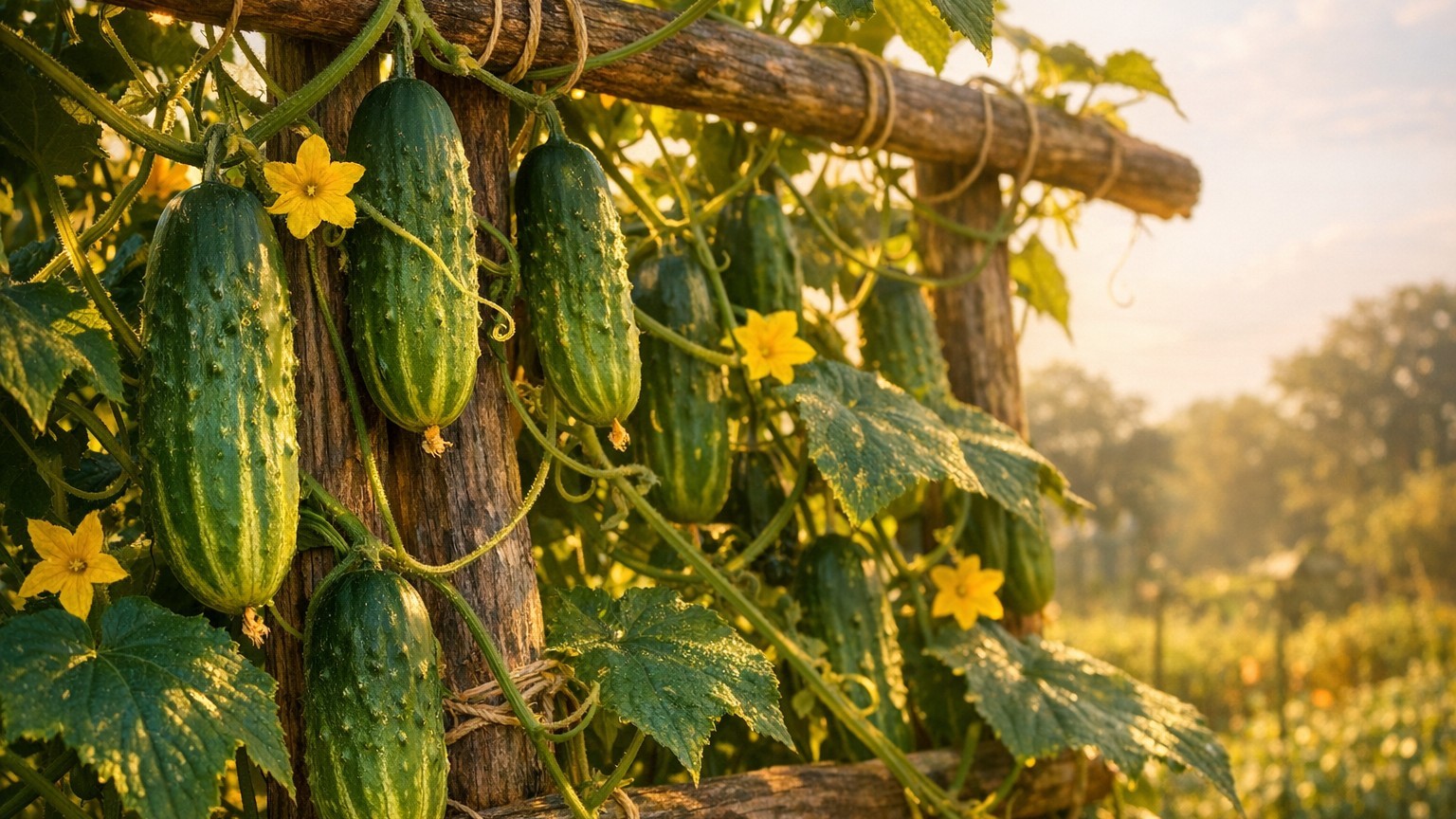

Arizona’s cucumber problem is not frost. It’s heat. With 168.9 days a year at or above 90°F, the state needs cucumber types that fruit fast, set without much help from pollinators, and finish before the thermometer shuts everything down. That points to parthenocarpic and burpless slicing types, fast pickling types, and bush habits for containers, all grown in tight spring and fall windows rather than through summer.
The short answer for Arizona
Start with what actually limits a cucumber crop in this state, because it isn’t what limits one almost anywhere else. At the reference station used for Arizona’s climate normals, spring freezes are rare enough to be a footnote: 32°F showed up in only 6 of the last 30 springs, and NOAA lists the frost-free season at 365 days. A gardener planning around a last-frost date here is solving the wrong problem. The real wall is summer heat, measured at 168.9 days a year of 90°F or hotter. Cucumber flowers stop setting fruit reliably once daytime highs sit in the upper 90s and nights won’t drop below the mid-70s, and low-desert Arizona hits that stretch for months, not weeks.
That single fact reshapes the variety decision. The types worth choosing are the ones that can complete their cycle inside a narrow window before the heat wall, or slip a second crop in after it breaks in fall.
Types that fit the window
- Parthenocarpic types: set fruit without pollination, which matters when extreme heat suppresses bee activity and pollen viability during the hottest weeks.
- Burpless slicing types: bred for lower bitterness and thinner skin, useful when heat stress otherwise makes fruit taste sharp and tough.
- Fast pickling types: bred to size up quickly, which is the whole point when the growing window is short.
- Bush habit types: compact vines that work in containers or raised beds, easier to move into afternoon shade or under 30 to 50 percent shade cloth once the heat load climbs.
Vining types are not ruled out. A trellis with afternoon shade can carry a vining cucumber through a hot stretch that would flatten an unsupported bush plant, and the extra air movement around trellised vines cuts down on the fungal pressure that shows up during monsoon humidity spikes. The trade-off is space and structure, which matters more in a small urban lot than in a larger county property.
None of this points to one named cultivar, because variety performance shifts by county elevation and by which strains the local extension office has actually trialed. Arizona Cooperative Extension is where that county-level answer lives.
What will not work here

Long-season types are the first casualty. Any cucumber that needs an extended stretch of mild days to bulk up runs straight into the heat wall before it finishes, because the workable spring window in low-desert Arizona closes fast once daytime highs climb past the mid-90s. A type bred for a cooler, longer Midwest or Pacific Northwest season simply doesn’t get the runway it needs here.
Watering on a weekly schedule
Weekly watering, standard advice in a lot of general gardening guides, fails against 168.9 days a year above 90°F. That heat load drives evaporation from both soil and leaf surface fast enough that a cucumber’s shallow root system can go from adequately moist to stressed in far less than seven days during peak summer. Fruit set drops off, and existing fruit turns bitter, well before the plant shows obvious wilt. This is a case where the calendar has to bend to the thermometer, not the other way around.
Dense, ground-level spacing during monsoon
Summer rainfall across June, July and August averages about 1.9 inches at the reference station, but that number hides a sharp split: June runs a nearly dry 0.02 inches, while July and August jump to 0.91 and 0.93 inches as monsoon storms move in. That pattern, long dry stretch followed by sudden, humid, storm-driven rain, is exactly the setup that triggers powdery mildew on cucumber leaves planted close together at ground level. Tight, sprawling spacing that might be fine in a drier, steadier climate becomes a mildew risk the moment monsoon humidity arrives. Wider spacing and trellising, which improve airflow around the leaves, matter more here than in a territory with steadier, lighter summer rain.
English or greenhouse-style types built around a cool, humid, controlled environment also struggle outdoors in this state. They weren’t bred for either the dry heat of the pre-monsoon stretch or the sudden humidity once the storms start.
What changes across Arizona
Arizona is not one growing climate, and the numbers make that obvious before a gardener even sets foot outside. The state’s USDA Plant Hardiness range runs from zone 4b to zone 10b, using the USDA Plant Hardiness Zone Map’s single measure: the average annual extreme minimum temperature. That is one of the widest hardiness spreads of any state in the country, and it means a variety recommendation built for one part of Arizona can be wrong for another part of the same state.
The low desert behaves like the description above: essentially frost-free, with a summer heat load so extreme that timing around fruit-set failure matters more than timing around freeze risk. High-elevation Arizona, including Flagstaff and the surrounding high country, is a different climate entirely. It does freeze hard, on a real seasonal schedule, and a cucumber grower there is working with an actual spring frost date and a shorter, cooler growing season, much closer to what a Northern grower deals with than to what a Phoenix-area grower deals with.
That range from 4b to 10b means there is no single planting date, no single variety type, and no single watering schedule that covers the whole state. A reader gardening at altitude should weight frost warnings more heavily and heat warnings less; a reader in the low desert should do the reverse. Neither extreme cancels the other out, and no single answer fits every individual garden. It can only say the spread exists and is unusually wide.
Where to check this for your own county
Arizona’s state-level picture is built from one reference station’s climate normals. That is useful for understanding the forces at work, heat load, monsoon timing, hardiness spread, but it is not a substitute for a county-level recommendation, and a county recommendation will beat it every time.
Arizona Cooperative Extension is the state’s land-grant extension service, and it is organized by county office, not by a single statewide calendar. That distinction matters for cucumbers specifically, because the gap between a Yuma County growing season and a Coconino County one is not small.
Two things are worth looking for once there:
- The local planting calendar, which will give actual spring and fall sowing windows tuned to that county’s elevation and monsoon timing, rather than the state-wide heat pattern described here.
- The varieties trialled in that county, since extension offices generally publish which cucumber types have actually performed well in local trial gardens, which is a more grounded source than any generic type-based recommendation.
A state-level page like this one can explain why heat matters more than frost in the low desert, or why the hardiness range is so wide. It can’t tell a reader in Pima County or Mohave County what the local office has already tested and confirmed. That’s the extension office’s job, and it’s worth treating as the next step rather than a formality.
Checking this against your own garden
Every figure is a normal, an average built from decades of data at one reference station. A reader’s own plot is a different question, and it usually answers itself faster than any calendar does.
Three things to watch, all checkable without any equipment:
- Soil warmth by feel. Cucumber seed germinates poorly in cold soil regardless of what the calendar says. If the soil feels cool to the touch a few inches down in the morning, especially in a shaded or north-facing bed, that spot is running behind the rest of the garden.
- The first flush of male flowers. Cucumbers typically open several male flowers before the first female flower appears, and a long gap with no female flowers at all often signals heat stress rather than a plant that’s simply slow. That gap tends to widen fast once daytime highs push into the 90s.
- The first true leaves. The seedling leaves look nothing like mature cucumber foliage; the first true leaves, with their rougher texture and more defined lobes, are the signal that the plant has moved past the fragile seedling stage and is ready for full sun exposure rather than partial shade.
None of that requires a thermometer or a soil probe. It requires walking the garden and looking closely, which, more than any state or even county calendar, is what actually tells a grower whether this is the year to push the planting window earlier, later, or right where the extension office says to put it.