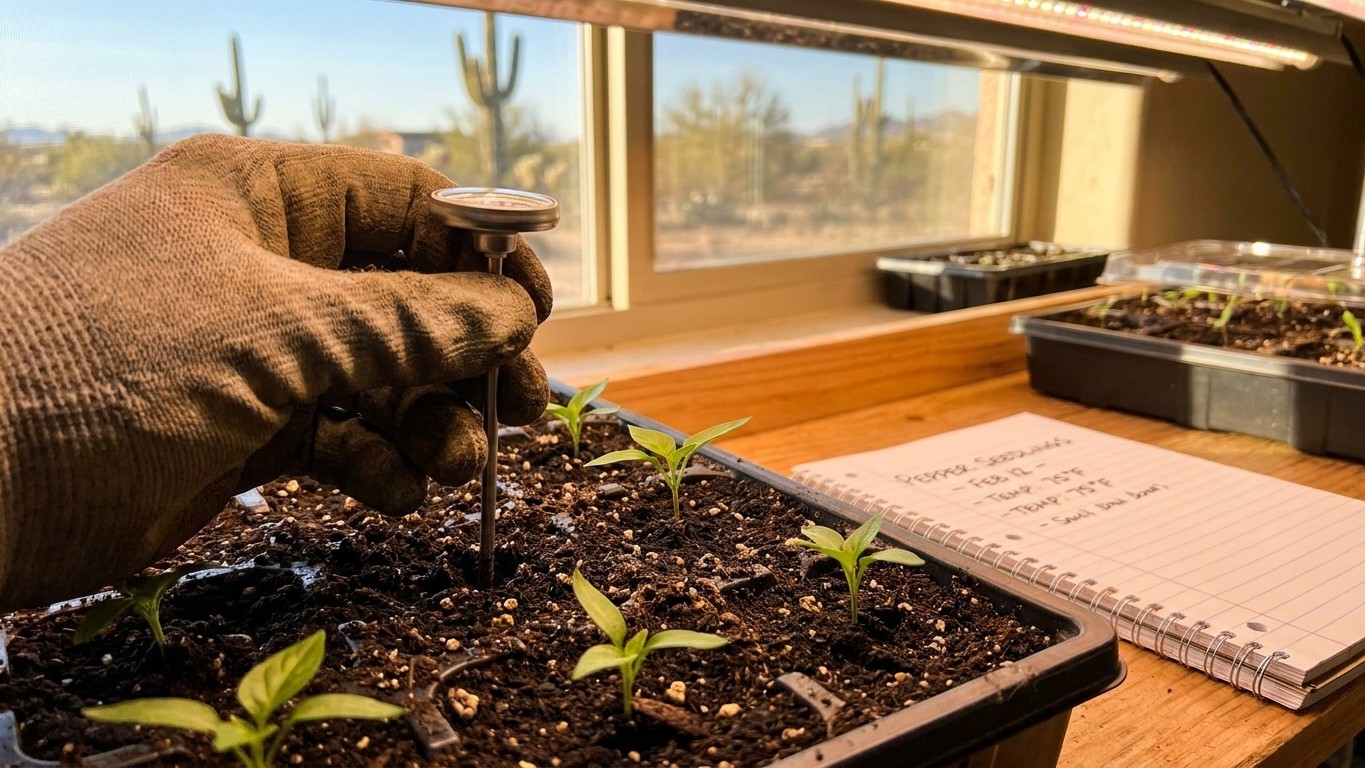

In Arizona’s low desert, soil crosses 60°F well before any lingering frost risk disappears, so the planting clock starts indoors 8 to 10 weeks ahead of that soil mark, not from a frost date on a calendar. Get the timing wrong and it’s heat, not cold, that shuts down fruit set by early summer. Start seed indoors in winter, then watch your own soil thermometer and nighttime lows before you transplant.
The short answer
Phoenix averages 168.9 days a year at or above 90°F, according to NOAA NCEI Climate Normals for 1991-2020 measured at the Phoenix reference station. That’s not a stretch of a few sweaty weeks. It’s more than five and a half months of the year sitting at or above a threshold that peppers treat as a stop sign. Pepper fruit set fails once daytime temperatures push past 90°F, and in this territory that isn’t a rare spike, it’s the baseline for a huge chunk of the growing calendar. Plants can survive the heat and keep growing leaves, but flowers drop instead of setting fruit, and a plant that isn’t setting fruit for months at a stretch is a plant that isn’t earning its space in the garden bed.
That’s one end of the failure window. The other end is just as real and gets ignored far more often: pepper fruit set also fails when nights drop below 55°F, according to Utah State University Extension. Cold nights slow pollen viability the same way scorching days do, just through a different mechanism. This is where a straightforward answer gets harder to give from a general resource like this one. This site tracks days at or above 90°F for Arizona because that number is measured, sourced, and consistent across the state’s low-desert stations. It does not track summer night minima, and nighttime lows vary block to block depending on elevation, urban heat, and how close you are to open desert versus a paved neighborhood.
That means the cool-end risk is one you have to watch yourself, not one this article can hand you as a fixed number. A backyard in a low-lying wash-adjacent lot can run several degrees cooler at night than one a mile away on a rocky bench. Don’t assume your nights based on how far south you live or what the coldest month typically looks like on a chart. Keep an outdoor thermometer running through your transplant window and check it at dawn, which is when the daily low actually lands. If you’re seeing sub-55°F mornings even as the calendar says spring is underway, hold your transplants a little longer or give them protection at night rather than trusting a generic date.
When to start seed here
Because frost isn’t the deciding factor in Arizona’s low desert (NOAA lists a 365-day frost-free season for the region, and the reference station reached 32°F in only 6 of 30 recorded springs, always as a rare late-December-to-mid-January cold snap rather than a spring event), the arithmetic that matters here runs backward from soil temperature and forward against the heat window, not from a frost date. Here’s how to build your own schedule using the same math a low-desert gardener would use, regardless of which county you’re in:
- Find your soil-warming point. Peppers need soil at 60°F before transplant, per Utah State University Extension. Track your own garden bed with a soil thermometer pushed 2 to 3 inches down, checked in the morning over several consecutive days, since a single warm afternoon reading will mislead you.
- Confirm the night floor is clearing 55°F. Soil warming up doesn’t guarantee your nights have cleared the 55°F threshold pepper flowers need to set fruit. Check your own overnight lows for at least a week before you commit transplants to the ground.
- Count backward 8 to 10 weeks from that transplant date. That’s your indoor seed-starting date. If your soil and nights both clear their thresholds in early spring, an 8 to 10 week countback lands your seed-starting date in the dead of winter, well before most gardeners think to touch a seed tray.
- Race the heat, not the calendar. With 168.9 days a year at or above 90°F waiting on the other side of spring, the practical goal is getting transplants established and flowering before that heat load arrives in force. A late transplant doesn’t just risk a slower start, it risks missing the fruit-set window entirely before summer heat closes it down for months.
- Reassess for a second window later in the year. Once summer’s heat load breaks and days at or above 90°F start tapering off, the same two thresholds (60°F soil, night lows above 55°F, days below 90°F) apply again in reverse. Watch your own conditions the same way rather than assuming a fixed date.
This sequence works whether you’re gardening in a Phoenix backyard or a Yuma plot with slightly different local numbers. The logic doesn’t change: soil temperature and your own nighttime lows set the transplant date, the heat count sets the deadline, and the 8 to 10 week indoor window connects the two.
What goes wrong here
- Blossom drop from a hot spell. A run of days at or above 90°F, which this territory logs 168.9 times a year on average, causes flowers to abort before they set fruit. There’s no fix for the heat itself once it arrives, but shade cloth over plants during the hottest stretch of the day can lower leaf and flower temperature enough to keep some fruit set going instead of losing the whole flush.
- Blossom drop from a cool night. The same failure shows up at the opposite end, whenever nights dip below 55°F, per Utah State University Extension. Since this site doesn’t carry summer night minima for any territory, the only reliable move is tracking your own overnight lows with a thermometer and holding transplants, or protecting already-planted seedlings with row cover on unexpectedly cool nights, rather than assuming your local nights based on general seasonal expectations.
- Sunscald on fruit and stems. Arizona’s sun intensity is strong enough that exposed fruit and bark can blister or develop pale, papery patches, especially on plants that lost leaf cover from heat stress or pruning. Keep foliage full rather than over-thinning, and consider light shade cloth during peak summer sun hours to protect both the plant’s canopy and the fruit underneath it.
- Blossom-end rot. This shows up as a sunken, leathery patch on the bottom of the fruit and is driven by inconsistent watering rather than a soil calcium shortage in most cases. In a climate running 168.9 days a year at or above 90°F, soil moisture swings fast between waterings, and that inconsistency is often the real trigger. Even, regular watering on a fixed schedule matters more here than it does in milder climates where soil holds moisture longer between rain events.
Common questions
Does Arizona’s low desert actually get a hard frost?
Rarely. NOAA lists the frost-free season for the reference station at 365 days, and the station only reached 32°F in 6 of 30 recorded springs, always as a rare cold snap between late December and mid-January rather than a spring event. Frost isn’t the factor that should drive your pepper planting calendar in this region; heat load is.
Can I just plant on a fixed calendar date instead of tracking soil and night temperatures?
You can, but you’ll be guessing at both ends of the fruit-set window. Soil temperature varies by yard and by year, and nighttime lows aren’t tracked on this site for any territory because they vary too much block to block. A thermometer in your own garden bed and a habit of checking dawn temperatures will serve you better than any fixed date.
What happens if I transplant too early, before soil hits 60°F?
Cold soil slows root development regardless of air temperature, and a stalled root system makes a plant more vulnerable once the heat arrives later. Wait for the soil itself to clear 60°F rather than transplanting based on air temperature or a calendar guess.
Is there a second planting window later in the year once summer heat breaks?
The same two thresholds apply again once the days at or above 90°F start tapering off, soil at 60°F and nights back above 55°F. Watch your own conditions the same way you did in spring rather than assuming a fixed date, since this site doesn’t publish a separate fall threshold for this territory.