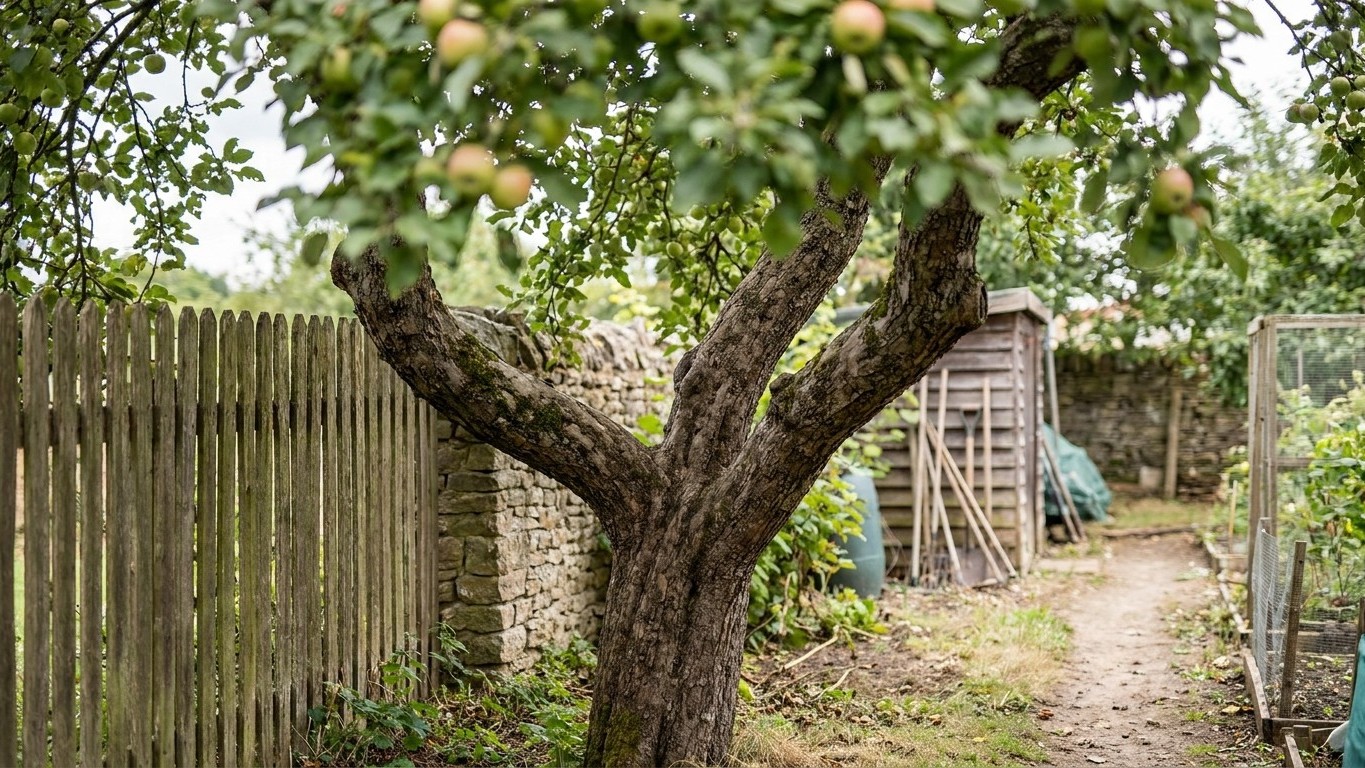

Arkansas apple harvest stretches from late July to mid-October, and the exact day depends on the variety hanging on your tree, not a fixed date on the calendar. Early selections come off within days of the first true summer heat breaking, while Arkansas Black and other late hangers wait for the season’s first cool nights. Storage life splits the same way: a few weeks for the earliest apples, four to six months for the dense, late-picked ones kept cold and humid.
When apples are ready to pick in Arkansas
Forget the month. The tree tells you when it’s ready through background color shifting from green to yellow or cream, seeds turning brown, and the fruit letting go with a gentle upward twist instead of a fight. Growers who wait for a specific week on the calendar often pick too early or too late, because the same variety can mature ten days apart depending on whether it’s growing in a warm bottomland or a cooler ridge.
That variation matters more in Arkansas than in flatter states, because the terrain itself splits into distinct growing conditions. The Ozark highlands in the northwest, around higher elevations near Fayetteville, run cooler at night than the Arkansas Delta lowlands to the east. Cooler nights slow fruit development but sharpen color and firmness, so an apple that’s ready in the Delta in early September might need another week or two up in the hills.
The frost window that frames the whole season
What sets the outer edges of the growing season, and therefore how much time a late variety has to finish ripening, is frost. NOAA’s 1991-2020 climate normals put the last spring freeze at 32°F between March 12 and March 28, and the first fall freeze at 32°F between November 7 and November 20, based on station USW00013963. That’s a growing season of roughly 225 to 250 days between frost risk on either end, plenty of room for both early apples that finish by late July and long-season varieties that hang until mid-October.
Winter survival is a separate question from bloom timing, and the two get confused constantly. The coldest month’s average daily minimum at Little Rock runs 30.9°F, according to NOAA NCEI Climate Normals for 1991-2020. That figure describes whether a tree survives the winter at all, and at that mild a minimum, standard apple varieties suited to USDA zone 7 have no trouble making it through. Whether a tree flowers well the following spring is a different filter entirely, tied to accumulated cold hours during dormancy rather than the coldest single month. Arkansas doesn’t publish a chill-hour figure for apple production through the sources checked for this page, so growers picking a variety for a specific county should confirm chill requirements with the University of Arkansas Division of Agriculture Cooperative Extension Service before planting.
Which ones keep, and which must be eaten
Not every apple is built to sit in a box until January. Storage life is a trait bred into the variety long before it ever reaches an Arkansas orchard, and it splits roughly into three tiers: apples meant to be eaten within days of picking, apples that hold a month or two under basic conditions, and apples dense enough to outlast the whole winter in a cold, humid space.
Arkansas Black deserves particular mention here, since it traces its origins to Benton County in the northwest part of the state during the 1800s. It’s about as dense and thick-skinned as an apple gets, which is exactly why it was prized before mechanical refrigeration existed: it simply held longer in a root cellar than the soft, early-season fruit growing alongside it.
| Variety type | Typical harvest timing | Storage life (well-kept, cold and humid) |
|---|---|---|
| Early summer apples (Lodi-type, early Gravenstein-type) | Late July to early August | 1 to 3 weeks |
| Gala, Honeycrisp | Late August to mid-September | 4 to 8 weeks |
| Golden Delicious, Jonathan/Jonagold | Mid to late September | 2 to 4 months |
| Granny Smith, Fuji | Late September to early October | 3 to 5 months |
| Arkansas Black | Early to mid-October | 4 to 6 months, often improving in flavor |
These figures describe the variety’s general storage behavior wherever it’s grown well, not a measurement specific to Arkansas orchards. No source checked for this page tracks Arkansas-specific storage-life testing, so treat the ranges above as a starting point and adjust based on how your own fruit is holding up week to week.
Storing them through a Arkansas winter
The ideal apple storage temperature sits between 32°F and 40°F, with humidity kept high enough that the fruit doesn’t shrivel. That’s the exact range where an unheated garage or shed becomes a gamble in much of Arkansas. With the coldest month’s average daily minimum at Little Rock running 30.9°F, an uninsulated outbuilding will spend plenty of nights right at the edge of that window, but daytime temperatures during warm spells can easily push well past 40°F, especially early and late in the storage season.
That gap matters more in the Delta lowlands, where daytime warmth lingers longer into fall and returns earlier in spring, than in the Ozark highlands, where cooler air holds more consistently. Growers in the highlands may get more natural days in the right range; growers in the Delta should plan on a root cellar with some insulation, or a dedicated refrigerator, rather than counting on an unheated space to hold steady.
Practical storage steps that actually help
- Store apples in a single layer or shallow crates so bruised fruit doesn’t spread rot to its neighbors
- Keep humidity high with a damp cloth or an open container of water nearby, since dry air shrivels skin fast
- Check the stash every one to two weeks and pull any apple showing soft spots before it spreads decay to the rest
- Keep apples away from potatoes and other ethylene-sensitive produce, since apples release a gas that speeds ripening in anything stored nearby
A basement corner that stays reliably cool through winter, even if it never drops to a perfect 32°F, will still outperform a warm kitchen pantry by months. The goal isn’t a lab-perfect number. It’s consistency.
What goes wrong here
Arkansas apple growers run into one recurring problem tied directly to the state’s mild winters: low-chill varieties break dormancy early and flower ahead of schedule, which sounds like an advantage until you remember the last spring freeze at 32°F can land as late as March 28, per NOAA NCEI records for station USW00013963. A tree in early bloom during that window can lose its entire crop to a single cold night. The trade-off isn’t avoidable, it’s a choice: pick a low-chill variety and accept the frost risk, or choose a moderate-chill, later-blooming variety and give up a few weeks of extra-early fruit. For most home growers in Arkansas, the later-blooming choice is the safer bet, since a lost bloom means a lost year, while a slightly later harvest is just a slightly later harvest.
Humidity brings its own trouble. Arkansas summers run warm and wet enough to favor fungal disease pressure on apple trees, particularly fire blight and cedar-apple rust, both of which spread fastest in the same warm, damp stretches that push fruit toward ripeness. Growers who skip a spring fungicide schedule in humid years often see it show up as scarred fruit at harvest, not as an obvious problem earlier in the season.
On the storage side, the most common failure is simple: fruit stored too warm turns mealy within weeks instead of holding for months, and fruit stored too wet without air movement molds from the inside of the crate outward. Both problems trace back to skipping the temperature and humidity check described above rather than any flaw in the apple itself. For variety recommendations suited to specific counties and current pest advisories, the University of Arkansas Division of Agriculture Cooperative Extension Service publishes regional guidance at uaex.uada.edu.
Common questions
What is the best month to pick apples in Arkansas?
There isn’t one best month for the whole state, since harvest timing depends on the variety, not the calendar. Early apples finish in late July, mid-season varieties come off through September, and late hangers like Arkansas Black wait until early to mid-October. Watch the fruit’s background color and seed color rather than a date.
Do apple trees survive Arkansas winters?
Yes, standard apple varieties have no trouble with Arkansas winters. The coldest month’s average daily minimum at Little Rock runs 30.9°F, according to NOAA NCEI Climate Normals for 1991-2020, well within the range apple trees tolerate. The bigger question for a given variety is whether it gets enough winter chill to flower well, which is a separate issue from surviving the cold.
How long do Arkansas-grown apples keep in storage?
It depends heavily on the variety. Early summer apples hold one to three weeks even under good conditions, while dense late-season varieties like Arkansas Black can keep four to six months in a cold, humid space. The apple’s own genetics decide most of that range; storage conditions decide the rest.
Which apple variety is native to Arkansas?
Arkansas Black traces its origins to Benton County in the northwest part of the state during the 1800s. It’s known for a thick, dark red skin and long storage life, and it remains one of the most commonly planted late-season varieties across the region today.