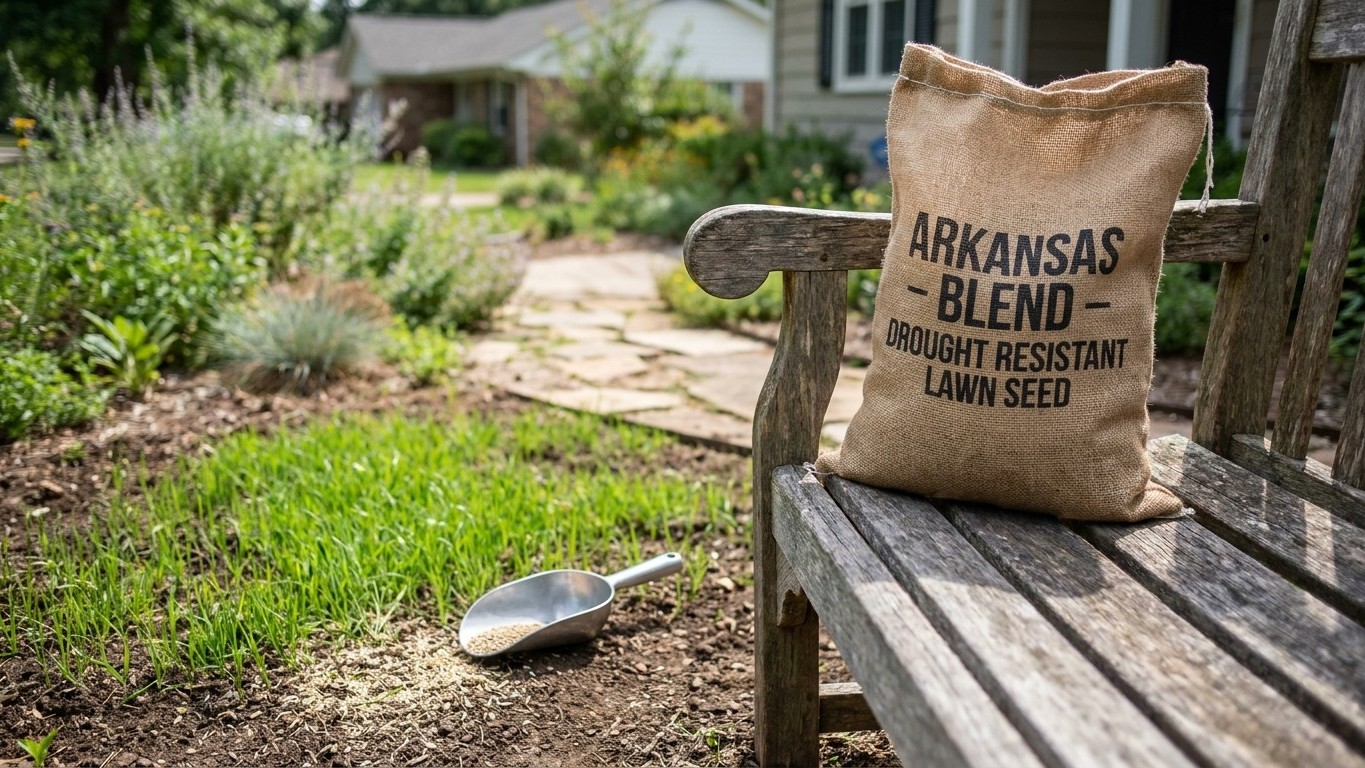

Arkansas lawns need a warm-season grass, full stop. Little Rock, the reference city NOAA and Clemson data use for the state, falls in the warm-season turf zone, and Clemson Cooperative Extension’s HGIC 1214 season-tolerance guide narrows the realistic choices to seven species: Bermudagrass, Zoysiagrass, Centipedegrass, St. Augustinegrass, Bahiagrass, Carpetgrass and Seashore Paspalum. Check your yard’s sun, traffic and water access against that list before you order a bag of seed, because those seven differ enormously in cost, patience required and where seed even exists as an option.
The short answer for Arkansas
St. Augustinegrass covers the shady corners of an Arkansas yard that nothing else here will touch — and yet you can’t buy it as seed, only sod or plugs. That one gap changes the whole decision. Of the seven warm-season grasses grown across the state, each answers to sun, traffic, and how much feeding and mowing you’re actually prepared to keep up, while Little Rock’s first fall freeze, landing sometime between November 7 and November 20, sets the deadline every choice has to work around.
Within the seven warm-season species Clemson lists, the right one depends on three things: how much sun the lawn actually gets, how much foot traffic it takes, and how much irrigation and fertilizer you’re willing to put into it every year. Bermudagrass wants full sun and tolerates heavy wear but needs mowing and feeding on a tight schedule. Centipedegrass wants the opposite: low fertility, infrequent mowing, and it sulks under regular lawn-care habits. St. Augustinegrass fills in shaded pockets nothing else here handles, but it has no commercial seed at all.
The other variable is timing. NOAA’s 1991-2020 climate normals put Little Rock’s first fall frost, the 32°F freeze with a 30 to 70 percent probability, between November 7 and November 20. That range marks when a warm-season lawn stops actively growing and any late-season seeding or fertilizing has run out of runway, whichever species you’ve chosen.
Working through the year

Rank these seven by what they cost you, not by which one wins outright, because the trade-offs are the whole decision on a warm-season seed page.
Bermudagrass

Common Bermudagrass is the easiest of the seven to actually buy as seed, and it establishes faster than anything else on this list once soil has warmed. The cost is upkeep: it wants full sun, tolerates almost no shade, and Clemson’s Bermudagrass Maintenance Calendar (HGIC 1216) runs a tighter mowing and feeding schedule through the growing season than the slower species below it.
Zoysiagrass

Zoysiagrass seed exists but germinates slowly, often taking a full season or more to fill in from seed rather than sod or plugs. The payoff is a dense, wear-tolerant, fine-textured lawn that needs less frequent mowing than Bermuda once established. Clemson’s Zoysiagrass Maintenance Calendar (HGIC 1217) reflects that patience with a lighter feeding schedule spread further apart.
Centipedegrass

Centipedegrass seed is available and cheap, and it asks for less fertilizer and less mowing than any other grass on this list. That low-input habit is also its main limitation: overfeed it and it declines, a problem well known enough that Clemson’s Centipedegrass Maintenance Calendar (HGIC 1215) keeps its nitrogen program deliberately sparse.
St. Augustinegrass

St. Augustinegrass has no viable seed for lawn establishment; it goes in as sod, plugs or sprigs, which raises the up-front cost considerably. What you get for that money is the best shade tolerance on the list, and Clemson’s St. Augustinegrass Maintenance Calendar (HGIC 1218) is built around that shaded-lawn reality.
Bahiagrass, Carpetgrass and Seashore Paspalum


Bahiagrass seed is cheap and tough, tolerant of poor soil, but coarse-textured and prone to tall, wiry seed stalks between mowings. Carpetgrass seed handles wet, poorly drained ground better than the others but has weak drought tolerance. Seashore Paspalum is mostly sold as sod or sprigs rather than seed, and its main selling point, salt tolerance, matters more on the coast than inland in Arkansas.
| Species | Seed availability | Shade tolerance | Drought tolerance | Wear tolerance |
|---|---|---|---|---|
| Bermudagrass | Common | Low | High | High |
| Zoysiagrass | Slow to establish | Medium | Medium-High | High |
| Centipedegrass | Common | Low-Medium | Medium | Low-Medium |
| St. Augustinegrass | None (sod/plugs only) | High | Medium | Medium |
| Bahiagrass | Common, cheap | Low | High | Medium |
| Carpetgrass | Available | Low-Medium | Low | Low |
| Seashore Paspalum | Mostly sod/sprigs | Low-Medium | High | Medium |
Whichever species you land on, the maintenance schedule that comes after planting matters as much as the seed choice. That’s the ground The Arkansas Lawn Care Calendar, Month by Month covers in more detail, month by month, once the grass is in the ground.
What changes across Arkansas
The Ozark Plateau and Boston Mountains in the northwest sit at meaningfully higher elevation than Little Rock, and higher ground generally sees frost earlier in fall and later in spring, which shortens the warm-season growing window even though the exact dates for that region aren’t in NOAA’s Little Rock data set.
The Arkansas Delta, the flat lowland running along the eastern edge of the state, tends to run warmer and more humid than Little Rock, conditions that favor St. Augustinegrass and Bermudagrass over the slower-growing Centipedegrass. Southern Arkansas, closer to the Louisiana border, likely has a longer frost-free stretch than Little Rock’s, which gives species like Seashore Paspalum and St. Augustinegrass a wider comfortable range there.
The more important line to watch is the boundary between the warm-season zone and the transition zone that sits north of it, where cool-season tall fescue can also persist alongside warm-season grasses.
The mistakes this climate punishes
Common errors and when they show up
- Feeding a warm-season lawn heading into fall. Nitrogen applied too close to dormancy pushes soft new growth that has no time to harden off before the first freeze; damage shows up as blackened, dead patches right after the first hard frost in the November 7 to November 20 window NOAA’s normals give for Little Rock.
- Seeding a cool-season grass in an Arkansas summer. Tall fescue or ryegrass seeded outside the transition zone thins visibly by July and is usually gone by August, once daytime heat outlasts the seedling’s tolerance.
- Mowing too short during a hot, dry stretch. Scalping a warm-season lawn in July or August strips the shade the crown needs to stay cool, and the damage shows as browning and thinning within one to two weeks, not immediately.
- Treating dormant brown as dead. Warm-season turf browns after frost and cool-season turf browns in summer drought; neither is dead, and ripping out a dormant lawn in November wastes a lawn that would have greened back up on its own.
Timing pre-emergent herbicide is its own trap. Apply it too early and it breaks down before weed seeds germinate; apply it too late and the weeds are already up. NWS Little Rock’s light-frost dates, April 3 in spring and October 31 in fall, are a rough seasonal marker for that window, not a soil-temperature trigger, and the maintenance calendar for your specific species, whether that’s Clemson’s HGIC 1216 for Bermudagrass or HGIC 1217 for Zoysiagrass, times it more precisely than a calendar date can.
Checking this against your county
Every figure above comes from a station near Little Rock, and county-level conditions elsewhere in Arkansas will differ enough to matter for seeding dates and species choice. The University of Arkansas System Division of Agriculture’s Cooperative Extension Service, at uaex.uada.edu, is the place to check local soil test recommendations and county-specific timing before you buy seed. A basic step most of that guidance assumes you’ve already handled is covered in Arkansas Lawn Care, worth a read if you haven’t dealt with soil prep or an existing lawn yet.
Common questions
Can I plant tall fescue seed in Arkansas?
Not reliably in most of the state. Little Rock’s warm-season zone means summer heat kills off cool-season grasses like tall fescue before they can persist, though the far northern highlands sit closer to the transition zone where it has a better shot.
Why is my Bermuda lawn brown in November?
That’s dormancy, not death. NOAA’s 1991-2020 normals put Little Rock’s first fall frost between November 7 and November 20, and Bermudagrass browns off after that freeze and greens back up on its own the following spring.
Can I grow St. Augustinegrass from a bag of seed?
No. St. Augustinegrass has no commercially viable seed for lawn use, so it has to go in as sod, plugs or sprigs, which costs more up front than seeding Bermuda or Centipede.
What’s the cheapest grass to seed in Arkansas?
Bahiagrass and common Bermudagrass are typically the least expensive seed to buy and the fastest to establish, but that low cost trades off against Bermuda’s high maintenance demands and Bahiagrass’s coarse texture and tall seed stalks.