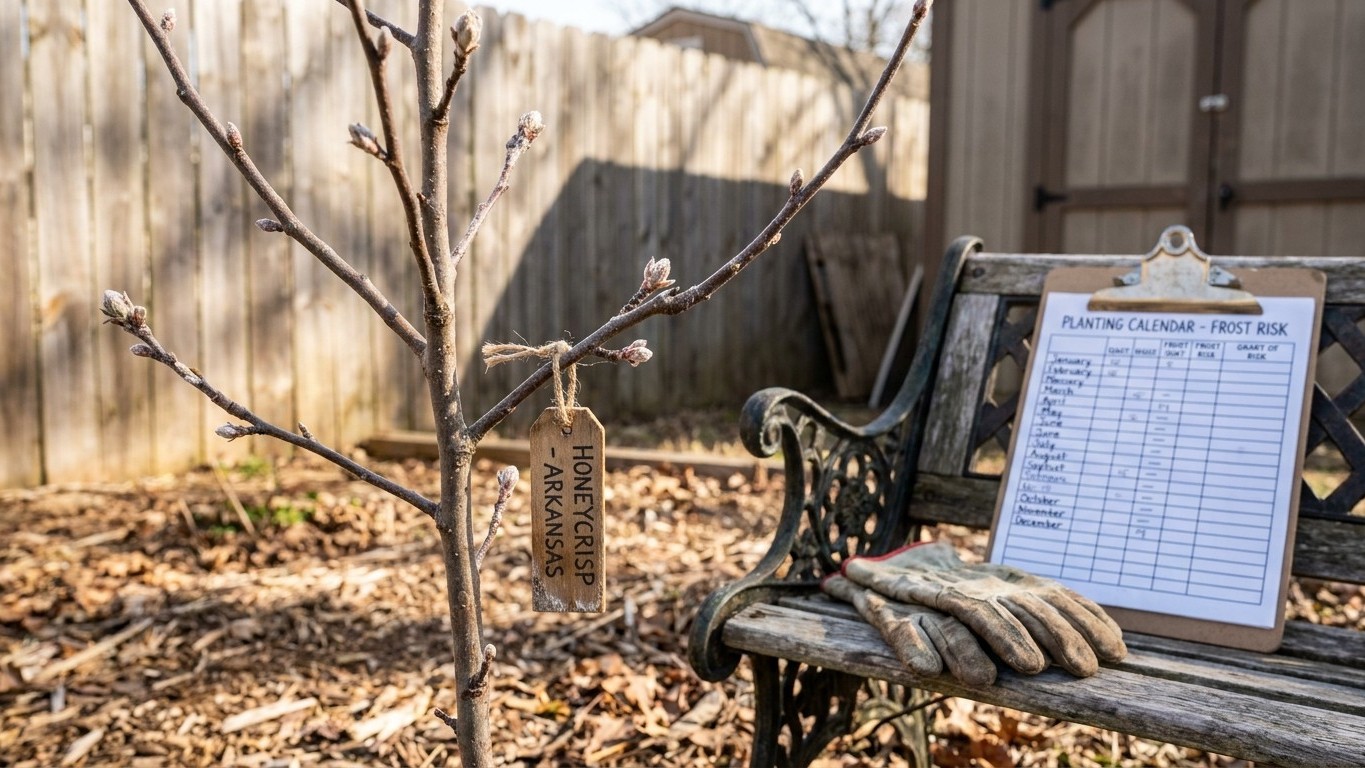

Elevation, not latitude, is what decides whether an apple tree thrives in Arkansas. The Ozark Plateau and Boston Mountains in the northwest sit high enough to deliver the kind of hard, even winter chill that sets flower buds properly for spring. Drop down into the Delta or the warmer south, and winters turn mild enough that a high-chill northern variety flowers thin and uneven instead of full. Zone numbers alone won’t tell you this — 6b to 8a covers the whole state — but where you sit inside that range decides which varieties are worth planting.
Can you grow apples in Arkansas
Yes, and the state’s own hardiness numbers back that up. The USDA’s 2023 Plant Hardiness Zone Map puts Arkansas at zones 6b to 8a, a range that covers almost every standard apple cultivar sold by mail-order nurseries. NOAA’s 1991-2020 climate normals, measured near Little Rock, put the average minimum temperature in the coldest month at 31.2°F. That figure is a mean, not a record low, but it tells you winter kill is not the obstacle it is farther north. Other parts of the state run colder or warmer than Little Rock, and that difference matters more than the zone number alone.
Elevation changes the picture more than latitude does
The Ozark Plateau and the Boston Mountains in the northwest sit at higher elevation than the Arkansas Delta in the east, and that elevation buys colder, more reliable winters. That is an advantage for apples, because a hard, even winter chill sets flower buds properly the following spring. The Delta and the warmer south of the state trend milder, and a mild winter is exactly where a high-chill northern variety can flower thin and uneven. If you are gardening in the Delta or the southern third of the state, lean toward the moderate end of the chill spectrum rather than the top.
None of this rules out apples anywhere in Arkansas. It means the choice of variety has to answer to your particular hillside, not to the state as a whole. A grower in the Ozarks and a grower outside Pine Bluff are working with different winters even though both fall inside the same USDA zone band, and the smart move is to treat the zone map as a starting filter, not the final answer — see this guide to Arkansas apple Best varieties for a closer look at what actually fits each region.
Which varieties suit this climate

Hardiness zone tells you whether a tree survives the winter. Winter chill, the number of cold hours a tree needs to break dormancy properly, tells you whether it flowers on schedule — and timing that flowering against the last frost is exactly what the Arkansas apple Calendar is built to help withe and sets a full crop. These are two separate filters, and a variety can pass one and fail the other. Arkansas’s mild-to-moderate winters, as reflected in Little Rock’s 31.2°F coldest-month minimum, put most of the state in the moderate-chill range rather than the high-chill range that suits the upper Midwest or the low-chill range bred for the Gulf Coast.
Cultivars worth ordering
Enterprise and Liberty are both scab-resistant, moderate-chill, mid-to-late blooming cultivars bred for exactly this kind of humid, disease-pressured summer. GoldRush is a late-season, scab-resistant apple that keeps well in storage and blooms late enough to dodge a lot of spring frost risk. Arkansas Black is a 19th-century heirloom that actually originated in the state, an old, hard, dark-skinned keeper apple with a late bloom. Yates is a smaller, older southern heirloom known for tolerating hot, humid summers better than many modern cultivars. Winesap, a longtime southern favorite, deserves a caution covered in the next section rather than here.
| Variety | Bloom timing | Chill need | Disease notes |
|---|---|---|---|
| Enterprise | Mid to late | Moderate | Scab-resistant |
| Liberty | Mid to late | Moderate | Scab-immune |
| GoldRush | Late | Moderate | Scab-resistant |
| Arkansas Black | Late | Moderate to high | Fairly tolerant, old heirloom |
| Yates | Late | Low to moderate | Good heat and humidity tolerance |
No state-issued list of recommended apple cultivars for Arkansas specifically exists, so treat the varieties above as catalog-documented options that fit the zone and chill profile, not as an official extension endorsement. That is a different problem than growers face at either climate extreme: a grower in Growing Apples in Minnesota: Varieties, Timing and Frost Risk needs long-chill, cold-hardy stock that would sit dormant too long here, while a grower following Growing Apples in Delaware: Varieties, Timing and Frost Risk is working a milder Mid-Atlantic chill calculus of its own.
Planting a pair that works here
Almost no apple variety sets a full crop on its own pollen. You need two trees that bloom in the same window, and at least one of them has to produce fertile pollen that the other can use. A workable pair for this climate is Enterprise and Liberty, both moderate-chill, both scab-resistant, and both blooming mid to late season so their flowering windows overlap reliably.
Watch for one trap specific to a popular southern apple. Winesap is a triploid, and triploid apples carry sterile pollen. A Winesap tree needs a nearby pollinizer to set its own fruit, but it cannot return the favor for anything planted next to it. If Winesap is on your list, plant it alongside two diploid varieties that bloom together, such as Enterprise and Liberty, rather than assuming any two apple trees will do the job for each other.
Late-blooming pairs carry an extra benefit in a climate where spring frost is a real risk, which the next section covers in detail. GoldRush and Arkansas Black both bloom late enough to overlap with each other and to dodge more of that risk than an early-blooming pair would.
The frost that costs a crop here

Spring frost is the real threat to an Arkansas apple crop, not winter cold. NOAA’s NCEI 1991-2020 climate normals, drawn from a station near Little Rock, put the 30-70% probability window for the last 32°F freeze at March 12 to March 28. That is a range, not a single date, and sites north or at higher elevation than Little Rock will run later than that window while warmer sites run earlier.
Why the tree survives and the crop doesn’t
A frost that arrives after flower buds reach the pink stage does not usually kill the tree. It kills the open or nearly open flowers, and a killed flower cannot become an apple. The tree leafs out fine that same spring and looks perfectly healthy all summer, while the crop for that year is simply gone. This is the trap that catches new growers: the tree shows no visible damage, so the failure gets blamed on pollination or a bad summer rather than on the frost night in March that actually did the damage.
There is not much you can do to protect an orchard-sized planting from a hard freeze once flowers are open, short of running frost cloth or a wind machine on a commercial scale. On a home planting, siting the tree away from low spots where cold air pools overnight helps, and so does delaying pruning cuts that would push bloom earlier. But the real, durable protection is variety choice. A late-blooming cultivar such as GoldRush or Arkansas Black reaches the pink and bloom stages later in spring, after more of that March 12 to March 28 frost risk near Little Rock has passed, which is the single biggest lever a home grower actually controls.
The apple year in Arkansas
Timing apple work by the calendar month is a mistake, because a warm or cool spring shifts every stage by a week or two. Read the stage on the tree itself, and anchor it against Little Rock’s own frost windows from NOAA’s NCEI normals.
- Dormancy: the tree is bare through winter. Prune during this stage, ideally toward the end of it rather than at the start, so a stray warm spell doesn’t push growth ahead of a later cold snap.
- Green tip: the first green shows at the buds, typically as the calendar closes in on the March 12 to March 28 last-frost window near Little Rock. This is the point to start watching short-range forecasts closely.
- Pink: buds swell and show color just before opening. Flowers at this stage are more frost-tolerant than fully open blooms, but still vulnerable.
- Bloom: flowers open fully. This is the stage most exposed to a late frost, and the stage that decides the year’s crop.
- Petal fall: petals drop and tiny fruitlets are visible. Frost risk has usually dropped sharply by this point in a normal year.
- Fruit set: fruitlets that survived pollination begin to size up through late spring and early summer. This is when thinning extra fruit pays off.
- Harvest: timing depends on the variety, from midsummer for the earliest apples to well into fall for keepers like GoldRush and Arkansas Black, all comfortably ahead of the November 7 to November 20 first-fall-frost window NOAA’s NCEI normals give for the Little Rock area.
Growers at higher elevation in the Ozarks should expect every one of these stages to run a bit later than a Little Rock timeline would suggest, while growers in the warmer Delta or southern counties should expect them to run earlier.
Local help
For a variety list actually tested under Arkansas conditions, and for current spray timing against apple scab and fire blight in the state’s humid summers, the University of Arkansas Cooperative Extension Service is the right first call. Extension offices also track local pest pressure county by county, which a national catalog description cannot do.
Common questions
Can apples grow in south Arkansas where winters barely get cold?
Yes, but lean toward the moderate-to-low end of the chill spectrum, such as Yates, rather than a high-chill northern cultivar, because a mild winter that never accumulates enough cold hours produces a thin, uneven bloom the following spring.
Do I really need two apple trees, or will one produce fruit alone?
Almost every standard apple variety needs cross-pollination from a genetically different tree blooming at the same time. A handful of cultivars are marketed as partially self-fertile, but even those set a heavier, more reliable crop with a compatible pollinizer nearby.
How many years before a new apple tree bears fruit?
A dwarf or semi-dwarf tree on nursery rootstock typically starts bearing a few years after planting, and a standard full-size tree takes longer. Exact timing depends on rootstock and how the tree was trained, so check the specific rootstock’s published bearing age at the nursery you order from.
What does fire blight look like on an apple tree here?
Look for shoot tips that blacken and curl over into a shepherd’s-crook shape, usually right after bloom in warm, wet weather. It spreads fast in humid springs, so cut out infected wood well below the visible damage and disinfect pruning tools between cuts, and confirm the diagnosis with your local extension office if you’re unsure.
My apple tree bloomed fine but set almost no fruit. What happened?
The most common cause is a frost that hit the open flowers without leaving any visible mark on the tree itself, the exact failure covered above, followed closely by a missing or poorly timed pollinizer. Check both before assuming a soil or nutrient problem.