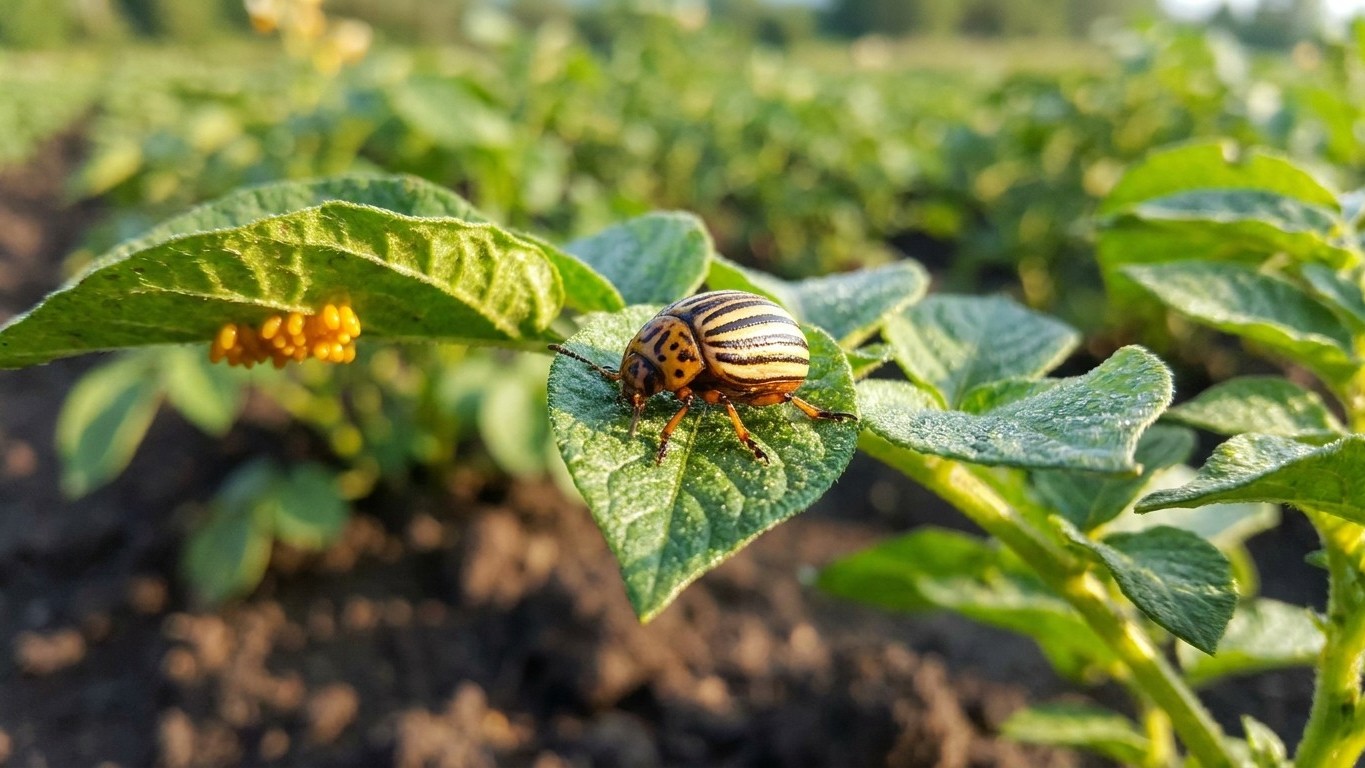

Arkansas gardeners growing potatoes deal with a short, defined list of pests: aphids, Japanese beetles, stink bugs, and whiteflies feed on foliage and can weaken a stand before tubers bulk up. Timing tracks the state’s frost-free window, and confusing insect damage with nutrient stress or disease wastes a growing season that is already tight.
Which pests attack potato in Arkansas

The University of Arkansas Division of Agriculture Cooperative Extension documents seven pests for this territory: aphids, Japanese beetles, scale insects, squash bugs (Anasa tristis), squash vine borer, stink bugs, and whiteflies. That is the full list for this territory, and it is short, not padded.
Not every name on that list has business in a potato patch. Scale insects settle on the bark and stems of woody ornamentals and fruit trees, feeding through a waxy shell fixed to a woody host; a potato plant has no woody tissue for them to colonize, so they simply do not show up there. Squash bugs and squash vine borer are cucurbit specialists, meaning their entire life cycle runs through squash, pumpkin, and cucumber vines. The vine borer’s larva tunnels inside a hollow cucurbit stem, something a potato stem does not offer, and the squash bug feeds and breeds almost exclusively on cucurbit foliage. Neither has a documented reason to touch a potato row.
That leaves four pests actually worth watching on potato: aphids, Japanese beetles, stink bugs, and whiteflies. Aphids cluster on the undersides of leaves and are the one to take most seriously, not because they strip much foliage, but because they carry potato virus Y and leafroll virus between plants while feeding. Japanese beetles are generalist chewers that skeletonize leaf tissue between the veins on a wide range of garden plants, potato included. Stink bugs pierce foliage and occasionally young stems with a needle-like mouthpart, and whiteflies feed the same way aphids do, in clusters on leaf undersides, scattering into the air when a plant is disturbed.
The decisive detail for anyone timing scouting trips is the region’s own frost pattern. NOAA NCEI’s 1991-2020 Climate Normals for station USW00013963 put the last spring freeze, at the 32°F threshold, somewhere between March 12 and March 28 in a given year. Potato foliage that emerges into that window is still vulnerable to cold, but it is also emerging right as these four pests start becoming active, which is why the calendar matters as much as the species list.
When each one shows up, and what it does first
Potato foliage that pushes through soil warmed past the last spring freeze is the trigger point for pest activity, not a specific month. Once soil temperature climbs past that freeze window (March 12 to March 28 at the reference station), foliage growth accelerates, and so does pest pressure. A gardener working from a calendar date instead of the plant’s own growth stage tends to scout too early or too late.
Aphids are usually the first arrivals, showing up on new, tender growth within the first few weeks after emergence. The earliest sign is rarely the insect itself but a shine on the upper leaf surface, sticky honeydew secreted by the aphids feeding underneath, sometimes followed by a black sooty mold growing on that residue. Leaves may start to curl or cup before any chewing damage appears anywhere on the plant.
Japanese beetles tend to arrive once the plant has built a full canopy, drawn to the mass of foliage rather than to the youngest leaves. Their first mark is a lace-like, skeletonized patch where the beetle has eaten the tissue between leaf veins and left the veins themselves intact, a pattern distinct enough that it rarely gets confused with anything else once a gardener knows to look for it.
Stink bugs show up a bit later in the season, often coinciding with flowering or early tuber set, and their damage starts as small, discolored puncture marks where the mouthpart pierced the leaf or stem tissue. Those spots can look almost bruised before they turn brown and papery.
Whiteflies follow a pattern close to aphids, appearing on the undersides of lower leaves first. The telltale early sign is a small cloud of tiny white insects lifting off the plant the moment a leaf is brushed or turned over, something aphids do not do since they stay put once settled.
Telling the damage apart from everything else
A potato plant showing stress can be reacting to an insect, a missing nutrient, a stretch of dry weather, a fungal or viral disease, or a garden tool that nicked a stem. Sorting those out matters, because treating a nutrient problem like an insect problem fixes nothing. The single most useful habit is checking the underside of a leaf before assuming anything about the top.
| What you see | Likely cause | What separates it |
|---|---|---|
| Lacy, skeletonized patches between leaf veins | Japanese beetle feeding | Veins left intact; beetles often visible on the plant during the day |
| Curled leaves, sticky shine, black sooty coating | Aphid feeding | Clusters of small soft-bodied insects on leaf undersides, honeydew residue |
| Small white insects lifting off when disturbed | Whitefly feeding | Insects fly briefly, then resettle, unlike stationary aphids |
| Small discolored puncture spots turning papery brown | Stink bug feeding | Isolated puncture marks rather than chewed tissue or a uniform pattern |
| Uniform yellowing across the row, no chewing marks | Nutrient deficiency | Even pattern across many plants, no insects present on close inspection |
| Wilting despite moist soil, leaf lesions with rings | Foliar disease | Concentric ring patterns on lesions, not torn or pierced tissue |
| Torn, bruised, or broken foliage in a random pattern | Mechanical or weather damage | Damage follows a storm or tool pass, not concentrated on new growth |
This table is a starting point, not a diagnosis. A county extension agent looking at the actual plant, with a sample in hand, will catch details a written description cannot.
What actually works here, and what is a waste of time
A short growing season punishes wasted time more than it punishes a missed spray. Scouting weekly, starting as soon as foliage emerges past the last freeze window, catches an aphid or beetle problem while a plant can still recover; waiting until damage is obvious usually means the window to act has already closed.
Physical barriers, floating row covers put in place right after emergence, keep flying pests like whiteflies and beetles off young plants during the weeks when foliage is most tender and most attractive to them. Covers need to come off before flowering if the crop depends on pollination, but potatoes do not, which makes row cover one of the more forgiving tools in this particular garden.
Hand-removal works surprisingly well against Japanese beetles on a small planting, since they are large, slow, and active in daylight, making them easy to knock into a bucket of soapy water. It does nothing for aphids or whiteflies, whose numbers build too fast for manual removal to keep pace.
What tends not to work is spraying on a fixed schedule regardless of what is actually present. Treating for aphids when the real problem is a nutrient gap wastes a trip and does not touch the actual issue. Any decision about a specific treatment, including whether one is even labeled for use on potatoes in Arkansas, belongs with the extension service rather than a general gardening guide, since product labels and state registrations change and only the extension service tracks what is currently approved.
Certified seed potatoes deserve a mention here too, even outside the pest conversation: uncertified seed can carry viruses that aphids then spread further through a planting, turning a seed-quality problem into a season-long pest problem.
Where to check this for your own county
State-level pest lists describe what has been documented across Arkansas, not what is necessarily present in one backyard. The county extension office is the next step, since pest pressure shifts noticeably even within a single state depending on local soil, moisture, and planting history.
The University of Arkansas Division of Agriculture Cooperative Extension maintains county offices across the state, and those offices are the right contact for anyone trying to confirm what is actually feeding on a specific planting rather than what shows up on a statewide list. An agent can look at a leaf sample, ask about recent weather, and rule out the nutrient or disease possibilities a written guide can only flag as options.
A pest documented for the state does not mean it will appear in every county, every season, or every garden. Soil type, nearby host plants, and even how close a garden sits to a wooded edge all shift which of these four pests actually turns up. The next useful step is not another search, but a call or visit to the local extension office with a leaf sample in hand.
Common questions
Do all four documented pests appear on potato every season in Arkansas?
Not necessarily. Documentation means the pest has been recorded on this crop in this territory, not that it appears in every garden every year. Local conditions decide which ones actually show up.
Can Japanese beetles cause serious yield loss on potato?
Their feeding is mostly cosmetic on a healthy, established plant, since they eat leaf tissue rather than tubers. A heavy, sustained infestation on a young plant is more concerning than scattered damage on a mature one.
Why do aphids matter more than the damage they cause would suggest?
Because they spread viruses between plants while feeding, not because of how much leaf tissue they remove. A light aphid presence can still introduce a virus problem that shows up later in reduced tuber quality.
Is a row cover enough on its own, or does it need to come off eventually?
A row cover placed right after emergence works well while foliage is young and most attractive to flying pests. Since potatoes do not need pollinators, the cover can generally stay on longer than it could on a flowering vegetable, but it should still be checked periodically for pests that got underneath before it was installed.