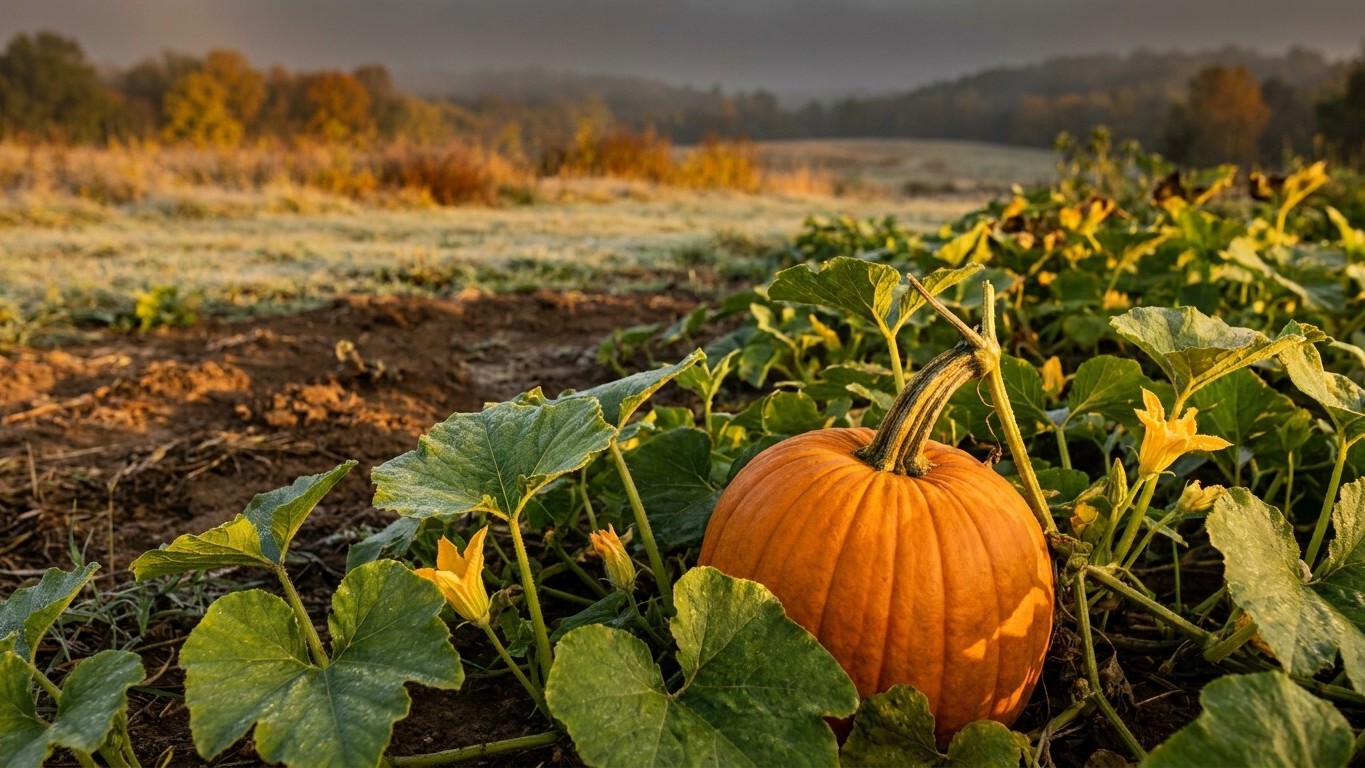

Yes, most of Arkansas gives pumpkins enough season to ripen before frost, but the deadline isn’t the seeding date; it’s the day the flower opens. For the full breakdown, see Will Pumpkins Ripen Before Frost in Arkansas? Arkansas’s first fall frost lands somewhere between November 7 and November 20, and a pumpkin needs 45 to 55 days after flowering to finish. Push that clock too far into fall and you get a green shell instead of an orange one. The margin exists, but it’s built on flowering dates, not the calendar you circled for seeding.
The short answer
Arkansas’s first freeze arrives somewhere in a two-week band, November 7 to November 20 across the state, based on NOAA’s 1991-2020 climate normals for station USW00013963. That window is the fixed end of the pumpkin clock. Everything else works backward from it.
Utah State University Extension puts pumpkin maturity at 45 to 55 days after flowering, not from the day the seed goes into the ground. That distinction matters more than almost anything else in pumpkin growing, because a plant can sit in the garden for months building vine before it ever sets a flower worth counting toward that clock.
Run the arithmetic against the earlier end of Arkansas’s frost window, November 7, since that’s the date that catches growers who assumed they had more time. Back up 55 days and you land on September 13. Back up 45 days and you land on September 23. That’s the safe range: a flower opening anywhere from September 13 to September 23 should have enough runway to finish coloring before the earliest frost risk arrives.
If frost holds off until the far end of the window, November 20, the math loosens. Fifty-five days back from November 20 is September 26; forty-five days back is October 6. A flower opening in early October could still ripen, but only if frost cooperates and stays on the late side of the range.
So the honest window for the last safe flowering date in Arkansas runs from about September 13, if you want to be covered against the earliest possible frost, out to roughly October 6, if you’re willing to bet on a later one. Split the difference and treat late September as the real cutoff for new blooms.
None of this is about when you plant. It’s about when the plant flowers, which depends on variety, weather, and how the season treats the vine along the way. A grower who seeds early but ends up with a stalled, stressed plant can still miss this window. A grower who seeds a bit later but pushes strong, steady growth can still make it. The frost date is fixed. The flowering date is the variable you’re actually managing.
When to sow here
Arkansas’s last spring frost falls between March 12 and March 28, per the same NOAA climate normals. That date tells you when the air stops threatening tender seedlings, but if you want the full breakdown of When to Sow Pumpkins in Arkansas, soil temperature is the piece that actually decides seeding day. It tells you nothing about the soil.
Utah State University Extension is specific that pumpkin seed wants soil at 65°F before it goes into the ground, and soil doesn’t warm on the same schedule as air. Ground holds onto cold longer than the atmosphere does, so a soil temperature of 65°F typically shows up weeks after the last frost date has already passed, not on it. Treating March 28 as the seeding date is one of the most common mistakes in Arkansas pumpkin patches; the ground simply isn’t ready yet.
Here’s how the sequence actually works, worked backward from the flowering window established above:
- Let the last-frost window close first. From March 12 to March 28, Arkansas’s air is still a wildcard for anything tender. Treat this window as the earliest possible starting line, not the actual one.
- Wait for the soil, not the calendar. Soil takes weeks longer than air to reach 65°F, so plan on seeding well into the stretch after that frost window closes, not immediately following it. A soil thermometer pushed a few inches into the bed beats guessing from the date printed on a seed packet.
- Use row covers to buy time if you’re impatient. Covering the bed traps enough daytime heat to functionally advance your sowing date by about two weeks, letting you get seed into ground that’s still a little short of 65°F without losing it to cold, wet soil.
- Seed once the soil holds at 65°F, whether that’s with or without covers, and note the actual date. This is your real starting point, not the frost date and not the day you bought the packet.
- Count forward from that seeding date through germination and vine growth to flowering, and check where flowering lands against the safe window worked out above, roughly September 13 through early October. If the arithmetic pushes flowering past that window, the planting date was simply too late for this season.
What goes wrong here
Arkansas’s season length is workable for pumpkins, but three failure patterns show up every year, and all three trace back to the same clock.
- A late flower that never colors. If new blooms keep opening into October, the fruit they set is racing a shortening window and often still shows green skin when frost arrives. The fix is to pinch off new flowers once you’re past the safe cutoff, roughly late September in most of Arkansas, so the plant stops investing in fruit that has no time to finish and puts its remaining energy into what’s already set.
- A fruit caught by frost before it’s done. Even fruit that set within the safe window can get nipped if frost lands on the early side of Arkansas’s November 7 to November 20 range. Utah State University Extension’s guidance is to harvest with the stem attached before frost hits; the source doesn’t publish a temperature or humidity target for ripening a pumpkin further off the vine, so once it’s cut, treat it as done rather than banking on it finishing indoors.
- A vine that dies back before the skin hardens. Pumpkin rind needs time on a living vine to cure into a durable shell, and a vine killed early by pests skips that step entirely, leaving fruit with thin, easily bruised skin. Squash bugs and cucumber beetles are the usual culprits behind an early vine collapse in Arkansas gardens; see this site’s squash bug page and cucumber beetle page for identification and control specific to this state.
All three failures share a fix: know your safe flowering window before the season starts, and treat everything after that date, a new bloom, a pest outbreak, a stalled vine, as something to manage against a fixed deadline rather than an open-ended growing season.
Checking this against your own county
Arkansas’s frost dates and the 45-to-55-day flowering clock give you a statewide baseline, but county-level conditions can shift both ends of the equation. Elevation, local frost pockets, and soil type all affect how quickly your particular garden bed warms in spring and how early frost actually settles in come fall, sometimes by more than the state-level window suggests.
The University of Arkansas Division of Agriculture Cooperative Extension Service tracks these local variations and can tell you how your county’s conditions compare to the statewide figures used here. Reach the extension service directly at uaex.uada.edu for county-specific planting guidance, soil testing services, and localized frost data that can tighten or loosen the safe flowering window calculated above.
If your county sits in a low-lying area prone to early cold pooling, treat the earlier end of the state’s frost window, and the earlier end of the safe flowering range, as the one to plan around.
Common questions
What happens if my flowers are still opening in early October?
Fruit set from an early-October flower sits on the far edge of the safe window worked out above, and only holds up if frost stays on the late side of Arkansas’s November 7 to November 20 range. Since frost timing isn’t fixed within that window, treat any flower opening after late September as a gamble rather than a plan.
Does removing leaves near the fruit speed up ripening?
Utah State University Extension’s guidance covers the flowering-to-harvest clock and the 65°F soil threshold, but it doesn’t publish figures on leaf removal or other mid-season techniques for speeding ripening. Absent that data, the safer approach is working within the flowering window already calculated rather than counting on a technique with no documented effect behind it.
Why does soil temperature matter more than the frost date for planting?
Because pumpkin seed germinates and grows based on soil warmth, not air temperature, and soil lags weeks behind the air after the last frost passes. Treating the frost date as the seeding date usually means putting seed into ground that hasn’t reached the 65°F threshold Utah State University Extension calls for, which risks poor germination or rot rather than a genuine head start.
Does variety choice change the 45-to-55-day window?
The 45-to-55-day range comes from Utah State University Extension covering pumpkins broadly, and specific varieties can run toward either end of it or slightly outside. Whatever variety you choose, count its maturity length from the day it flowers, not the day you seeded it, when checking it against Arkansas’s frost window.