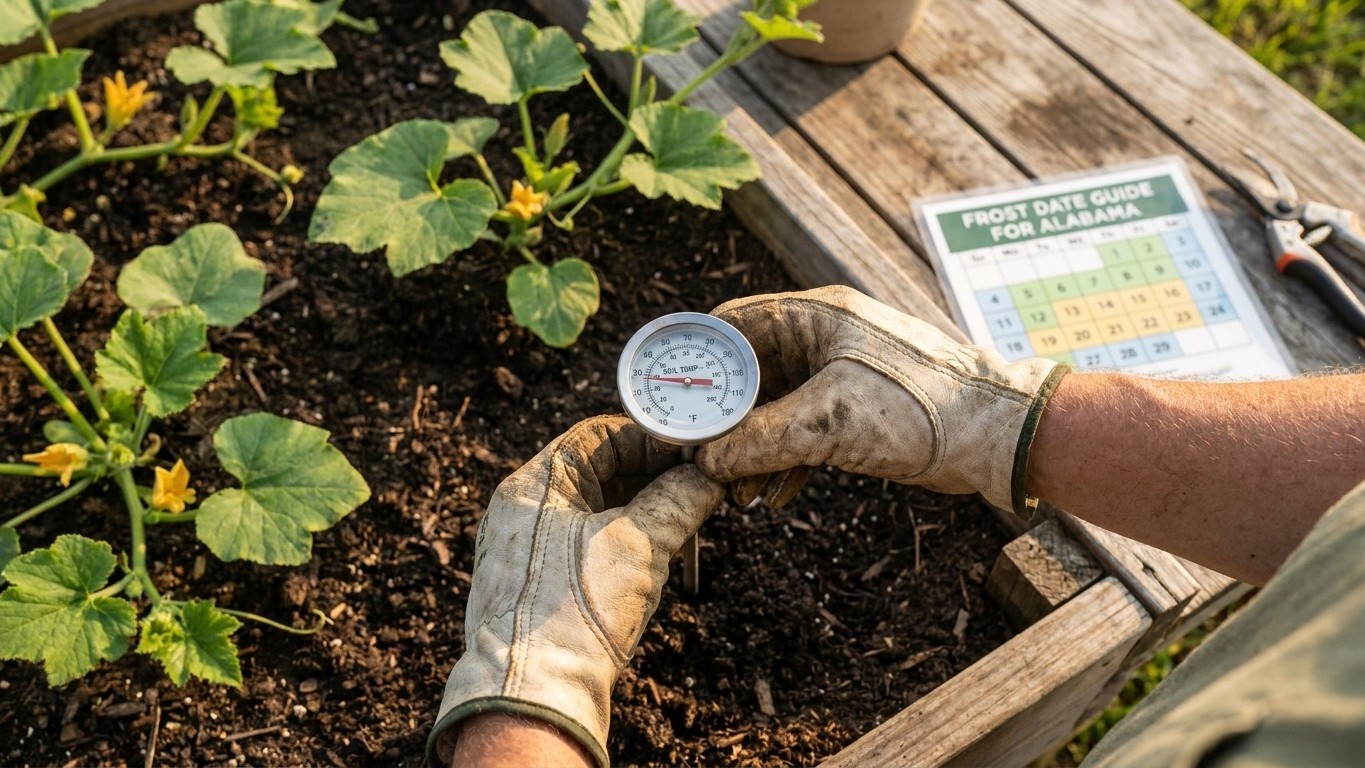

In Arkansas, sow pumpkin seeds once soil temperature reaches 65 F, which lands well after the last spring frost of March 12 to March 28. That usually puts sowing in early-to-mid April for most of the state. But the date that really controls a pumpkin harvest here isn’t the sowing date at all, it’s the day the first flower opens, because everything after that has to fit before the first fall frost arrives between November 7 and November 20.
The short answer
Start from the other end of the calendar. Arkansas’s first fall frost lands somewhere between November 7 and November 20, according to NOAA’s 1991-2020 Climate Normals for the state’s freeze probabilities. That’s the hard stop. Once temperatures drop into frost range, an unripe pumpkin on the vine is done, its skin stays soft, its color stays green or pale, and there’s no fixing it after the fact.
Pumpkins need 45 to 55 days after flowering to reach maturity, according to Utah State University Extension. That count starts the moment a female flower opens and gets pollinated, not when the seed goes into the ground and not when the vine first sprawls across the row. This distinction trips up a lot of gardeners, because a pumpkin patch can look lush and promising in August with plenty of blossoms, while the fruit those blossoms produce is mathematically too late to Ripen Before Frost.
Run the numbers backward from the earliest edge of the frost window, November 7, since that’s the safer assumption. Subtract 55 days and you land on September 13. Subtract 45 days and you land on September 23. That gives a flowering window of roughly September 13 to September 23, the last stretch in which a new blossom can open and still have enough warm days ahead of it to finish the job.
Any flower that opens after that window is racing a clock it probably won’t beat. The fruit might still swell and take shape, but the coloring, the rind hardening, the stem drying down, those late steps are the ones frost interrupts first. Growers aiming for full-size, deeply colored pumpkins for October decorating or pie work should treat late September as the practical deadline for new blooms, not a soft suggestion.
Because the frost window itself spans nearly two weeks (November 7 to November 20), and the maturation clock spans ten days (45 to 55), stacking those two ranges is what produces the flowering window above. It’s not one date. It’s a band, and gardeners closer to the northern part of the state, where frost tends to arrive earlier in that range, should lean toward the earlier edge of the flowering window rather than the later one.
When to sow here
- Track the last spring frost window first. NOAA’s Climate Normals put it at March 12 to March 28 for this station. That date tells you when the air stops freezing, nothing more.
- Wait for the soil, not the air, to warm. Soil six inches down doesn’t follow the thermometer the way the air does. It holds onto winter cold and releases it slowly, so a 65 F soil reading typically shows up several weeks after that last frost date has already passed, not the same week.
- Check soil temperature directly rather than guessing from the calendar. A simple soil thermometer pushed to planting depth in the morning gives a far more reliable answer than counting days off the frost date.
- Use row covers to buy roughly two weeks. Covering the bed traps daytime heat and can nudge soil into the 65 F range earlier than it would warm on its own, effectively moving the sowing date up by about two weeks for gardeners who want a head start.
- Land the sowing window in April. Between the last-frost range and the soil-lag behind it, most of Arkansas ends up sowing pumpkin seed sometime in early-to-mid April, with row covers allowing an earlier start for those who use them.
The arithmetic matters because sowing too early, before the soil catches up to that 65 F mark, doesn’t just slow germination. Cold, damp soil rots pumpkin seed outright before it ever sprouts. Patience at planting time is what protects the whole season that follows.
What goes wrong here
- A late flower that never colors. When blossoms keep opening into October, chasing a longer harvest, the fruit they set often runs out of warm days before the rind fully hardens and turns orange. Remedy: pinch off new blooms after the September flowering window closes so the plant channels its remaining energy into fruit already set, rather than starting new ones that can’t finish.
- A fruit caught by frost before it’s cut. A pumpkin sitting on the vine when the first frost of November 7 to November 20 arrives can suffer skin damage or soft spots even if it looked ready the week before. Remedy: harvest with the stem attached ahead of the forecast frost date rather than waiting for a “perfect” look, and move fruit to a spot where it won’t freeze.
- A vine that dies back before the skin hardens. Powdery mildew, drought stress, or an early cold snap can collapse the foliage weeks before the fruit is fully cured. Remedy: keep vines watered through late summer and watch for stress signs early, since a vine that fails prematurely cuts the maturation clock short no matter what the calendar says.
- Insect pressure stalling the plant during its critical weeks. Squash bugs and cucumber beetles can weaken vines right when fruit needs the most support to finish sizing and coloring. For identification and control specific to this state, see this site’s pages on squash bugs in Arkansas and cucumber beetles in Arkansas.
Common questions
Can I still sow pumpkins in July in Arkansas?
A July sowing puts flowering well past the September 13 to September 23 window this state’s frost dates allow, so fruit set that late has little margin to reach maturity before the first fall frost between November 7 and November 20. Early-to-mid April sowing gives the plant enough runway to flower on schedule.
Does soil temperature or the last frost date decide when to sow?
Soil temperature decides it. The last spring frost (March 12 to March 28) marks when the air stops freezing, but the soil at planting depth takes weeks longer to climb to the 65 F mark pumpkins need, according to Utah State University Extension. Sowing right at the frost date, before the soil catches up, risks seed rot rather than germination.
How do I know if my pumpkin varieties differ in their sowing window?
Nine or so named pumpkin varieties are commonly grown across the country, but no published days-to-maturity, size, or color figures accompany that list here. Treat variety names as names only, and rely on the flowering-to-frost arithmetic above rather than a specific variety’s marketing description to time your sowing.
What’s the safest way to store harvested pumpkins?
Utah State University Extension’s guidance only specifies keeping harvested pumpkins somewhere they will not freeze, with no published storage temperature, humidity level, or keeping-time figure attached. Beyond frost protection, no further storage specifics are available from this source.