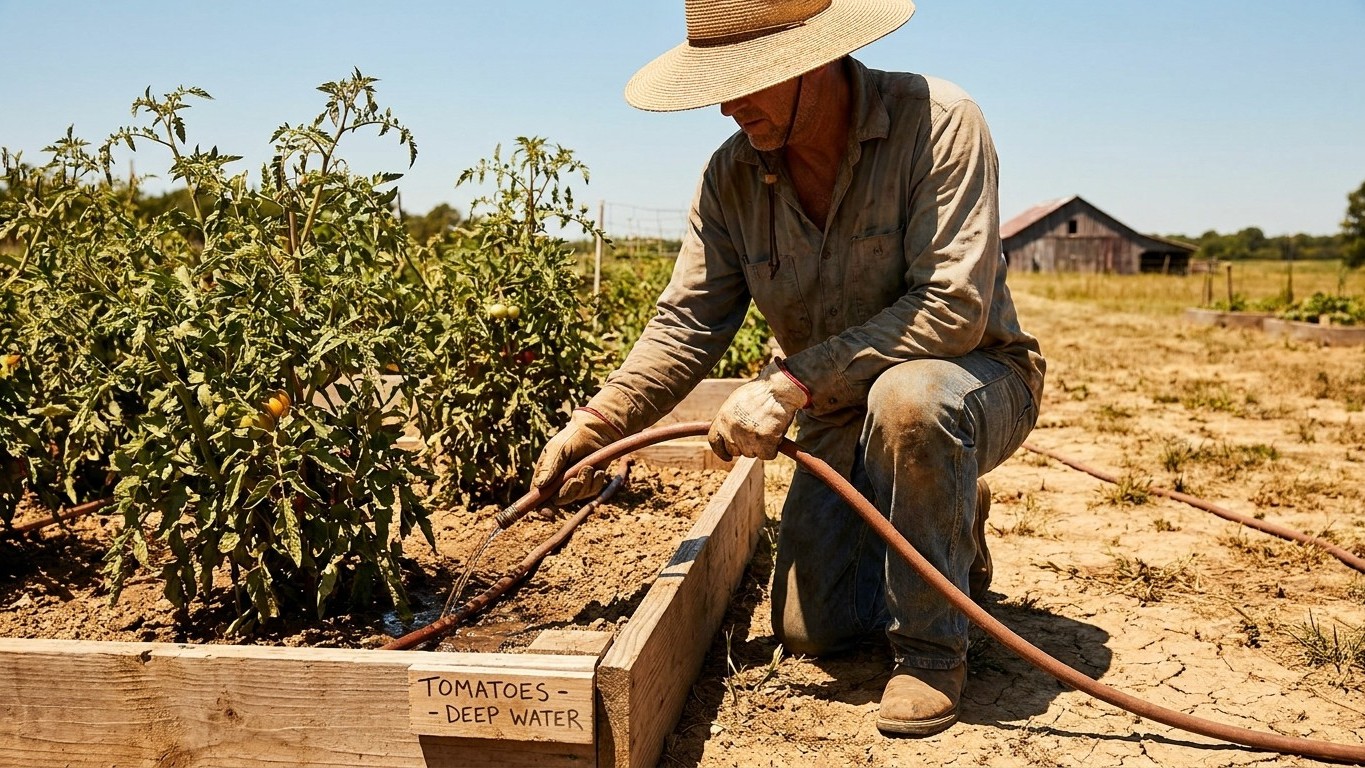

Arkansas summers throw two things at a garden: punishing heat and rain that shows up in bursts rather than steady soaks. The short answer: water deeply, about an inch a week, delivered in one or two sessions rather than daily sprinkles, and check your local water utility before you set a timer, because rules shift with drought conditions. The details below explain why, and how to read your own soil.
What the climate asks of you

Little Rock’s climate record puts the number plainly: 69.2 days a year reach 90F or hotter, according to NOAA’s 1991-2020 Climate Normals for that reference station. That is nearly ten weeks of heat stress stacked on top of each other, and it is the figure that rules out cool-season grasses and shallow-rooted plantings across most of the state. A garden bed doesn’t care what season it is technically in. It cares whether the sun is cooking the top two inches of soil into dust by 10 a.m., and for over two months of the year in Arkansas, it usually is.
Rain during those hot months rarely arrives the way a gardener would design it. Summer precipitation here tends to come from thunderstorms, meaning a soaking downpour one afternoon can be followed by a dry stretch of a week or more with nothing at all. A garden bed wants roughly an inch of water spread evenly across seven days. When that inch instead falls in twenty minutes and runs off a compacted bed before it soaks in, the sky’s average doesn’t translate into what the roots actually get. That gap is what the gardener ends up carrying with a hose or a drip line, and it’s exactly the situation covered in Watering Through a Dry Spell in Arkansas.
Soil texture changes how far that gap goes. In the Delta lowlands of eastern Arkansas, heavy clay holds onto moisture for days, which sounds like an advantage until a storm hits ground that’s already saturated and the roots start to suffocate. In the Ozark and Ouachita highlands, thinner, rockier soil drains fast, so the same storm that keeps a Delta garden wet for a week might leave a hillside bed dry again within two or three days. Neither soil type gets a pass from the 69.2-day heat number. It just changes how often the gardener has to step in between storms.
How much, how often
Deep and infrequent watering beats a daily sprinkle every time, because shallow watering trains roots to stay near the surface where the sun bakes them fastest. A quick daily splash wets the top half inch of soil and evaporates by noon, doing almost nothing for a plant whose roots run six or eight inches down. The fix isn’t more water more often. It’s more water, less often, so the moisture has time to travel downward and pull roots with it.
The simplest gauge doesn’t need a gadget. Push a finger, or better, a trowel, two inches into the soil near the base of a plant. If it’s dry at that depth, it’s time to water, whether that’s from a hose, a drip line, or Watering Pots and Containers in Arkansas. If it’s still damp, wait. This test matters more in Arkansas than in a milder state, because with 69.2 days of 90-degree heat, the surface can look and feel dry within hours of a soaking while the root zone underneath is still holding moisture just fine. Trust the two-inch test over the appearance of the topsoil.
A watering sequence for Arkansas beds
- Check soil moisture two inches down with a finger or trowel before touching a hose, every time, not just once a week on a fixed schedule.
- Water at the base of the plant, not overhead, since wet leaves in Arkansas humidity invite fungal problems on top of wasting water to evaporation.
- Water in the early morning, before the heat of the day arrives, so moisture soaks in rather than flashing off the surface.
- On sandy or rocky Ozark and Ouachita ground, plan on shorter, more frequent soakings, since this soil holds little water at any one time.
- On Delta clay, give one deep soaking and then leave it alone until the two-inch test says otherwise; watering or working clay that’s still wet compacts it and can drown roots.
- During the driest stretches of summer, when storm-driven rain skips a garden for a week or more, treat the bed as being on irrigation, not on rainfall, and water accordingly rather than waiting for a storm that may not come.
Restrictions and rules
Watering restrictions are common across the country and they change with drought conditions, local reservoir levels, and even which water utility serves a particular town, so no single blanket rule applies statewide in Arkansas. Some systems ask customers to water on alternating days, others restrict watering to early morning or evening hours during dry spells, and enforcement and specifics vary by provider. Rather than guess at a rule that might not apply to a specific address, the reliable move is to check directly with the local water utility or municipal water department before setting an automatic timer or installing a new irrigation system.
Because Arkansas summer rain tends to arrive in uneven bursts rather than steady totals, dry spells between storms are exactly when local systems are most likely to issue temporary watering limits. A garden that looks fine after a big thunderstorm can be sitting in a district under restriction two weeks later once that storm’s moisture is gone and no more has followed. Arkansas gardeners can also check with the state’s Cooperative Extension Service, available at uaex.uada.edu, for county-specific guidance on watering practices and current local conditions.
Using less
Cutting water use in an Arkansas garden isn’t about watering less than the plants need. It’s about making sure less of what’s applied gets wasted to evaporation, runoff, or overspray. A few techniques do most of the work here, and they’re worth treating as separate tools rather than one blurred routine.
- Mulch: a two to three inch layer over the root zone slows evaporation dramatically, which matters most during the stretches when 90-degree heat is baking bare soil dry within a single afternoon.
- Drip irrigation or soaker hoses: water goes straight to the root zone instead of spraying into the air or onto leaves, cutting the amount lost to evaporation and wind drift compared with overhead sprinklers.
- Grouping plants by water need: putting thirsty vegetables together and drought-tolerant natives together means neither group gets over- or under-watered just because they share a zone with mismatched needs.
- Organic matter in the soil: compost worked into sandy Ozark or Ouachita soil helps it hold water longer between soakings, while the same compost worked into Delta clay improves drainage so roots don’t sit waterlogged.
- Rain barrels, where local rules allow them: an inch of rain falling on a thousand square feet of roof yields roughly 600 gallons of runoff. During a storm-driven summer downpour, a barrel can fill fast, but given how unevenly Arkansas summer rain arrives, that same barrel can sit empty for a week or more once the dry stretch that follows a storm sets in, right when 90-degree heat is pushing garden demand the highest.
Common questions
What USDA hardiness zone is Arkansas in?
Arkansas spans USDA zones 6b through 8a according to the 2023 Plant Hardiness Zone Map, which is a statewide range rather than a single number. Little Rock is often used as the reference point for dated planting recommendations, but gardeners in the far north of the state or in the higher Ozark elevations should expect conditions closer to the cooler end of that range, and should confirm their specific zone rather than assuming the reference city’s figure applies directly.
When is the last frost date in Arkansas?
At the 32F freeze threshold, NOAA’s 1991-2020 Climate Normals put the last spring frost window between March 12 and March 28 for the reference station near Little Rock, with first fall frost falling between November 7 and November 20. For tender plants, though, the more useful figures come from the lighter 36F threshold, where NWS Little Rock gives April 3 as the safer spring planting date and October 31 as the fall cutoff. Tender seedlings should go by the 36F dates, not the 32F ones.
Is it legal to collect rainwater in a barrel in Arkansas?
Rain barrel legality and any restrictions on their use are set at the local level and can vary by city or water utility, so there’s no single statewide answer that applies everywhere. Anyone planning to install one should check with their municipal water provider or the Cooperative Extension Service for guidance specific to their county before setting one up.
What time of day should I water my garden in Arkansas heat?
Early morning, before the heat of the day sets in. With 69.2 days a year reaching 90F or higher, watering during the peak afternoon heat means much of what’s applied evaporates before it ever reaches the root zone, and evening watering can leave leaves damp overnight in Arkansas’s humidity, which invites fungal disease. Morning watering at the base of the plant avoids both problems.