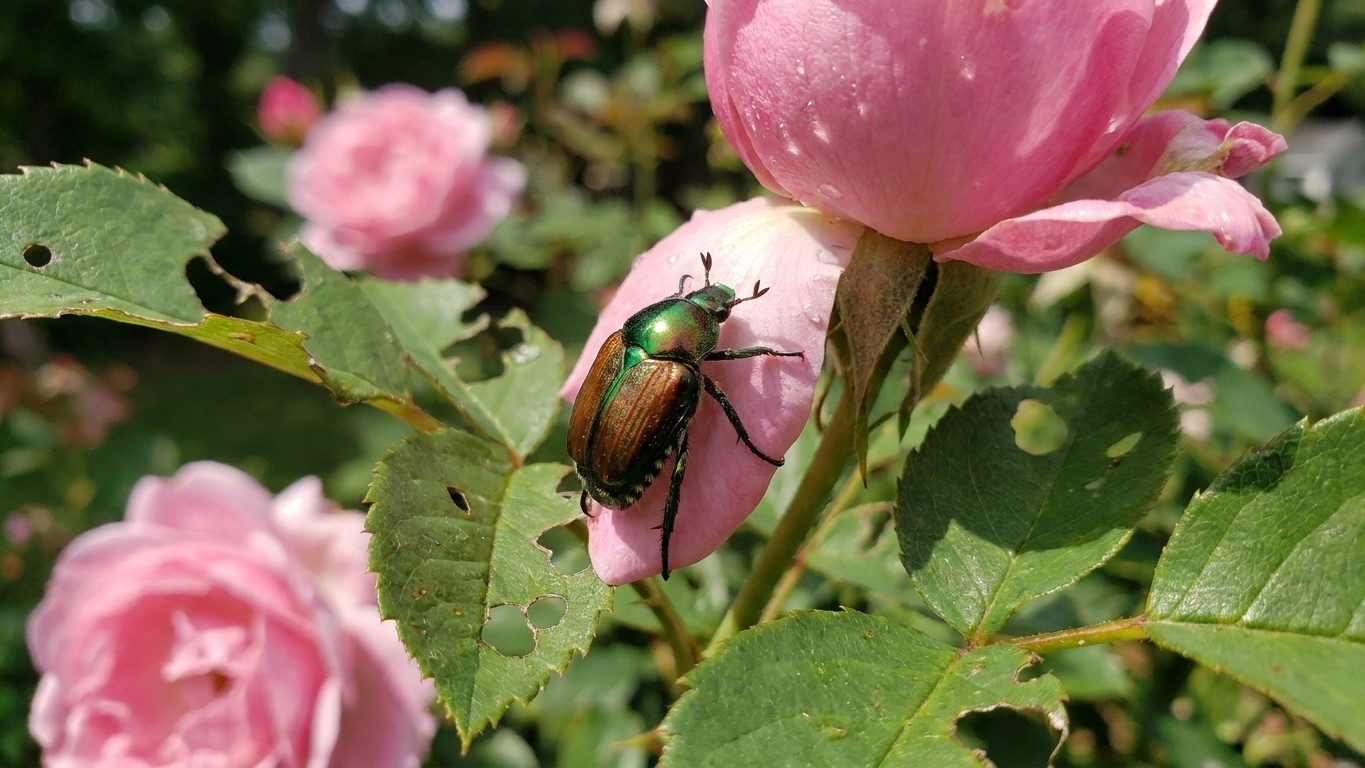

Japanese beetles show up in Arkansas gardens from June through August, with feeding pressure building as roses, grapes, and beans push out tender summer growth. Adults chew lace-like holes through leaves while their grubs work quietly underground on turf roots. Knowing that window, and what actually interrupts the insect’s life cycle, separates a few chewed leaves from a rose bush stripped bare by mid-July.
The weeks to watch

The University of Arkansas Division of Agriculture Cooperative Extension names June through August as peak season for Japanese beetle activity in the state, part of a broader summer pest calendar that also tracks squash vine borer and squash bugs. That window isn’t arbitrary. Adult beetles emerge from the soil once temperatures warm enough to trigger pupation, then spend roughly four to six weeks feeding and mating before laying eggs back into turf and garden soil.
Adults: June through August
This is the stage a gardener actually sees. Beetles cluster on foliage in groups, often starting at the top of a plant and working down, which is why upper leaves on roses and grapevines get hit first. Feeding is heaviest on warm, sunny afternoons and tapers off by evening.
Grubs: active before and after the flight
The extension’s seasonal note doesn’t publish a specific grub-activity date range for Arkansas, so the general pattern applies here: grubs feed near the soil surface in cooler weather on either side of the adult flight, then move deeper when soil temperatures turn extreme. That’s the stage responsible for brown, spongy patches in lawns, and it operates on a completely different schedule than the leaf-chewing adults above ground.
Reading the calendar from your last frost

Japanese beetles don’t check a calendar. They respond to soil warmth, which means an early or late spring shifts their emergence earlier or later than any fixed date. For Arkansas, NOAA’s 1991-2020 climate normals put the last spring frost between March 12 and March 28, based on the 30 to 70 percent freeze-probability band at station USW00013963. That range, not a single day, is what a gardener actually has to work with.
Running the numbers from that frost date to the extension’s June-through-August peak gives a rough planning window, not a promise:
- Start from the last frost range: March 12 to March 28.
- Count forward to the start of peak beetle activity in June: that’s roughly nine to fourteen weeks, depending on where in the frost range a given spring falls.
Practically, that means row covers or other protective measures need to go on well before Memorial Day if a spring runs early, and can wait a bit longer in a late, cool year. For tender transplants especially, the National Weather Service’s Little Rock office lists a tighter 36-degree light-frost window of April 3 to October 31, which matters more for deciding when seedlings go into the ground in the first place.
What it attacks, and what the damage looks like

Most gardeners notice the damage before they ever spot the beetle itself. Leaves take on a skeletonized look, with the soft tissue between veins chewed away and only a lacy network of leaf veins left standing. On roses, flower buds and petals get shredded outright. In turfgrass, the giveaway is different: irregular brown patches that pull up like loose carpet, a sign grubs have severed the roots underneath.
Japanese beetles favor a wide host range, but a few crops and ornamentals take the brunt of it in Arkansas yards:
- Roses
- Grapes
- Green beans
- Okra
- Corn silks
- Linden and birch trees
- Crepe myrtle
- Turfgrass roots (grub stage only)
The life stage matters for deciding what treatment still makes sense. Adults do the leaf and flower damage above ground, and that’s the stage most home remedies target. Grubs, feeding underground on roots, are a separate problem that leaf-focused controls never touch, which is why a lawn with grub damage needs a completely different approach than a rose bush covered in adults.
How Arkansas Sits in This Pest’s Range
Japanese beetle is established well beyond Arkansas, across most of the eastern and midwestern United States, which makes it a widespread pest rather than one confined to a narrow band of territory. That distribution matters for how a gardener should read regional advice: differences between states are mostly about timing, not whether the insect shows up at all. A gardener in a cooler northern state might see the June-through-August window shift a few weeks later; someone farther south might see it start earlier.
The Arkansas extension’s pest calendar doesn’t rank the state’s severity against its neighbors or cite a specific count of states where the beetle occurs, and no comparative figure appears in the available guidance. What the data does support is that Arkansas sits solidly within the beetle’s established range rather than near an edge where establishment is still uncertain, which is why the state maintains its own dedicated pest-season guidance rather than deferring to a neighboring state’s extension office.
What actually works against it

Cheapest and most direct measures first, since Japanese beetle control depends heavily on catching the problem before eggs are laid:
- Hand-pick beetles in early morning, when they’re sluggish from cooler overnight temperatures, and drop them into a container of soapy water. This works well when numbers are still low but needs repeating daily through the peak weeks, since new adults keep arriving from surrounding areas.
- Skip pheromone traps near the plants you’re protecting. Extension entomologists generally note that these traps draw in more beetles from the surrounding neighborhood than they actually capture, often making nearby damage worse rather than better.
- Use lightweight row covers during the June-through-August flight, removing them when flowering plants need pollinator access. Covers work by physically blocking adults from reaching foliage, but they do nothing once beetles are already established on a plant underneath.
- Address turf grub activity separately, since anything aimed at leaf-feeding adults has no effect below ground. Grub treatments matter most for lawns showing the spongy, disconnected-turf symptom described above.
- Milky spore powder, a product marketed to introduce a bacteria that specifically targets Japanese beetle grubs, is common among home gardeners. Its performance depends heavily on soil temperature and existing grub density, and trial results across different regions have been inconsistent, so treat it as a long-term soil investment rather than a quick fix.
Crop rotation, useful against many soil-dwelling pests, offers limited benefit here. Adult beetles are strong fliers that disperse widely from surrounding lawns and wooded areas, so moving a vegetable bed a few feet rarely puts it out of reach.
Common questions
Do Japanese beetles come back every year in Arkansas?
Yes. The species is established in the state’s soil and turf, not just passing through, so grubs overwinter locally and produce new adults each summer within the June-through-August window.
Can row covers alone keep beetles off a vegetable garden?
Covers block adults from reaching foliage, but they need to go on before beetles arrive and come off during bloom for pollinator access, which creates a gap in protection right when plants are most vulnerable.
Is lawn damage from grubs treated the same way as leaf damage from adults?
No. Adult feeding above ground and grub feeding on roots are separate problems on separate schedules, and a treatment aimed at one stage generally has no effect on the other.