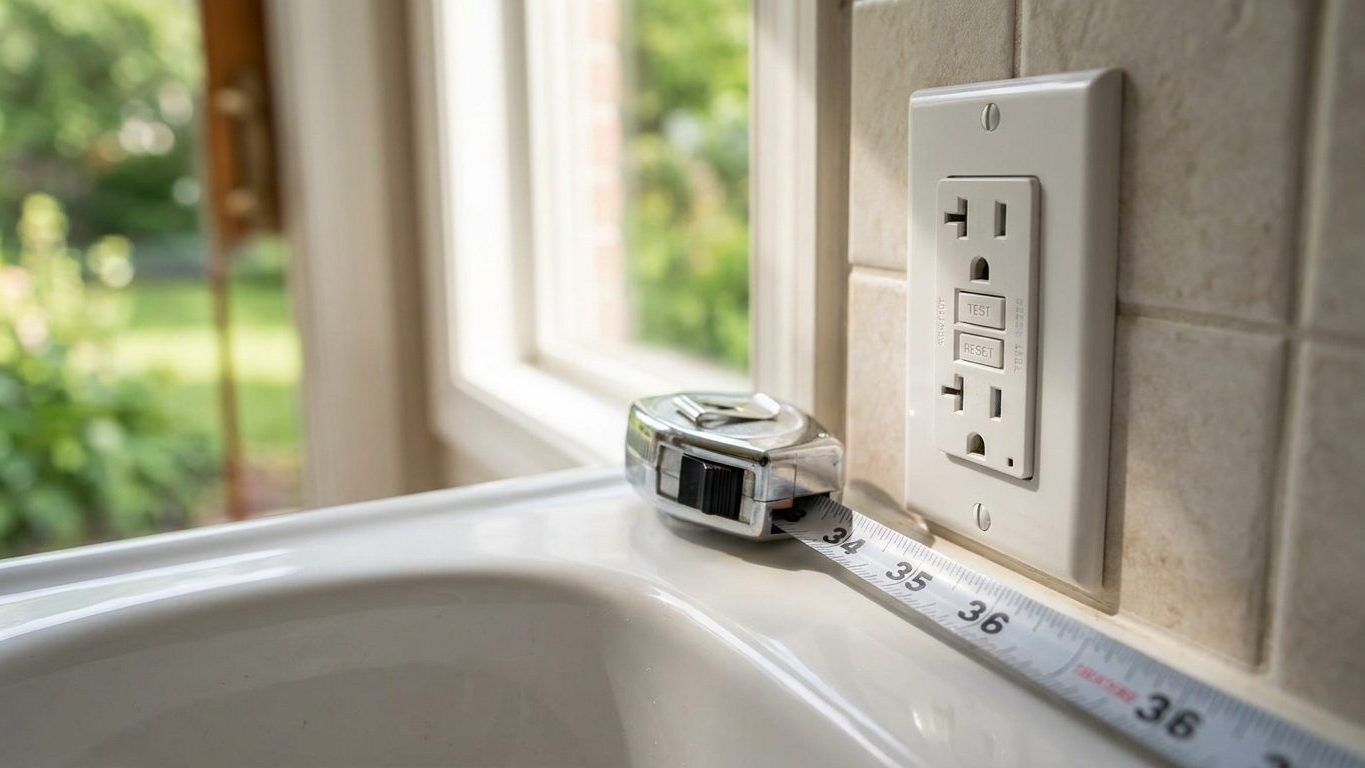

The 36-inch mark starts at the outside edge of the basin, not the wall or the faucet, and it decides where your bathroom receptacle has to sit: at least one outlet within that reach of the sink, full stop. GFCI protection is a separate requirement that rides along on every bathroom receptacle regardless of distance. Measure from the basin’s outer edge before you cut any drywall or move a vanity.
The three separate rules people collapse into one

At least 36 inches is the required reach from the outside edge of a bathroom basin to the nearest receptacle, a figure set by section 210.52(D) of the 2020 National Electrical Code. That single number gets tangled up with three other requirements that live in completely different sections of the same code, and most of the confusion in a renovation comes from treating all four as one rule instead of four.
The receptacle location rule only answers where an outlet has to exist. It says nothing about what protects that outlet once it’s installed, what circuit feeds it, or whether it can sit inside the shower. Those are covered elsewhere in the code, and each one has its own consequence if it’s skipped.
| Rule | What it governs | Code section (2020 NEC) |
|---|---|---|
| Receptacle location | At least one outlet within 36 inches of each basin’s outside edge | 210.52(D) |
| GFCI protection | Every 125-volt bathroom receptacle, regardless of location | 210.8(A)(1) |
| Dedicated circuit | A 20-amp circuit serving no other room | 210.11(C)(3) |
| Tub and shower zone | No receptacle inside the tub or shower space itself | 406.9(C) |
Four rules, four sections, and an electrician reads them as a single instruction: put a GFCI-protected outlet within reach of the sink, feed it from its own 20-amp circuit, and keep it out of the tub or shower enclosure. Skip any one of the four and the other three don’t cover for it. A GFCI-protected outlet in the wrong spot still fails the location rule, and a correctly placed outlet on a shared circuit still fails the dedicated-circuit rule regardless of how well it tests.
What a GFCI actually senses, and why a bathroom needs it
A ground-fault circuit interrupter watches the current going out to a device on the hot conductor and the current coming back on the neutral conductor. In a healthy circuit those two numbers match exactly, because every electron that leaves has to return by the same path. The instant they stop matching, some current is leaving the circuit by a route the device never intended, often through a person, and the GFCI cuts power before that path does damage.
Why water changes the math
Water is what makes a bathroom different from a hallway. Wet skin has far less resistance than dry skin, so a person standing on a wet floor holding a hair dryer that has developed a fault becomes a much lower-resistance path to ground than the dry insulation around them was designed to expect. A fault that would deliver a mild tingle in a dry room can deliver a dangerous shock in a bathroom, and it can do it at a current level too small to trip a standard breaker.
That’s the gap a GFCI is built to close. It doesn’t care about the fault’s cause, a cracked appliance cord, a splash into an open outlet, corrosion inside a wall box. It only cares about the imbalance between the two conductors, and it reacts fast enough that the exposure never has time to become dangerous. This is also why the rule doesn’t stop at the outlet closest to the sink. Every 125-volt receptacle in the room falls under section 210.8(A)(1) of the 2020 National Electrical Code, including a spare outlet by the door or one wired into a vanity light. There’s no such thing as a bathroom outlet exempt from this because of where it sits in the room.
The same logic extends past the basin entirely. A floor-warming system installed under bathroom tile carries the same water exposure the code is worried about, which is why Electric Underfloor Heating runs into the identical protection requirement even though it isn’t a receptacle at all.
The 36 inches, measured from where exactly
The tape measure starts at the outside edge of the basin, not the centerline of the faucet and not the wall behind it. Section 210.52(D) of the 2020 National Electrical Code measures the 36 inches along the counter or wall surface to the nearest edge of the receptacle, so a vanity with a wide overhang or a vessel sink set off-center changes where that outlet legally needs to land.
That measurement runs straight into the other boundary in this part of the code. A receptacle can’t sit inside the tub or shower space itself, under section 406.9(C), and in a small bathroom those two rules can nearly collide. A basin close to a shower enclosure can leave very little wall space where an outlet satisfies the 36-inch reach without also landing inside the prohibited zone. When that happens, the fix is where the outlet sits within the compliant strip, not an exception to either rule, because the 2020 code doesn’t carve one out for tight layouts.
A bathroom with a separate tub and shower, or a vanity light and shaving station near the mirror, raises the same question about fixtures overhead instead of outlets. What Light Fixtures Are Allowed Directly Over a Shower? covers the equivalent clearance question for lighting, and the two rules get confused for the same reason: both measure from the edge of a wet zone rather than from the fixture itself.
None of this is guaranteed to be the rule enforced in a given town. A model code only applies where a state or local jurisdiction has adopted it, and adoption often comes with local amendments that change a measurement or add a requirement the base code doesn’t carry. The 2020 edition is cited here because it’s the version the facts in this article come from, but the version actually enforced where the work is happening is whatever the local building department has adopted. That office, not this page, is the authority on which edition and which amendments apply to a specific permit.
Testing a GFCI, and what a monthly test proves

Testing a GFCI tells you the sensing circuit inside the device still works. It doesn’t tell you whether the outlet is protected the way the 2020 National Electrical Code requires, because a device can pass its own test and still be fed from the wrong circuit or sit in the wrong location. Those are separate questions, and a building department is who answers the second one.
Running the test
- Plug a small lamp or nightlight into the outlet and turn it on.
- Press the button marked TEST on the GFCI outlet, or on the breaker if the bathroom is protected from the panel instead.
- Confirm the lamp goes dark. If it doesn’t, the device has failed and needs replacing regardless of how long it’s been in the wall.
- Press RESET and confirm the lamp comes back on.
The most common mistake is testing the wrong outlet. A single GFCI device can protect several downstream receptacles on the same circuit, so a bathroom might have only one actual GFCI outlet even though every outlet in the room trips together during a real fault. Pressing TEST on a downstream outlet that only looks like a GFCI, because it wears the same faceplate, does nothing, and it’s easy to mistake that for a device that failed to trip.
A monthly test is the interval most GFCI manufacturers print directly on the device label, and it exists because the internal components can fail silently over years of humidity exposure in a bathroom without ever tripping the outlet or cutting power on their own. A device that no longer trips still passes current normally, so nothing about daily use will reveal the failure. The test button is the only way to find out before a real fault does.
The shared circuit that trips every time the hairdryer runs
A bathroom receptacle fed from a circuit that also serves a bedroom or a hallway light violates section 210.11(C)(3) of the 2020 National Electrical Code, which requires a 20-amp circuit that serves no other room. The symptom shows up long before anyone reads the code section: a hair dryer or a curling iron pulls enough current that the breaker trips, and it takes the bedroom lamp or the hallway outlet down with it.
At inspection, this is one of the easier violations to catch, because the panel schedule or a simple continuity check shows exactly which other rooms share the breaker. A retrofit that added a bathroom outlet by tapping into an existing bedroom circuit, a common shortcut in older homes, gets flagged the moment an inspector traces the wiring rather than just testing the GFCI button.
Left uncorrected, the practical cost isn’t a fine, it’s a breaker that trips at the least convenient moment for years, plus a house that won’t clear inspection at resale until the circuit gets separated. Correcting it after the fact usually means running a new dedicated circuit back to the panel, which is far more disruptive than getting it right during the original wiring.
None of the four rules in this article are things to verify by eye. A licensed electrician can trace what circuit actually feeds a given bathroom outlet, and the local building department can confirm which edition of the code and which amendments apply to a specific address before any permit is pulled.
Common questions
Can I put a GFCI outlet anywhere in the bathroom or does it have to be near the sink?
GFCI protection is required on every 125-volt receptacle in the room under section 210.8(A)(1) of the 2020 National Electrical Code, no matter where it sits. The 36-inch rule in section 210.52(D) is a separate requirement that only guarantees one outlet within reach of the basin. A bathroom can have GFCI-protected outlets elsewhere in the room too.
Does a GFCI breaker in the panel count instead of a GFCI outlet at the wall?
The code’s requirement is protection on the receptacle, not a specific device location, so a GFCI breaker feeding the circuit and a GFCI outlet at the wall are both ways of meeting section 210.8(A)(1). Which one is actually installed in a given bathroom isn’t always obvious from the faceplate alone, so check the panel or ask an electrician if you aren’t sure which device is doing the job.
Do I need an outlet on every wall of the bathroom?
No. The 2020 National Electrical Code only requires at least one receptacle within 36 inches of each basin’s outside edge, under section 210.52(D). It doesn’t require additional outlets on other walls, near the tub, or anywhere else in the room.
Can a bathroom outlet share a circuit with the exhaust fan or a heat lamp?
Section 210.11(C)(3) of the 2020 National Electrical Code requires bathroom receptacles to be on a 20-amp circuit that serves no other room, but it doesn’t spell out every fixture that can or can’t share that same circuit within the bathroom itself. That detail depends on the specific fixtures and total load involved, so it’s worth confirming with a licensed electrician before assuming a fan or heat lamp can ride the same circuit as the outlet.