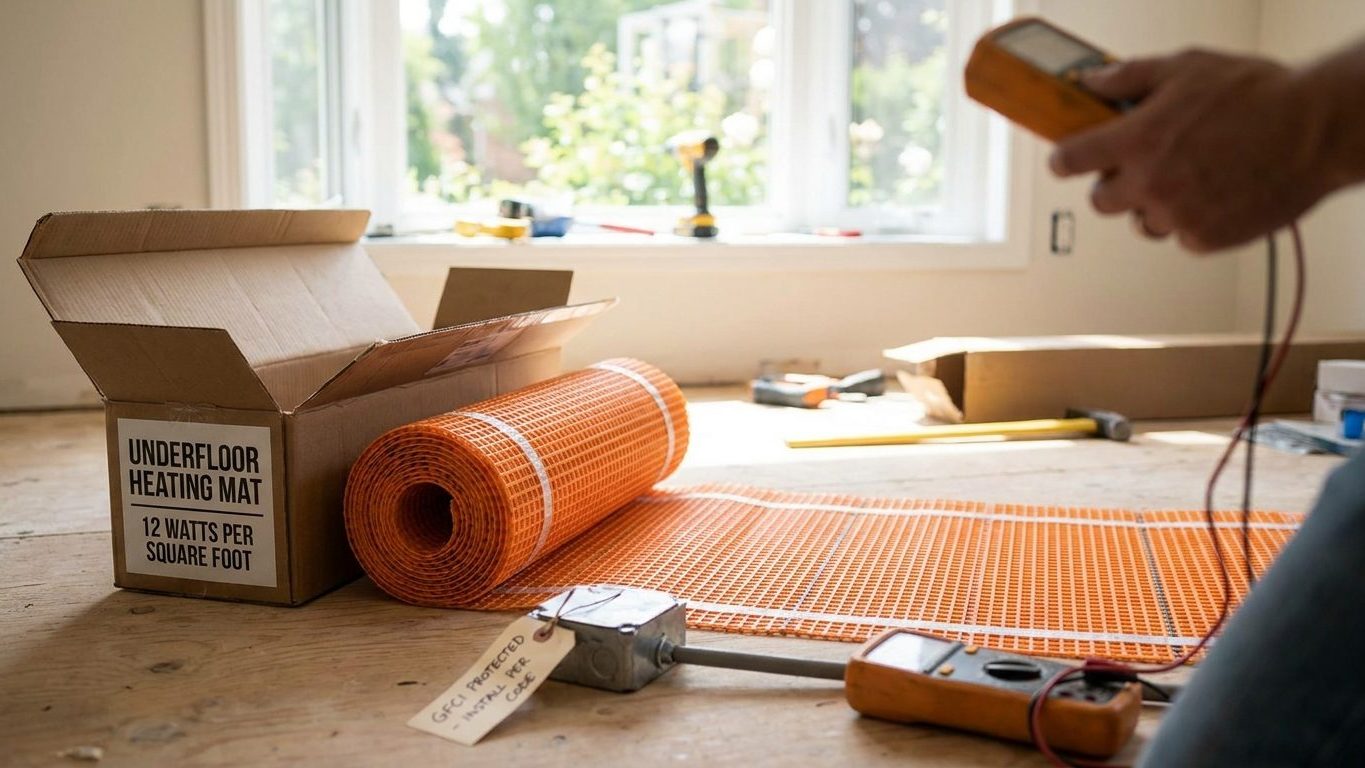

Electric floor-warming mats get shopped like light bulbs, one number on the box assumed to scale with the whole room. The real figure is 12 to 15 watts per square foot of heated floor, and it only counts the area the mat actually covers, not the bathroom‘s total footprint. Measure the open floor you plan to tile, not the room’s overall square footage, before you order a mat.
The watts a bathroom floor actually needs

Electric floor-warming mats draw 12 to 15 watts per square foot of heated area, a range that comes from UL 1673 listed systems and manufacturer data sheets rather than one fixed wattage every mat hits. A mat toward the top of that range warms up faster and costs a little more to run per hour than one at the bottom, but both are doing the same job: raising the surface temperature of the tile underfoot, not heating the room’s air.
“Per square foot of heated area” is the phrase that trips people up. It means the mat’s actual heated footprint, the area the cable covers once it’s snaked back and forth across the floor, not the square footage printed on the bathroom’s floor plan. A 40 square foot bathroom rarely ends up with 40 square feet of heated mat, because the space under fixed fixtures never gets cable run through it at all. Order a mat sized to the room’s total footage and you’ll either have several feet of leftover cable with nowhere flat to lay it, or you’ll cut the mat short and leave a cold strip along one wall.
Why the wattage range matters at the breaker
The 12 to 15 watt spread also decides what the circuit has to carry. A 30 square foot heated area at the low end of the range draws less current than the same 30 square feet at the high end, and that difference is what an electrician sizes the breaker and feeder wire against. Two mats that look identical in the box, same footprint, same roll length, can still call for different circuit ratings once you check the wattage printed on each one’s label.
GFCI is not optional on a heated floor
Why a standard breaker isn’t enough
The 2020 National Electrical Code, section 424.44(G), requires ground-fault protection for personnel on every electric floor-warming circuit. That’s a different job than what a standard breaker does. A regular breaker trips on overload or a short, when the circuit is pulling more current than the wire is rated to carry. A ground-fault circuit interrupter trips on imbalance instead: the moment more current is leaving on the hot conductor than is coming back on the neutral, it assumes the difference is going somewhere it shouldn’t, often through a person, and cuts power in a fraction of a second.
A heated bathroom floor is exactly the situation that rule is written for. The cable sits directly under tile that gets wet, in a room where someone is usually standing barefoot, and any nick in the mat’s insulation during installation, or any breakdown of it over years of thermal cycling, opens a path for current to leak into the thinset and the person standing on it. An overload breaker would never catch that, because the total current draw barely changes. Only a ground-fault device measures the imbalance itself, which is why section 424.44(G) calls it out as its own requirement instead of assuming a standard breaker already covers it.
This is the same category of protection the code requires at the outlets themselves, and for the same reason: water and a bare conductor sharing the same few feet of floor. The floor-warming circuit usually gets its own dedicated GFCI breaker at the panel rather than sharing a receptacle-type device, since it’s a hardwired heating circuit and not a plug-in appliance. Test that breaker monthly the same way you’d test any other GFCI, pressing the test button and confirming the mat cuts off, because a ground-fault device that has failed silently gives no warning until the day it’s actually needed.
The areas you do not heat, and why
The 2020 NEC, section 424.44(A), keeps the mat off three parts of the bathroom floor: under a vanity, under a toilet’s footprint, and under a tub. The reasoning behind each isn’t identical, but the result is the same. A vanity cabinet and a tub base both trap heat against wood, laminate or a fiberglass shell that was never built to sit on a warm surface day after day, and a toilet’s footprint is small, permanently occupied by porcelain, and gets no benefit from warming a tile no foot will ever touch.
What this does to the mat’s real size
Practically, this is why a mat kit’s rated square footage always comes in smaller than the room’s floor plan suggests. In a wet room with a curbless shower, the heated area also has to work around the slope and drain at the shower’s low point, since that section of floor is sloped substrate and membrane rather than the flat, dry-side tile the mat is designed for.
None of this is a manufacturer’s suggestion. It’s written into the code model itself, section 424.44(A), so an installer who runs cable over the toilet footprint to avoid a cold tile there isn’t taking a shortcut the code allows. They’re leaving that section out entirely.
The National Electrical Code is a model first and a law only where a state or local jurisdiction has adopted it, often with local amendments that add to or soften specific sections. The 2020 edition is current in a lot of places as of this writing, but not everywhere, and some jurisdictions are still working from an earlier edition. Check with your local building department for which edition and which amendments apply before you plan the mat’s layout around any of this.
Testing resistance before, during and after the tile goes down

Before you spread a foot of thinset, measure the mat’s resistance across its two lead wires with an ohmmeter and write that number down alongside the reading on the factory tag that ships with the mat. That baseline is the only thing you’ll have to compare against later, so record it before the mat goes anywhere near the floor, not after you’ve already started setting tile.
Test again at three points in the install:
- Straight out of the box, before the mat is unrolled, against the factory tag reading
- After the mat is set and embedded in thinset, before it’s covered with tile
- After the tile is set and the grout has cured, before the floor is handed over as finished
The measuring mistake that hides a break
At each stage, the reading should stay close to the one before it. A resistance reading that has drifted noticeably from the factory number, or one that reads zero or infinite resistance, means something changed inside the mat, most often a staple, a trowel edge or a dropped tool nicked a heating wire during setting. The most common mistake is testing at the leads outside the tile field and assuming that proves the whole run is intact. It only proves the two ends are still connected. It says nothing about a break somewhere in the middle of the run, which is why the mid-installation test, after the mat is embedded but before it’s covered, matters as much as the first one.
What a given reading means for your specific installation isn’t something to guess at from an article. Bring the baseline number and the follow-up readings to whoever is doing your rough-in inspection, or to a licensed electrician, and let them tell you whether the numbers indicate the mat came through installation intact.
The mat that is cut to fit and never comes on again
A heating cable is not like a lamp cord. Once a wire inside the mat is nicked or severed, there’s no splice that puts it back in service without tearing out the tile above it. A mat that fails a resistance test after it’s embedded in thinset but before it’s tiled over is a mat you replace at that stage, while it’s still cheap to reach. A mat that fails after the tile is down and grouted has failed under a floor that’s now considered finished, and the fix at that point is demolition, not a repair.
What an inspector is actually checking
At inspection, whoever signs off on the rough-in is looking for the same things this page has walked through: a dedicated ground-fault device on the circuit under 424.44(G), no heating cable run under the tub, vanity or toilet footprint under 424.44(A), and a floor sensor rather than a room thermostat governing the temperature, which the code also specifies at section 424.44. None of that is something to eyeball. Bring your resistance readings and your layout plan to the inspection rather than assuming it will pass because the mat powered on once in the box.
Ten years from now, the mat that was cut a few inches short to clear a cabinet edge, or spliced with electrical tape because it ran long, is the mat someone is chiseling tile off to find. Get the layout checked against the room’s actual dimensions before the first strip of tape goes down, and have a licensed electrician land the circuit and confirm the ground-fault protection before any of it gets covered for good.
Common questions
Can I put electric heating mats under a bathtub or vanity to keep everything warm?
No. The 2020 NEC, section 424.44(A), keeps heating cable out from under the tub, the vanity and the toilet footprint, so a mat kit’s usable area is always smaller than the room’s total floor space. Check with your local building department on how your jurisdiction has adopted and amended this section before planning a layout that pushes against it.
Do I need a separate GFCI breaker for the floor heating, or can it share with the bathroom outlets?
The floor-warming circuit needs its own ground-fault protection under section 424.44(G), and it’s typically a dedicated GFCI breaker at the panel rather than a shared device with the bathroom’s outlets. A licensed electrician sizing the circuit will confirm what your specific panel and code edition require.
How many watts does a small bathroom floor actually use, in real numbers?
Multiply the heated area, in square feet, by the 12 to 15 watt per square foot range from UL 1673 listed systems and manufacturer data, and you get a wattage range rather than one number, since it depends on the mat’s specific rating and how much of the room’s floor is actually left open once fixtures are excluded.
What controls the temperature if there’s no room thermostat?
A floor sensor embedded in the mat, not a room air thermostat, governs the temperature under section 424.44 of the 2020 NEC. That sensor reads the temperature of the floor itself, which is the surface the code is regulating, rather than the air temperature of the bathroom.