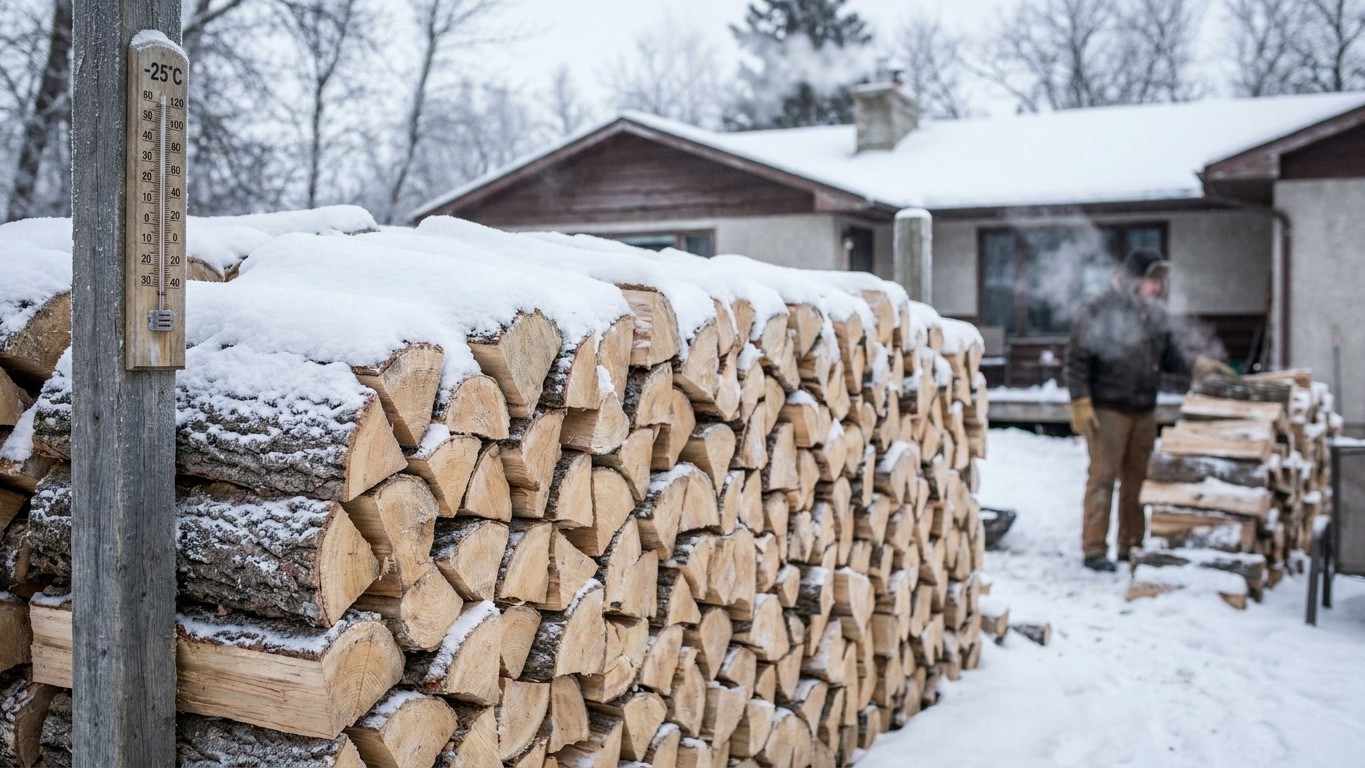

Winnipeg’s coldest month averages a low of -6.6°F, and that single number changes everything about how you buy, store, and burn wood here. This isn’t a climate where firewood is a weekend hobby. It’s infrastructure. The species you choose, how much you stack, and how dry it gets before the first cold snap all trace back to that figure, so it’s worth starting there before getting into cords and BTUs.
How cold it actually gets here

Manitoba’s reference numbers come from Environment and Climate Change Canada’s 1981-2010 Climate Normals for Winnipeg, and the figure that matters most for wood heat isn’t the record low everyone talks about at the coffee shop. It’s the average daily minimum for the coldest month: -6.6°F. That’s not a single brutal night. That’s the typical low, repeated across weeks, the baseline your stove or furnace has to fight night after night.
A mean minimum that far below zero puts Manitoba squarely in the category where wood heat is functional, not decorative. Compare that to regions where winter lows hover in the 30s and 40s, where a fire is mostly about ambiance and a backup source rarely gets tested. Here, if wood is your primary or even a serious secondary heat source, an underperforming cord in January isn’t an inconvenience. It’s a cold house at 2 a.m. with no cushion.
What that cold actually demands
Heating through a winter that bottoms out near -6.6°F means the stove is running long hours, often overnight without reloading, for stretches that can last weeks at a time. The wood has to hold a bed of coals through the night and still throw enough heat that the house doesn’t lose ground by morning. That’s a different job than tossing a log on for a few hours of evening warmth.
It also means the margin for error shrinks. Wood that’s only 80 percent seasoned, or a species that burns fast and cool, might be tolerable in a milder climate where the furnace picks up the slack. In a Manitoba winter, that same shortfall shows up as a genuinely cold morning. This is for someone stacking a woodpile that has to perform, not just look good on the porch.
None of this means every stick needs to be premium hardwood. It means the choices below, species, drying time, volume, aren’t optional refinements. They’re the difference between a woodpile that gets you through February and one that runs out in the third week of January when the truck can’t get down the road anyway.
Which woods are worth the effort here
Once you accept that -6.6°F is the number you’re heating against, density becomes the whole story. A cord is a fixed volume, always 4 feet by 4 feet by 8 feet, or 128 cubic feet, no matter what’s stacked inside it. But a cord of dense hardwood packs a lot more actual wood fiber, and therefore a lot more stored heat, into that same box than a cord of a lighter species. According to Michigan State University Extension, a cord of well-seasoned hardwood delivers roughly 20 million BTU, which lines up with about 145 gallons of #2 fuel oil or 215 gallons of LP gas. That’s the benchmark to hold every load against.
Denser hardwoods are what you want stacked closest to the door for the coldest nights, the ones where you load the stove at 10 p.m. and need coals still glowing at 6 a.m. Lighter, less dense woods burn hot and fast but don’t hold a coal bed the same way, which makes them better for kindling, quick morning fires, or the shoulder-season weeks in October and April when you just need to take the chill off, not fight a -6.6°F night.
Comparing by what actually matters at the stove
| Wood category | Heat per cord (seasoned) | Smoke | Sparks |
|---|---|---|---|
| Dense hardwood | At or near the ~20 million BTU average | Lower once fully seasoned | Fewer, burns steady |
| Lighter/softer wood | Noticeably below the hardwood average per cord | Higher if not fully dry | More, especially resinous types |
Availability matters as much as this table does. A theoretically superior species sitting green in a farmyard, unsplit and unstacked, is worse firewood than a modest species you can actually buy already seasoned. Manitoba’s supply is regional. What’s stacked and dry at a yard outside Brandon isn’t necessarily what’s sitting ready near Winnipeg or up toward The Pas. Ask any seller directly how long it’s been split and stacked, not just cut, before you commit a season’s budget to it.
How much wood a winter takes
Any number you see published for “cords per winter” in Manitoba is close to meaningless on its own, because it depends entirely on three things that vary from one house to the next, even on the same street. The first is the cold figure itself, that -6.6°F average minimum, which sets the baseline demand. The second is how well the house holds heat. The third is whether wood is doing all the work or just supplementing a furnace that kicks in when the fire dies down.
Here’s the mechanism that makes the estimate swing so widely: a poorly insulated house, drafty windows, thin attic insulation, no vapor barrier, can burn through double the wood of a tightly sealed house in the exact same weather. That’s not a small variance. It means two neighbors in identical climate can need four cords or eight cords for the same winter, and neither number is wrong. It’s a function of the building, not the weather.
- Winter severity: use the -6.6°F average minimum as your baseline, not the occasional deep-freeze night that makes the news
- House insulation and air sealing: older, drafty homes lose heat far faster and burn through wood correspondingly faster
- Role of wood in the heating system: primary heat source versus a supplement to a furnace changes the total by a large margin
- Stove or fireplace efficiency: an airtight modern stove extracts more heat per cord than an open fireplace or an older leaky unit
- House size and layout: a compact, single-story floor plan holds heat differently than a large or multi-story one
Run your own situation down that list rather than borrowing a number from a neighbor or a forum post. Someone heating a tight, well-insulated bungalow with a modern airtight stove as backup heat might get through winter on three or four cords. Someone in an older farmhouse using wood as the only heat source could need double that or more, in the same town, under the same sky.
Drying wood in this climate
Species matters, but seasoning decides whether any of it pays off. Michigan State University Extension is direct on the threshold: wood should burn at 20 percent moisture or less, while green wood can sit above 60 percent. That extra water has to boil off inside the firebox before the wood gives you any usable heat, and that process eats the energy you were counting on. A green log doesn’t just smoke more. It’s quietly stealing BTUs from your house to dry itself out.
What actually dries wood is air movement and time, not sunlight sitting on top of a pile. Split wood, stacked loosely enough that air passes through the rows, reaches that 20 percent target after one full summer in most cases. Manitoba’s summers are short relative to milder regions, which compresses that drying window, and humid stretches slow it further. Red oak is the named exception worth remembering: its cell structure holds moisture longer than most species, so it needs more than a single summer to reach that same 20 percent mark, even split and stacked the same way.
This is where the most common local mistake shows up. Wood cut and split in spring, meant for the winter that follows just months later, almost never reaches 20 percent moisture in time. It gets burned anyway, because it’s what’s on hand, and it smokes, sparks, and underperforms all season. The wood that actually works well against a -6.6°F night was split and stacked at least a year earlier, sometimes longer for red oak, and sat through a full summer with air moving freely around every row.