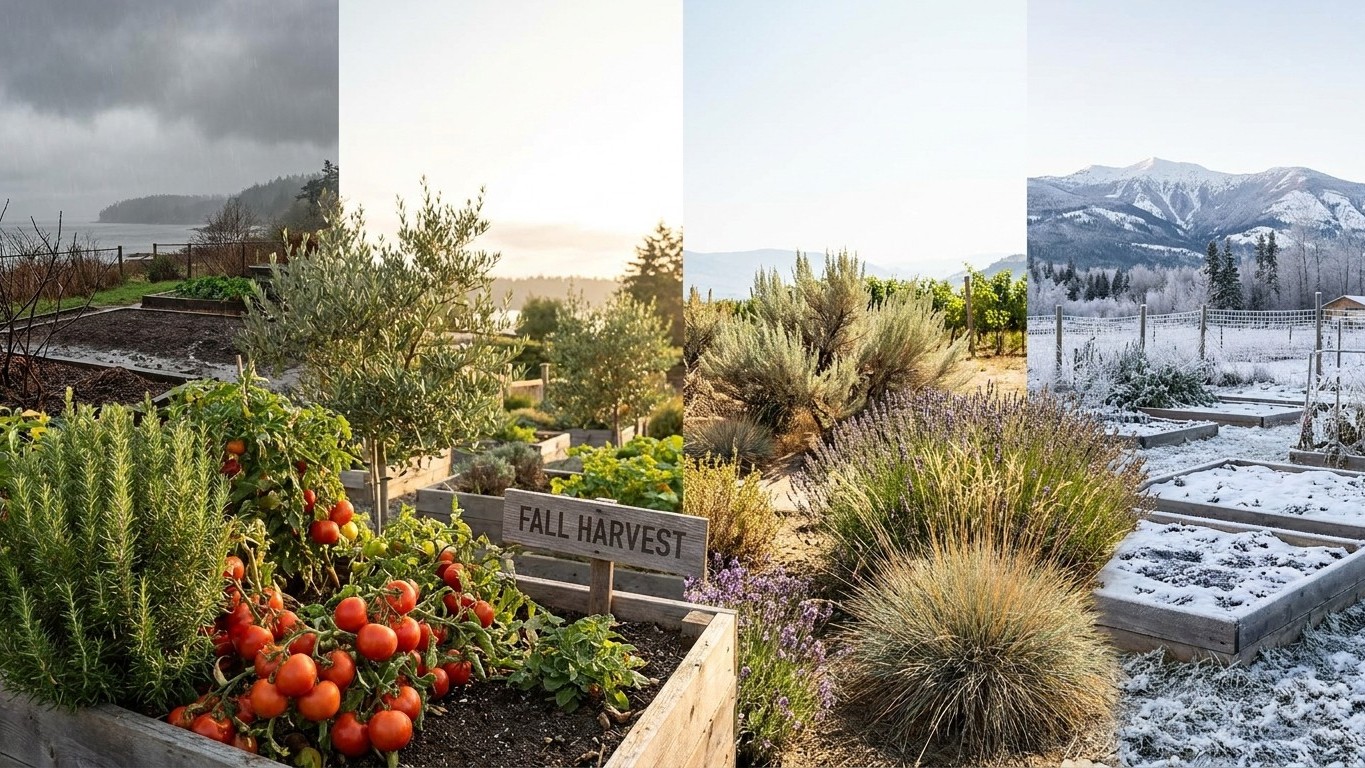

British Columbia doesn’t have one growing season. It has at least four, and they barely resemble each other. A gardener in Victoria is picking tomatoes in October while someone in Fort St. John is already covering beds against frost. Understanding which BC you’re actually gardening in, coastal, Okanagan, Kootenay, or northern interior, matters more than any generic planting calendar ever could.
The province stretches from Mediterranean-like rain shadows to near-desert valleys to subarctic plateaus, all within a single political border. That range is the whole story. What grows easily in one region fails outright sixty miles away, and the reasons come down to moisture, elevation, and how far you are from the moderating hand of the Pacific.
Vancouver, Victoria, and the Gulf Islands sit in Canadian Plant Hardiness Zones 8 to 9, enjoying a long, mild growing season shaped by their coastal location. That’s mild enough to keep some vegetables in the ground through winter and to grow figs, hardy palms, and cool-season greens most of the year. The frost-free stretch in Victoria can run 250 days or more, among the longest in Canada.
The catch is timing. Coastal BC gets the bulk of its rain between October and April, then dries out just when plants need water most. July and August routinely see weeks without meaningful rainfall, especially in the Victoria and Gulf Islands rain shadow, which sits in the lee of Washington State’s Olympic Mountains and receives noticeably less precipitation than Seattle or Vancouver. Gardeners who assume the coast is perpetually damp end up with crispy lawns and stressed vegetable beds by mid-summer, simply because they didn’t plan for irrigation.
Slugs are the other coastal reality. Persistent moisture through spring and fall creates ideal conditions for slug populations that can strip seedlings overnight. Raised beds, copper barriers, and evening slug patrols aren’t paranoia here, they’re basic maintenance. Soil tends to run acidic too, a byproduct of heavy rainfall leaching calcium and conifer needle litter breaking down over decades. Vegetable gardeners on the coast often need to lime beds periodically to bring pH back into a range where broccoli, beans, and brassicas actually thrive.
What Actually Works on the Coast
Cool-season crops perform exceptionally well here. Kale, Growing Spinach in British Columbia, and lettuce can be sown nearly year-round with the right cover, and overwintering vegetables like leeks, Growing Parsnips in British Columbia is a genuine coastal specialty, along with some cabbage varieties. Growing Carrots in British Columbia also thrives in this mild, moisture-rich climate, with roots that can stay in the ground well in, and even Growing Pumpkins in British Columbia can succeed given a sunny, sheltered spot despite the region’s cool, damp summers, and perennial beds devoted to Growing Asparagus in British Columbia take full advantage of the region’s mild winters and long frost-free stretchto the cooler months, just as Growing Beets in British Columbia benefits from the same cool, damp conditions, and Growing Potatoes in British Columbia is another coastal staple that benefits from the region’s long, mild season. Heat-loving crops like corn, melons, and even peppers struggle more than the mild climate would suggest, simply because summer nights stay cool and total heat accumulation is lower than a zone map alone would imply, as anyone attempting Growing Peppers in British Columbia on the coast quickly discovers.
The Okanagan and Southern Interior: Heat, Drought, and a Short Fuse

Drive four hours east from Vancouver and the climate flips entirely. Kelowna, Penticton, and Osoyoos sit in valleys shaped by rain shadows on the opposite side of the coastal mountains, and the result is Canada’s only pocket of true desert grassland near Osoyoos. Summers regularly push past 90°F, winters can drop well below freezing, and the growing season, while shorter than the coast’s, compresses intense heat into a productive window.
This is wine and orchard country for a reason. Grapes, peaches, cherries, and apricots need exactly what the Okanagan offers: hot, dry summers with cool nights that preserve sugar and acidity in fruit. Home gardeners in the region lean hard into tomatoes, peppers, and melons that would sulk on the coast but flourish here given consistent irrigation.
Water is the constraint, not warmth. Annual precipitation in parts of the Okanagan Valley is low enough that unirrigated land reverts to sagebrush and bunchgrass, so drip irrigation isn’t optional infrastructure, it’s the baseline requirement for a productive garden. Powdery mildew shows up frequently too, an odd pairing with a dry climate, but it happens where overhead sprinklers wet foliage in the evening and heat speeds fungal spread the next day. Switching to drip lines at the soil level solves most of it.
The Kootenays: Mountains Rewrite the Rules
East of the Okanagan, the Kootenay region adds elevation into the mix. Valley floors around Nelson or Creston can support a reasonably long season, but climb a few hundred feet and frost risk extends deeper into spring and returns earlier in fall. Microclimates matter enormously here. A south-facing slope with good air drainage might be frost-free for 140 days, while a shaded valley bottom a mile away sees 100 or fewer.
Gardeners in mountain valleys learn to read their own property’s terrain before trusting any regional average. Cold air pools in low spots on still nights, which means the coldest part of a yard is often the lowest, not the highest. Placing tender crops on a gentle slope rather than a flat basin can add weeks of usable season without any other intervention.
Northern BC: Short Season, Long Light
Prince George, Fort St. John, and communities further north, garden in Canadian plant hardiness zones as low as 0 to 2, reflecting the region’s short growing seasons and long, harsh winters. Frost-free periods can run as short as 90 days, and a late spring frost or early fall cold snap isn’t a rare event, it’s a near-annual planning consideration.
What compensates is daylight. Northern BC sits far enough north that midsummer days stretch past 17 hours, and that extended light drives rapid growth once soil finally warms. Root vegetables, hardy brassicas, and short-season grain varieties bred for prairie and northern climates do well, and many northern gardeners start seedlings indoors weeks earlier than their southern counterparts just to have transplant-ready plants the moment the frost risk clears.
Season extension isn’t optional in this zone. Cold frames, row covers, and high tunnels routinely add three to four weeks on each end of the season, which can mean the difference between a modest harvest and none at all for anything beyond the hardiest vegetables.
Reading the Official Hardiness Map Correctly
Canada uses its own Plant Hardiness Zone system, distinct from the USDA map most American gardeners know, built from a wider set of climate variables including summer heat, wind, and precipitation rather than just average minimum winter temperature. The current map is maintained by Natural Resources Canada and is publicly available at planthardiness.gc.ca. It’s worth checking directly rather than relying on rough USDA conversions, since BC’s coastal and interior zones don’t always translate cleanly across the two systems.
The map is also a starting point, not a guarantee. Two properties in the same official zone can behave completely differently depending on slope, water exposure, and proximity to a large body of water. Coastal properties directly facing the ocean often run a half-zone milder than inland neighbors just a few miles away, because large water bodies buffer temperature swings in both directions.
What Actually Determines Success
Zone maps tell you what’s theoretically possible. Three other factors decide what actually happens in a given yard.
Soil is the first. Coastal acidity, interior alkalinity from lower rainfall and higher mineral content, and thin rocky soils in mountain regions all demand different amendment strategies. A soil test, not a guess, is the fastest way to stop fighting a garden’s chemistry instead of working with it.
Water timing is the second, and the one most gardeners underestimate. The instinct is to assume a “rainy province” needs less irrigation planning than a dry one, but BC’s rain falls almost entirely in the wrong months for summer crop production across most of the province. Drip irrigation on a timer, set up before the dry stretch begins rather than after plants show stress, prevents most of the damage that shows up as “the garden just didn’t do well this year.”
Microclimate is the third, and it’s the one within a gardener’s direct control. A south-facing wall, a windbreak hedge, raised beds that warm faster in spring, or simply choosing the slope over the low point in a yard can shift effective growing conditions by a full zone or more. In a province where the difference between zone 5 and zone 7 can be the difference between losing a fig tree every winter and harvesting fruit from it, that kind of small positional decision carries outsized weight.
Where to check before you plant
Every figure above comes from one reference point, and BC punishes that kind of shortcut more than most places. The province stretches from coastal rainforest to interior semi-desert to subalpine valleys, sometimes within a single day’s drive, and a planting date tuned to one pocket can be badly wrong twenty minutes away by elevation or aspect alone. Before committing seed money or bench space to a schedule, confirm it against your own conditions.
The BC Ministry of Agriculture and Food www2.gov.bc.ca publishes zone maps, frost data, and crop guidance built for the province’s actual range of climates rather than a single city’s averages, which matters here more than in a smaller or flatter jurisdiction.
Pair that with your own regional district’s agricultural office or a local agrologist, since frost pockets, rain shadows, and microclimates shift enough from valley to valley that even provincial figures need a local correction. Fifteen minutes checking both sources against your actual address is cheaper than replanting a bed in the fifth week of the season.
Digging Into Specific Crops and Care
The broad strokes of frost dates and elevation only get you so far — the details change depending on what you’re actually trying to grow. If garlic is on your list, the planting math shifts with elevation across the province, and growing garlic in British Columbia walks through how Environment and Climate Change Canada’s fall frost averages play out from Vancouver to the higher ground. Lawns face their own version of this problem: British Columbia doesn’t fit neatly into the categories most feeding schedules assume, and British Columbia lawn care covers what to plant and when to feed it once you account for the near-total absence of 90°F days near the coast. And if you’re chasing ripe tomatoes before the weather turns, growing tomatoes in British Columbia lays out the safe transplant window in the Lower Mainland, timed against the region’s average last spring frost. Each of these pages takes the same climate-normals approach as this one, but narrows it down to the decisions that actually matter for that particular plant.