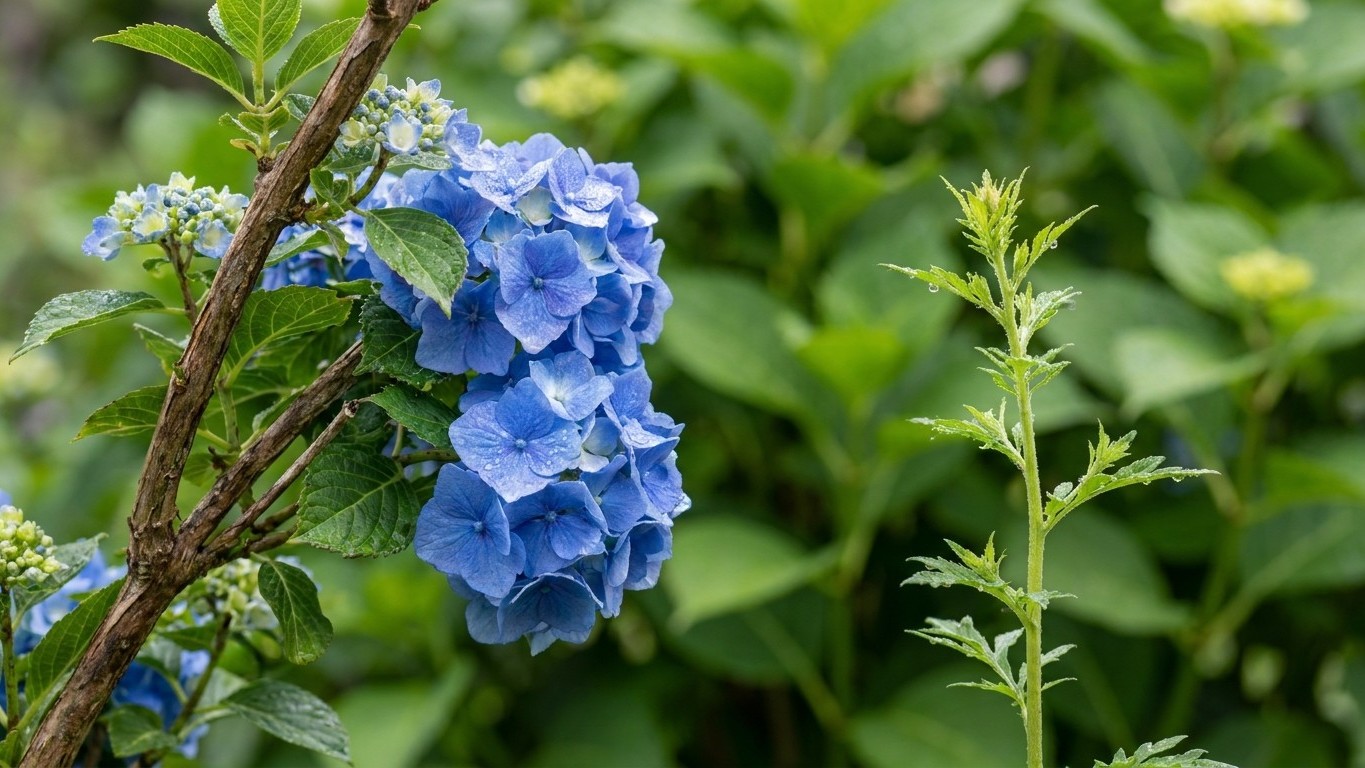

Most hydrangeas survive a winter at the coast of British Columbia, and the toughest types, smooth and panicle hydrangeas, survive almost anywhere in the province where gardeners grow them at all. The real divide is between plants that live and plants that bloom. A mophead can come through January alive and still hand you a summer of green leaves, because its flower buds died on the stem.
What this comes down to in British Columbia
At Vancouver International Airport, the station this page uses as its reference, the average last spring frost is March 18 and the average first fall frost is November 10. Those are mean dates, so in about one year out of two the frost arrives later than each figure. Treat them as the middle of a window, not a safe date. Natural Resources Canada puts Vancouver in Canadian hardiness zone 9a, a rating from the Canadian system, which is not a USDA zone and does not convert to one.
The gap between those two means is a bit under eight months, and winter lows in a 9a city rarely threaten the plant itself. What decides the outcome is where each cultivar carries its flower buds. The list below runs from the toughest to the most exposed. If you want the basics of planting and care first, start with the guide to growing hydrangeas in British Columbia.
Annabelle
A smooth hydrangea (Hydrangea arborescens) with large white snowball heads. It flowers on new wood, so even a hard winter that kills the stems to the ground costs you nothing in bloom. The stems flop in heavy rain, which on the coast is a real nuisance.
Incrediball
A smooth hydrangea bred from the same idea as Annabelle but with sturdier stems. Same new-wood habit, same winter reliability, and fewer heads face-down in the November mud.
Limelight
A panicle hydrangea (Hydrangea paniculata) with cone-shaped heads that open lime-green and age toward pink. It blooms on new wood and ranks among the hardiest garden hydrangeas. It is also the one most likely to be thriving in a colder inland yard.
Quick Fire
Another panicle type, valued because it opens its flowers earlier than most of its relatives. Earlier bloom means more time for the wood to ripen before a fall frost. The hardiness matches Limelight.
Snow Queen
An oakleaf hydrangea (Hydrangea quercifolia) with white, upright flower spikes and good fall color. The plant itself is sturdy, but it flowers on old wood, so a late spring frost can take the display. At the coast it is dependable. In colder districts it is a gamble.
Endless Summer
A bigleaf hydrangea (Hydrangea macrophylla) sold for flowering on both old and new wood. That is its insurance policy: if winter kills the old buds, it can still bloom later in the season on new growth. Expect a lighter show in those years.
Nikko Blue
A classic old-wood mophead. Its blue or pink globes are gorgeous in a mild winter and absent after a cold one. At the coast it does well. Move inland or uphill and it needs protection to flower reliably.
Working it out for your own garden
You can test any hydrangea you meet in a nursery with one question: where does it carry its flower buds? Catalogues for hydrangeas don’t list days to maturity the way vegetable seed packets do, so the useful equivalent is the wood type. New-wood bloomers form buds in spring on stems that grew this year, which means the winter can only hurt the framework. Old-wood bloomers set buds the previous late summer, and those buds ride through winter exposed.
| Cultivar | Blooms on | What a hard winter costs |
|---|---|---|
| Annabelle | New wood | Height, not flowers |
| Limelight | New wood | Height, not flowers |
| Endless Summer | Old and new wood | An early flush; later bloom still comes |
| Snow Queen | Old wood | Most or all of that year’s flowers |
| Nikko Blue | Old wood | Most or all of that year’s flowers |
Now work one cultivar through to the end. Take Limelight. Its buds form on shoots that start growing after the last spring frost, which averages March 18 at Vancouver International Airport, with a frost in half of years arriving later. Whatever a late frost does to leaf tips, it does not touch buds that do not exist yet. Limelight finishes its season well ahead of the first fall frost, averaging November 10, and the stems harden off in the weeks between bloom and that date. It passes the test.
Nikko Blue does not pass it, at least not on its own. Its buds are already formed by the time that November window opens, and they have to sit through every cold night until the following spring, including nights after the mean last-frost date. In a mild coastal winter that is fine. In a year with a hard Arctic outbreak, or in a colder district than the reference station, the buds are the first casualty.
The same arithmetic works for feeding. Working back from a mean first frost around November 10, stopping nitrogen in midsummer gives the new growth roughly four months to firm up. Push soft growth in September and the first hard frost catches it. If your plant blooms on old wood, how and when you cut it matters just as much, and the pruning guide for when to prune hydrangeas in British Columbia covers that side.
What changes across the state
The Vancouver figures describe one mild corner. British Columbia stretches from a rainy Pacific shore to dry interior valleys, high plateaus, and the cold north. Move away from the coast and the numbers move with you, and in the northern and upland districts the frost dates run weeks behind the airport’s.
Elevation is the first lever. Air cools as you climb, so a hillside property a few hundred feet above the valley floor can see frost later in spring and earlier in fall than the town below it. Cold air also pools in low spots on still nights, so a garden at the bottom of a slope can be hit harder than its neighbors higher up.
Distance from the ocean is the second. The coast and the southern parts of Vancouver Island are tempered by the water, which is why old-wood mopheads are an ordinary sight there. Inland, in the Okanagan and farther into the Kootenays, the Cariboo and the north, winters are colder and the swings sharper, and the smooth and panicle hydrangeas pull ahead of the bigleaf group. The Okanagan adds a twist: hot, dry summers mean even a hardy hydrangea needs afternoon shade and steady water.
The nursery tag will not tell you which of these you live in. The trend is simple, though. The colder your winter, the more you should lean on new-wood bloomers.
The mistakes this state punishes
The first is trusting a warm spell. February and March can bring days warm enough to wake a hydrangea, and a frost can still follow, since in half of years the last one lands after March 18. Old-wood bloomers that leaf out early lose their buds to exactly this. Wait for the window to pass, and keep winter mulch or covers handy until then. The guide to protecting hydrangeas through a British Columbia winter covers how.
The second is buying by flower color. A blue mophead in a catalogue photo looks the same whether it will bloom reliably in your district or not. Ask which wood it blooms on, then match that to your winter. In a colder inland garden, picking Nikko Blue over Annabelle because of the color swap is the single most common way to end up with a green shrub.
The third is a fall tidy-up. Cutting back an old-wood hydrangea in October removes next summer’s flowers along with the dead leaves. Leave the stems standing until spring, then cut only what is clearly dead.
The fourth is wet feet. The coast gets long, soaking winters, and a hydrangea sitting in heavy clay can rot at the roots, a fate that no hardiness rating accounts for. Raise the planting spot a little or loosen the soil rather than hoping the plant copes.
Checking this against your county
A single reference station is a starting point, not an instruction. British Columbia does not have county extension offices like the American states do, so use the province’s agriculture and seafood pages as your official starting point, then ask a local garden club or independent nursery what survives in your own district. They know the frost pockets and the cold years. The overall guide to growing hydrangeas in British Columbia covers the rest.
Common questions
Will hydrangeas die in a Vancouver winter?
Rarely. The reference city sits in Canadian hardiness zone 9a, and most hydrangeas live through the winters there. The more likely loss is flower buds on old-wood types, from a cold snap or a late frost.
Which hydrangea is the hardiest choice for British Columbia?
Smooth hydrangeas such as Annabelle and Incrediball, and panicle types such as Limelight and Quick Fire. All bloom on new wood, so a hard winter cannot take the flowers.
Why did my hydrangea leaf out but never bloom?
The usual cause is dead flower buds on an old-wood type, killed by winter cold or a spring frost, or cut off by pruning at the wrong time.
Is Canadian zone 9a the same as USDA zone 9a?
No. The Canadian system uses seven climate variables and the USDA system uses one, and Natural Resources Canada says there is no simple conversion between them. Name the system whenever you quote a zone.