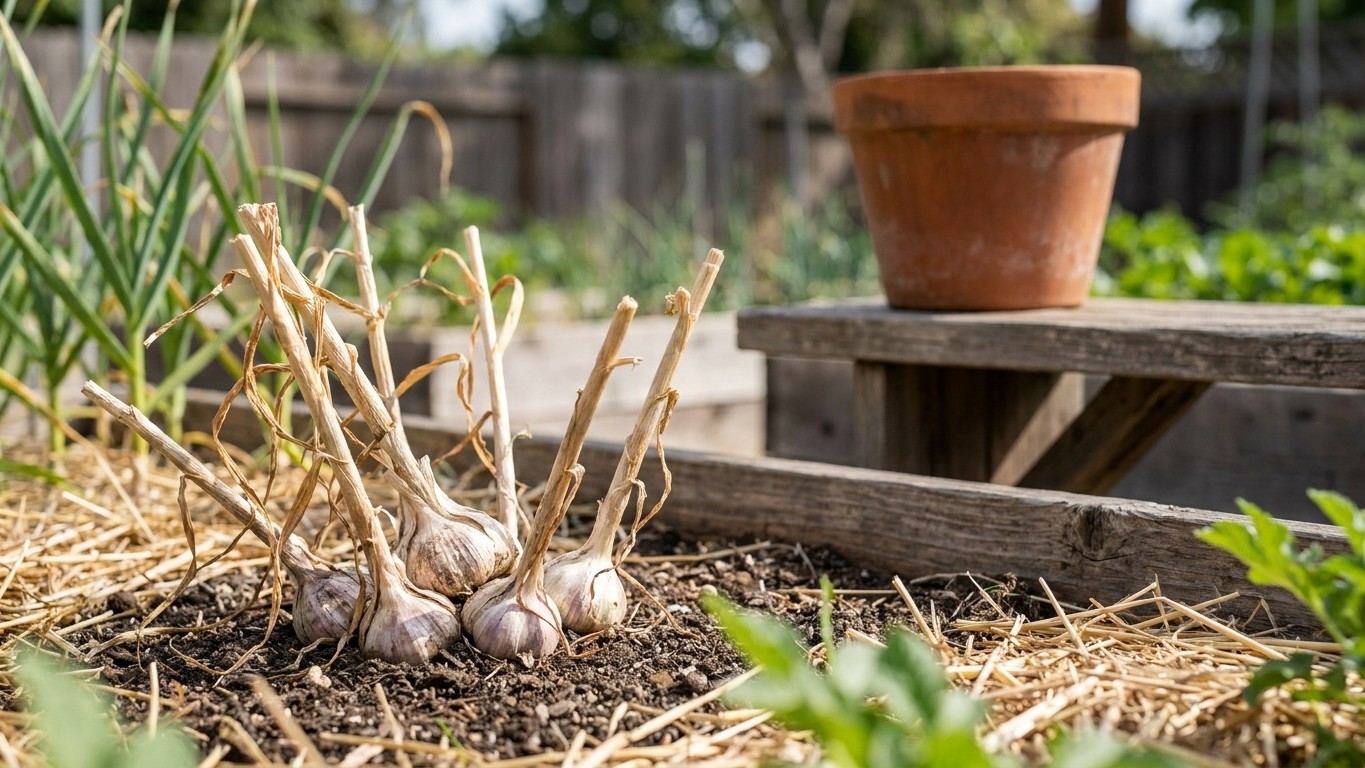

Near Los Angeles, a planted garlic clove can sail through an entire winter without ever meeting a real freeze — and that’s the problem. Garlic doesn’t split into a head of cloves on faith; it needs weeks of sustained chill below 40°F to divide properly, the kind of cold that regions farther north get for free and California’s coast and south rarely see. Skip it, and you dig up one round bulb instead of a head. The fix isn’t moving north — it’s tricking the clove into thinking it did.
Will garlic get the cold it needs in California

A garlic clove is not really a seed. It is a piece of last year’s bulb, and it only divides into a new head of cloves if it goes through a sustained cold period after it goes in the ground. Skip that cold and you lift a single round bulb the following summer instead of a head split into cloves, a common and disappointing first-year mistake. University of Georgia Extension publication C854 puts the requirement at six to eight weeks of temperatures below 40°F for the clove to vernalize properly.
Where that threshold is hard to clear
Near Los Angeles, NOAA’s NCEI climate normals show no freeze at all in an average year and a 365-day frost-free season. A location that never drops to 32°F is very unlikely to also produce six to eight consecutive weeks below 40°F, so coastal and southern California growers should assume they fall short of the UGA threshold rather than hope they clear it. This is a heat-and-drought climate for gardening purposes, not a frost climate, and garlic is one of the few crops where that mildness actually works against you.
What to do about it
Two real options exist if you garden inside that frost-free belt. Refrigerate your seed cloves at a cold setting for six to eight weeks before planting, separated but still in their papery skins, to substitute for the cold the ground will not provide. Or plant a softneck cultivar, choosing from the Garlic Varieties That Suit California Winters that growers have bred over generations in milder growing regions to size up and divide reliably without a hard chill. Never simply skip the cold step and hope: an unvernalized clove almost always disappoints.
Where California actually freezes, the calculation flips. The Central Valley, the Sierra foothills, and the northern counties see real winter cold that vernalizes garlic in the ground with no help from a refrigerator, and hardneck cultivars there perform the way they do in classically cold garlic country.
When to put the cloves in
Most garlic-growing regions set their planting date by counting backward from the first fall frost. Near Los Angeles, that clock doesn’t exist: NOAA’s data for the area shows no reliable freeze in an average year, so there is no frost date to plant around at all. That’s why knowing When to Plant Garlic in California requires a different approach than the usual frost-based method. That absence is itself the fact worth knowing, not a gap to fill in with an invented date.
No frost anchor near the coast
Instead, coastal and southern California growers anchor planting on the seasonal drop in soil temperature and on the practice of local growers rather than on a frost date. Plant once nights turn consistently cooler and the fall rains, when they come, start to break the summer’s heat out of the topsoil. The goal is the same one gardeners everywhere are chasing: enough time for roots to establish before the coldest part of winter, without so much time that the clove pushes tall, tender top growth that has nothing to gain from surviving a mild winter unprotected.
What shifts the timing
Elevation, a large body of water, and proximity to the coast all move the calendar in California more than almost anywhere else in the country. A vineyard at elevation in the Sierra foothills cools weeks ahead of a valley floor a few miles away. The coast itself moderates both ends of the swing, holding nights warmer in winter and days cooler in summer than inland sites at the same latitude. A grower moving from a state with a defined frost date, the kind of clock described for Growing Garlic in Colorado, has to unlearn that habit entirely on the coast and rebuild timing around soil feel and local custom instead.
In the parts of the state that do get a real winter, the ordinary rule still applies: plant far enough ahead of the hard freeze for roots to take hold, but not so early that a lot of leaf shows above ground before the cold sets in. Growers there should get exact local timing from their county’s University of California Cooperative Extension office rather than from a statewide guess, since the same state holds desert valleys and snow-country foothills within a few hours’ drive of each other.
Which types suit California
Hardneck and softneck garlic are not interchangeable, and in California the choice is dictated by winter, not preference. Hardneck garlic wants a real cold season to trigger the clove division and the characteristic scape; softneck garlic tolerates mild winters, skips the scape, and stores for months longer in the pantry. That single difference decides which one belongs in your bed.
Why softneck fits the coast and south
In the frost-free belt around Los Angeles and through most of coastal and southern California, softneck cultivars are the more reliable choice. Early Red Italian, Inchelium Red, Italian Late, and Lorz Italian are all softneck varieties bred to size up and divide without a hard winter chill, and softneck’s long storage life suits a climate where summer heat arrives early and a curing crop needs to hold in a warm garage or kitchen for months. Growers facing the same mild-winter tradeoff elsewhere, the situation described for Growing Garlic in North Carolina, are working through the identical calculation.
Where hardneck still works
Hardneck cultivars, including Bavarian Purple, Blue Music, Chesnok Red, Duganski, Fall Festival, Georgian Crystal, Georgian Fire, German Red, German White, and Ivan, belong in the parts of California that actually freeze: the Central Valley, the Sierra foothills, and the northern counties. Grown there, they get the sustained cold their clove division depends on without any help, and many gardeners find their flavor sharper and more complex than softneck’s. Grown on the frost-free coast without pre-chilling, they are far more likely to size down or skip splitting into cloves altogether.
| Cultivar | Neck type | Best fit in California |
|---|---|---|
| Early Red Italian | Softneck | Coastal and southern, frost-free areas |
| Inchelium Red | Softneck | Coastal and southern, frost-free areas |
| Italian Late | Softneck | Coastal and southern, frost-free areas |
| Lorz Italian | Softneck | Coastal and southern, frost-free areas |
| Bavarian Purple | Hardneck | Central Valley, Sierra foothills, north |
| Blue Music | Hardneck | Central Valley, Sierra foothills, north |
| Chesnok Red | Hardneck | Central Valley, Sierra foothills, north |
| Duganski | Hardneck | Central Valley, Sierra foothills, north |
| Fall Festival | Hardneck | Central Valley, Sierra foothills, north |
| Georgian Crystal | Hardneck | Central Valley, Sierra foothills, north |
| Georgian Fire | Hardneck | Central Valley, Sierra foothills, north |
| German Red | Hardneck | Central Valley, Sierra foothills, north |
| German White | Hardneck | Central Valley, Sierra foothills, north |
| Ivan | Hardneck | Central Valley, Sierra foothills, north |
Soil and bed preparation
Garlic sits in the same patch of ground for eight or nine months, through whatever rain the winter brings, so the bed has to drain before it has to do anything else. Standing water rots cloves long before any fungus in the soil gets a chance, and a low spot that looks fine in September can turn into a swamp the first time an atmospheric river moves through. Work the bed into a raised mound or a bed frame with a few inches of fall if your soil is heavy clay, and skip the lowest corner of the yard even if it gets the best sun.
Work several inches of finished compost into the top layer of soil before planting. Garlic is a light feeder compared to tomatoes or squash, but it grows slowly through winter with a limited root system, and it draws on whatever fertility is already in the bed rather than putting on a late growth spurt from a midseason feeding. Break up any clods and rake the surface reasonably fine so cloves make good contact with soil rather than sitting in an air pocket that dries out or floods.
Avoid planting garlic where onions, leeks, or garlic itself grew in the last few years. Rotating alliums out of a bed for a season or two is one of the simplest ways to cut down on soilborne disease pressure building up in one spot, a point that matters more in California than the mild climate might suggest, covered in the next section.
What the climate here favours, and what it does not
UC IPM’s Pest Management Guidelines for Onion and Garlic, published by UC ANR as Publication 3453, list soil temperature ranges for the major diseases that hit garlic. Comparing those published ranges against average air temperatures near Los Angeles over the growing season, from September through the following July, shows where this climate leans and where it doesn’t. Two cautions apply to every number below: the published thresholds are soil temperatures, while the figures here are air temperatures, since soil lags air and swings less. And a single reference station near Los Angeles does not describe the Central Valley or the Sierra foothills, let alone the whole state.
Where the climate leans risky
White rot, caused by the fungus Sclerotium cepivorum, has a published range of 50-75°F. Near Los Angeles, the average air temperature falls inside that range in eleven of the eleven growing-season months on record, including three months at the pathogen’s published optimum. That is the most persistent disease pressure garlic faces in this climate. Fusarium basal rot, caused by Fusarium oxysporum f. sp. cepae, has a wider published range of 59-90°F, and the average air temperature near Los Angeles falls inside it in seven of those months. Neither of these figures is a prediction that either disease will appear in your bed. A monthly average is not a month spent inside that range, since a month averaging 65°F still holds days near 50 and days near 80, and both pathogens travel most reliably on infected seed stock rather than climate alone. Buying clean, certified seed garlic matters more here than any adjustment to planting date or mulch.
Where it does not
Southern blight, caused by Sclerotium rolfsii, has a published optimum of 86-95°F, and no month of the growing season near Los Angeles reaches an average air temperature inside that band. Pink root, caused by Setophoma terrestris, has a published optimum of 75-85°F, and the same is true there too. Outside its optimum, a disease is less active, not absent, so this is reassurance about tendency, not a guarantee that either disease cannot show up in a California garlic bed.
Getting it through the winter
How you handle a planted garlic bed through winter depends almost entirely on which California you garden in, and this is the point where a cold-winter garden and a frost-free one diverge most sharply.
In the Central Valley, the Sierra foothills, and the northern counties, a layer of straw mulch laid down after planting protects against the freeze-thaw cycling that heaves shallow-planted cloves right out of the ground over winter. A clove planted too shallow, or one that loses its mulch blanket partway through the cold season, can end up sitting half-exposed on the soil surface by spring with its roots torn loose. Pull that mulch back gradually as the weather warms and shoots start pushing through, watching the local frost forecast before removing it entirely.
Near the frost-free coast, heaving from freeze-thaw is not the concern NOAA’s data describes for this area, since the ground there simply doesn’t freeze. Mulch’s job on the coast is holding moisture and moderating soil temperature swings rather than insulating against a freeze that isn’t coming, which matters given how much of California gardening runs up against drought and local water restrictions. A lighter mulch layer, refreshed rather than piled deep, does the job without inviting the rot that heavy, wet mulch causes in a climate short on hard freezes to dry things back out.
Harvest and curing here
Lift garlic by reading the plant, not the calendar. The standard signal across growing regions is when the lower leaves have browned back and the upper handful of leaves are still green, which usually means the bulb has finished sizing up but the wrapper leaves haven’t yet rotted away in the ground. Pulling too early costs you bulb size; waiting too long past that point costs you the papery wrapper that protects the bulb in storage.
Curing is where California’s dry heat and its coastal humidity ask for different handling. In the Central Valley’s dry summer heat, garlic cures quickly hanging in bunches or laid on screens in a shaded, airy spot, usually within a few weeks, since low humidity pulls moisture out of the necks fast. Near the coast, where summer fog and higher humidity are common, curing takes longer and needs real airflow, since damp necks are exactly where mold and rot start after the bulb is otherwise safely out of the ground. A fan running in a shaded, covered space helps more on the coast than it does inland. Whichever climate you’re in, cure out of direct sun, since sun scald on a curing bulb is just as damaging as a wet neck.
Local help
Planting windows, soil conditions, and disease pressure all shift across a state as large and climatically varied as California. For county-level planting dates, soil testing, and disease diagnosis specific to your area, contact your local office through the University of California Agriculture and Natural Resources extension network, which covers every county in the state.
Common questions
Can I use garlic from the grocery store to plant?
You can, but it carries more risk than certified seed garlic. Grocery garlic is often treated to slow sprouting, and its disease history and cultivar identity are unknown, which matters given how easily white rot and Fusarium basal rot travel on infected planting stock.
My garlic came up as one round bulb with no cloves. What happened?
That’s the classic sign of insufficient cold before or after planting. The clove sprouted and grew but never divided, which is exactly the failure mode described above for garlic that misses its vernalization window near the coast.
Do I need to refrigerate my garlic if I live in the Sierra foothills or the Central Valley?
Usually not. Those areas get a real winter that vernalizes cloves in the ground on its own, unlike the frost-free belt around Los Angeles. Check with your local UC ANR extension office if you’re at an unusual elevation or in a valley with an unusually mild microclimate.
Is it too late to plant if it’s already deep into winter?
Garlic planted late can still grow, but bulbs are usually smaller because the plant has less time to build roots before pushing top growth. If you’ve missed your usual window, it’s better to plant late than to skip a year, but don’t expect full-size bulbs from a late start.
Can I grow garlic in containers in Southern California?
Yes, as long as the container has real drainage holes and you stay on top of watering, since pots dry out far faster than garden soil in a hot, dry climate. Choose a softneck cultivar for the reasons covered above, and expect to water more often than you would for garlic planted directly in the ground.