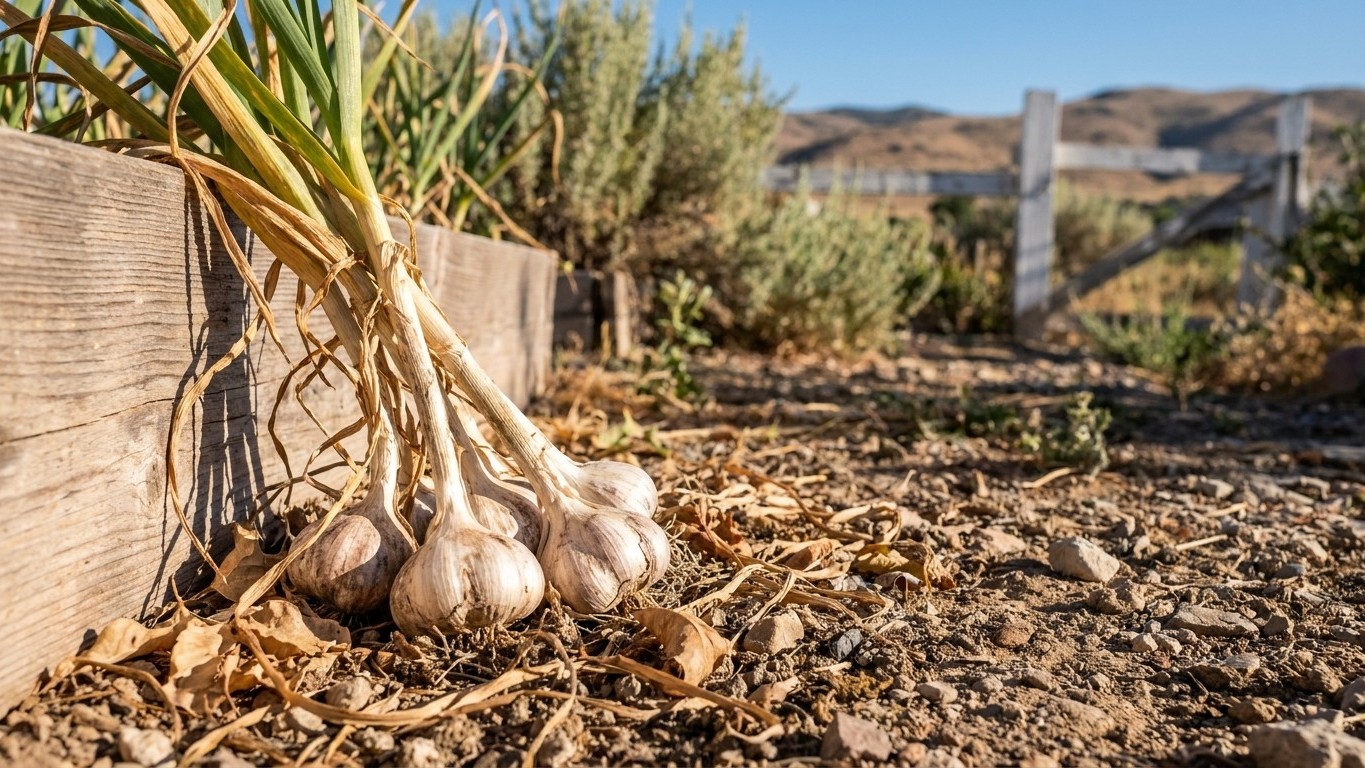

Most California gardens lift garlic sometime between late spring and midsummer, and the trigger isn’t a date on the calendar. It’s the plant itself: when the lower leaves brown off and the stalk starts to lean, the bulb underground has stopped growing. Wait for that signal, not for a specific week, because California’s climate zones mature garlic at very different speeds.
When garlic is ready to lift in California
Garlic planted in autumn spends winter building roots and a modest top of leaves, then pushes hard into bulb formation once days lengthen and soil warms. The finish line looks the same everywhere: the bottom leaves turn yellow and papery first, the color moves upward through the plant, and the whole stalk loses its rigid, upright look. That’s the cue to stop watering and start checking bulbs, not a fixed month.
What changes across the state is how fast the plant gets there. In the Central Valley, where summer heat arrives early and hard, bulbs typically mature and dry down faster than they would in a cooler, foggier coastal garden. Along the coast, marine layer overcast keeps soil temperatures milder for longer, which stretches out the bulbing period. In the Sierra foothills and interior valleys of Northern California, where actual winter cold slows early growth, the whole cycle can run later than in a low desert or Southern California garden that never really freezes.
Why frost matters here, but not the way people expect
This is where California stops behaving like a single climate. Coastal and Southern California don’t have a meaningful frost season at all. Thirty years of daily station records show zero days at or below 32°F, and the frost-free season is listed as running the full 365 days of the year, according to NOAA’s National Centers for Environmental Information (1991-2020 Climate Normals). For a gardener there, the limiting factor on garlic isn’t cold. It’s heat, drought, and whatever water restrictions are in place that year.
Northern California, the Central Valley, and the Sierra are a different story. Those regions do freeze in a normal winter, and that cold slows early root and leaf growth just enough to push the eventual harvest window later than it would fall in a frost-free coastal bed. Treating the whole state as one garlic calendar is the single biggest planning mistake, because a technique that works in a frost-free Southern California yard can leave a Sierra foothill grower harvesting weeks behind schedule.
Once several leaves have browned and the rest look tired rather than lush, pull one test bulb. A well-formed bulb should show plump, distinct cloves under a skin that’s still intact. If the wrapper is already splitting, don’t wait on the rest of the row.
Curing it, and where to hang it here
Curing is what turns a freshly pulled bulb, still full of moisture, into something that will actually keep. Skip it, or rush it, and even a perfect harvest rots in the pantry within weeks.
The process itself is simple: bulbs need weeks of airflow in a shaded, dry spot, with the leaves left attached and the roots left on. What’s not simple in California is finding that spot, because the state’s dry heat and its damp coastal air create opposite problems.
Inland and Central Valley conditions
In the hot interior, the risk is too much of a good thing. Direct sun on curing garlic can scald or partially cook the outer cloves, especially when afternoon temperatures climb into the high 90s or above. A garage, carport, or covered porch out of direct light works better than an open patio table. Good cross-ventilation matters more than shade alone, since stagnant hot air traps moisture against the bulb just as badly as fog does.
Coastal and marine-layer conditions
Along the coast, the problem flips. Persistent fog and higher humidity slow the drying process and raise the odds of mold starting on the outer wrappers before the bulb has fully cured. A well-ventilated shed, an open-sided carport, or an enclosed porch with a fan running gives the air movement that damp coastal conditions won’t provide on their own. Bunching stalks loosely, rather than packing them tight, also helps air reach every bulb instead of just the outer layer.
However the space is set up, the same rule applies everywhere in the state: keep curing garlic out of direct sun, out of standing humidity, and give it real airflow until the outer wrappers feel papery and dry rather than cool and moist.
Storing it through a California winter
Cured garlic keeps best cool, dry, dark, and ventilated, but “cool” means something different depending on where in California it’s stored.
In the frost-free coastal and Southern California zones documented by NOAA, outdoor storage structures never face a freezing risk in a typical winter. The challenge there is heat, not cold. A detached garage or shed can still climb into the 80s on a warm winter afternoon in some parts of Southern California, and that kind of warmth pushes stored bulbs toward early sprouting or softening. An interior closet, a cool pantry, or a shaded utility room away from any appliance that generates heat holds a steadier temperature than an uninsulated outbuilding.
In Northern California, the Central Valley, and the Sierra, where actual winter freezes do occur, the opposite risk shows up. An unheated shed or an exterior storage bin can drop cold enough on the coldest nights to affect bulbs stored right against an exterior wall, particularly in the Sierra foothills and higher interior valleys. Moving stored garlic a few feet away from uninsulated walls, or storing it in a garage rather than a fully exposed structure, avoids that edge-of-freezing exposure without needing to heat the space.
Humidity is the other variable that swings by region. Coastal fog and Central Valley tule fog both raise ambient moisture through winter, and that moisture is what triggers mold on stored bulbs faster than anything else. A layer of mesh, an open basket, or a paper bag with holes punched in it lets air circulate around stored garlic, while a sealed plastic container traps the exact humidity that causes rot. Checking stored bulbs every few weeks and pulling any that feel soft keeps one bad bulb from spreading mold through the rest of the batch.
What goes wrong here
Some of the most common garlic problems in California trace back to pests that UC Agriculture and Natural Resources documents as active in home gardens across the state. These are the ones with a record here, not a general list of everything that can bother a garlic bed nationwide:
- Aphids, including melon aphid
- Brown garden snail and slugs (Cornu aspersum)
- Corn earworm (Helicoverpa zea)
- Cucumber beetles
- Earwigs
- Leaffooted bugs
- Root-knot nematodes
- Spider mites
- Stink bugs
- Tomato hornworm (Manduca sexta and quinquemaculata)
- Whiteflies
Root-knot nematodes are the one that does the most damage before harvest ever happens, since they attack roots and bulbs underground and can leave garlic stunted or misshapen without any obvious sign above ground until the bulb is pulled. Brown garden snail and slugs, along with earwigs, tend to show up around curing bulbs left too close to soil or mulch, so lifting bulbs fully clear of the ground before curing cuts down on that contact.
Past the pest list, the two failures that show up most in California specifically are heat scald during curing in the Central Valley and interior deserts, and mold from lingering humidity along the coast. Both trace back to the same root cause: treating a curing or storage method that works in one part of the state as if it will work everywhere in it.
Anyone unsure how a given pest or growing issue applies to their specific county can check with their local University of California Cooperative Extension office, since recommendations shift by region even within a state this large.
Common questions
Does California garlic ever need protection from frost?
Only in the parts of the state that actually freeze. Northern California, the Central Valley, and the Sierra see normal winter freezes, while coastal and Southern California gardens are effectively frost-free based on 30 years of station records. A frost date, where one applies, is a midpoint too, meaning frost arrives later than that midpoint in roughly half of all years.
Can garlic cure outdoors in full California sun?
Not safely in the hotter parts of the state. Direct sun during curing can scald cloves once temperatures climb into the high 90s, which is common across the Central Valley and interior deserts in summer. Shade with strong airflow works better than open sun anywhere in California.
Why does stored garlic mold faster near the coast?
Marine layer fog keeps ambient humidity higher through much of the year, and that moisture is exactly what mold needs to take hold on stored bulbs. Ventilated storage, like mesh bags or open baskets rather than sealed containers, reduces that risk.
Are root-knot nematodes a common problem in California garlic beds?
They’re one of the pests UC Agriculture and Natural Resources documents in the state, and they attack underground, so damage often isn’t visible until harvest reveals stunted or misshapen bulbs. There’s no sign to watch for above ground that reliably flags an infestation early.