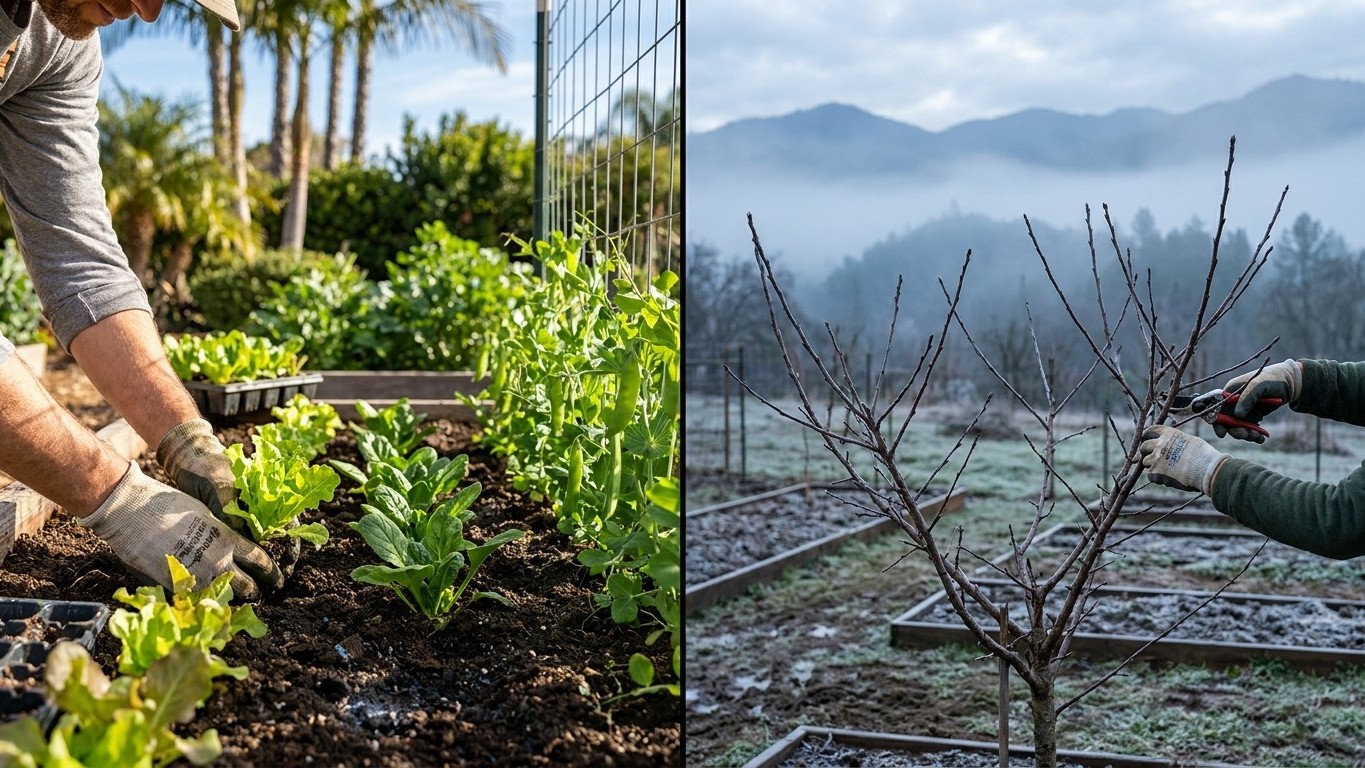

The honest answer depends on which California you’re gardening in. Along the coast and through Southern California, frost simply doesn’t happen in an average year, so January is an active planting month for cool-season crops. Head into the Central Valley, the foothills or anywhere in Northern California’s higher elevations, and the ground is often too cold or too wet to work, which shifts the month toward bare-root planting, dormant pruning and setup rather than seeding.
What goes in the ground in January

The decision here isn’t the calendar. It’s soil temperature and whether your particular patch of California sees a real freeze. NOAA’s climate data for the coastal and Southern California station shows zero days at or below 32°F across three decades of records, with the frost-free season listed at a full 365 days. That’s not a typo. It means gardeners in those zones are working against heat, drought and water restrictions in the growing season ahead, not frost damage in January.
For that frost-free stretch of the state, January is prime time to direct-sow lettuce, spinach, arugula, peas, fava beans and root vegetables like carrots and beets. Onion and garlic sets go in now too, along with transplants of broccoli, cabbage and other brassicas that shrug off cool nights. None of this is a gamble in these zones; the soil rarely drops cold enough to stall germination for long.
Inland and northern parts of the state tell a different story. The Central Valley, the Sierra foothills and interior valleys sit in USDA hardiness zones well below the coastal 10a-11a range, some dipping into the 5a-6b territory typical of higher elevations. Frost and even hard freezes are routine there in January, and the ground is frequently too wet or too cold to dig without compacting it.
What still works even where it freezes
Garlic and shallots can still go into workable ground in these colder zones, since both need a cold spell to size up properly. Bare-root fruit trees, roses and cane berries are dormant right now, which makes this the best window of the year to plant them, regardless of which California you’re in. Cold frames and low tunnels extend the option to sow hardy greens even where open-ground planting is off the table, and indoor forcing of chicory or rhubarb crowns gives something to harvest while the outdoor beds wait.
What to start under cover
Because frost isn’t the constraint along the coast and in Southern California, the arithmetic under cover looks different there than it does in a state with a hard freeze date. Instead of counting backward from a last-frost number, gardeners in these zones are timing tomato, pepper and eggplant seed starts so the transplants are sturdy, not leggy, by the time soil warms enough in spring to support them, typically eight to ten weeks before that soil-temperature shift happens locally.
In the Central Valley, the foothills and Northern California’s colder pockets, the traditional backward count from an average last-frost window still applies, but that date varies enough by elevation and microclimate that no single figure for the whole state is reliable. A gardener at 4,000 feet and one in a valley floor twenty miles away can be six weeks apart on when it’s safe to set plants out. Checking the local planting calendar through your county’s UC Cooperative Extension office replaces guessing with something closer to certainty.
The two ways this goes wrong are familiar to anyone who’s started seeds before. Start too early, and pepper or tomato seedlings sit in small pots for weeks past their prime, turning rootbound and stretched toward the light, then sulking for a month after transplant while they recover. Start too late, especially in the colder interior zones with a shorter true growing season, and warm-season crops don’t have enough days left to mature before fall cold shuts things down. Either mistake costs weeks of production, which is why the count matters more than the calendar page.
What is ready to pick
Citrus carries the harvest in California’s frost-free zones this month. Navel oranges, mandarins, grapefruit and lemons are all ripening on the tree through winter, and color alone isn’t a reliable signal that they’re ready; a taste test of one or two fruits per tree tells you more than the peel does, since citrus can hold color for weeks before or after peak sweetness. Alongside citrus, coastal and Southern California gardens are still producing lettuce, brassicas, root vegetables and herbs planted in fall.
Inland and in the colder mountain zones, outdoor harvest is thinner. Kale and leeks that overwintered in the ground often improve after cold exposure, since the plant converts starches to sugars as a kind of natural antifreeze, making them sweeter than they were in fall. Anything growing under a cold frame is fair game for cutting as needed.
Indoors, sprouts and microgreens fill the gap in every part of the state, ready in one to two weeks from seed with nothing more than a windowsill and a tray. This is also the month to walk the root cellar or pantry shelf and check stored squash, potatoes and onions. A soft spot on a squash, sprouting eyes on a potato, or a sour smell from an onion means that item gets used or composted now, before it spreads to the rest of the batch.
The jobs that matter this month
Dormant pruning tops the list for fruit trees, grapevines and cane berries anywhere in the state, since the plant’s energy is stored in the roots right now and cuts made while it’s leafless heal cleanly before spring growth resumes. Pair that pruning with the bare-root planting mentioned earlier and January becomes the single most efficient month of the year for establishing new fruiting plants.
Seed catalogs move fast, and the varieties most suited to California’s particular mix of heat, drought and short winters (heirloom tomatoes bred for dry-farming, drought-tolerant squash, citrus rootstocks) tend to sell out earliest. Ordering now, rather than waiting for spring planting fever, secures the varieties actually worth growing here.
Soil, tools and water
A soil test taken now gives results in time to amend before spring planting, whether that means adjusting pH in alkaline valley soils or adding organic matter to sandy coastal ground. Turning the compost pile, even in cold weather, keeps decomposition moving and prevents it from going anaerobic and sour. Tools deserve the same attention: a sharp pruning blade makes a cleaner cut that heals faster than a dull one that crushes tissue.
Given California’s recurring water restrictions, this is also the month to check drip lines and irrigation timers for winter damage before the system is under real demand in summer. Raised beds, fences and trellising that took a beating over the growing season get repaired now while nothing is actively growing through them. None of these jobs are glamorous, but skipping them shows up as a slower, weaker season later.
What not to do in January
The most common mistake in California’s mild coastal and Southern zones is planting warm-season crops because a stretch of sunny, 70-degree days felt like spring. Air temperature is not soil temperature. Tomatoes, peppers and squash set into soil that hasn’t warmed enough will sit stalled for weeks, vulnerable to rot and slow to establish roots, even with zero frost risk. Wait for the soil itself to warm, not the forecast.
In the colder interior and mountain zones, the equivalent error is uncovering cold frames or removing mulch after a few mild days, only to have a hard freeze move back in and damage plants that had started to push new growth. Once a plant breaks dormancy, it loses much of its cold tolerance, so protection stays on until the freeze risk has genuinely passed in that specific location.
Nitrogen fertilizer applied to dormant fruit trees or perennials right now does little good and can push soft new growth right before a freeze, which is exactly the growth most vulnerable to cold damage. Hold nitrogen until active growth resumes. And in a state where water use is often restricted by district rules, overwatering dormant beds “just in case” wastes a resource that will matter far more in the dry months ahead. Check soil moisture before running irrigation on anything that isn’t actively growing.
Checking this against your own county
Everything above is a statewide starting point, and California is too large and too varied for that to be an instruction. Elevation alone can shift a planting window by a month or more, and the difference between a foggy coastal strip and an inland valley twenty miles away can be just as large. Treating Los Angeles conditions as representative of Redding or South Lake Tahoe is one of the most common errors gardeners make with this state.
The University of California’s Agriculture and Natural Resources division runs county-based Cooperative Extension offices with planting calendars built for local conditions. Checking your county’s page at ucanr.edu turns this general guide into something specific to your actual garden.
Common questions
Can I plant tomatoes in California in January?
In coastal and Southern California, frost isn’t the obstacle, but soil is usually still too cool for tomato roots to establish well outdoors. Start seeds indoors instead and hold transplanting until soil warms. In the Central Valley and colder interior zones, outdoor tomato planting is well off, since freeze risk is still present.
Is California really frost-free in January?
Coastal and Southern California, yes, according to NOAA climate normals showing zero freeze days across three decades of record. Northern California, the Central Valley and the Sierra foothills are a different climate entirely and do experience freezing temperatures in January.
What USDA hardiness zone is California in?
The state spans an unusually wide range, from roughly 5a in high mountain areas to 11a along the mild coast and in the desert Southwest, per the USDA Plant Hardiness Zone Map. Always check your specific zone rather than treating the state as one climate.
When should I start seeds indoors for a California garden?
In frost-free coastal and Southern zones, count backward eight to ten weeks from when soil typically warms enough for transplanting, rather than from a frost date. In colder interior and mountain zones, count backward from your local average last-frost window, which your county extension office can provide than a statewide figure can.