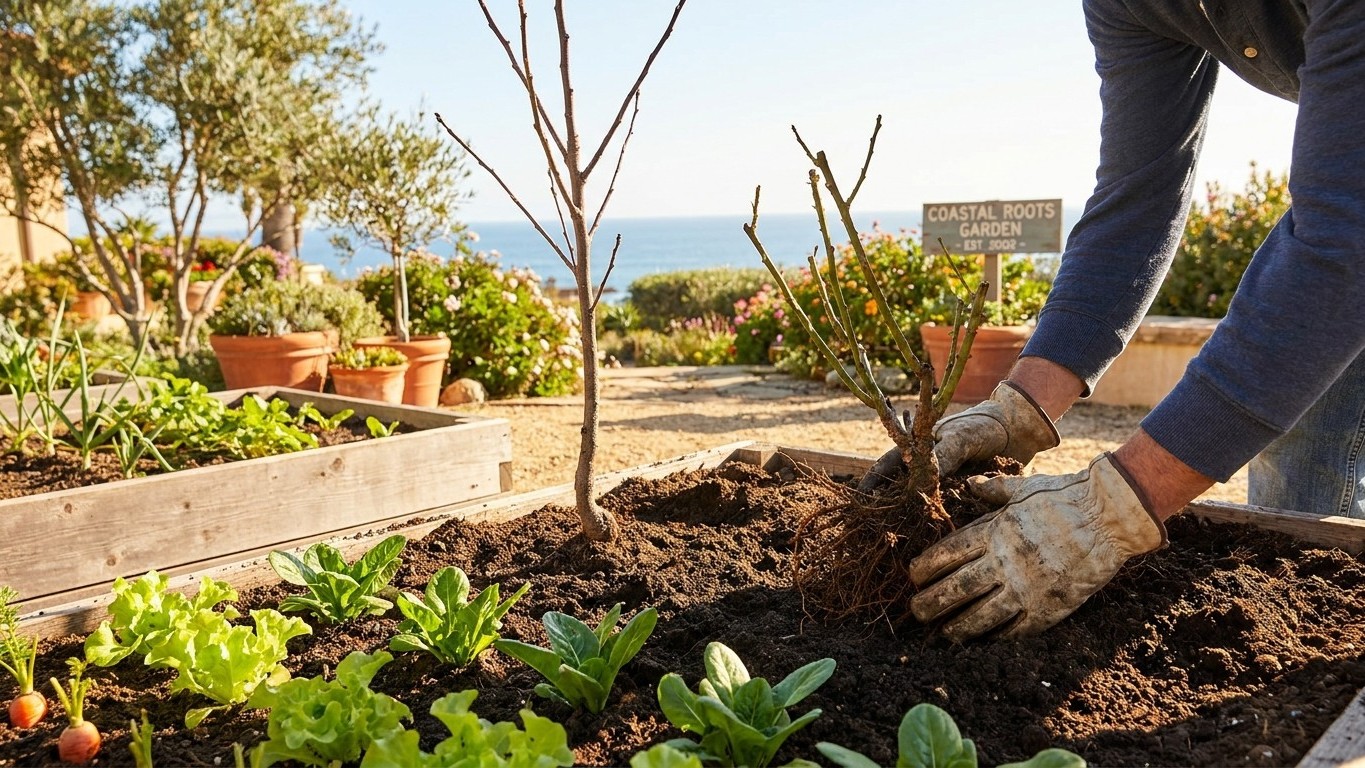

February in California splits into two different gardens depending on where you stand. Along the coast and through Southern California, frost simply doesn’t happen in an average year, so cool-season vegetables, bare-root roses, and dormant fruit trees can go into open ground right now. Inland in the Central Valley and up into the Sierra foothills, freezing nights are still a real risk, and the safe list narrows to hardy greens, alliums, and peas.
What goes in the ground in February

The reason California doesn’t fit a single answer comes down to elevation and distance from the ocean, not the date on the wall. Coastal and Southern California sit in a stretch of the state where NOAA’s 1991-2020 climate normals record zero days at or below 32°F across three decades of daily data. The frost-free season there is listed as 365 days. That’s not a rounding trick. It means the constraint on your garden this month is heat, drought, and water restrictions, not frost, and it means cool-season crops that would sulk under a frost blanket elsewhere can simply go straight into the ground.
In those frost-free zones, direct-sow lettuce, spinach, carrots, beets, radishes, and peas. Transplant broccoli, cabbage, and cauliflower starts. Onion sets and garlic cloves still go in where the soil is workable. Bare-root season for roses, fruit trees, cane berries, and asparagus crowns is in full swing, and February is one of the best windows of the year to get dormant stock into the ground before it breaks bud.
Move inland or up in elevation and the picture changes fast. The Central Valley and the Sierra foothills sit toward the colder end of California’s USDA Plant Hardiness range of 5a to 11a, a scale built on the average annual extreme minimum temperature, not on how many frosts you get in a normal winter. There, hold off on anything tender. Stick to what tolerates a hard chill: garlic, shallots, and peas can still go in on workable ground, and hardy greens like kale and spinach shrug off a light frost that would kill a pepper transplant overnight.
| Region | Frost risk this month | Safe to plant outdoors |
|---|---|---|
| Coastal & Southern California | None in an average year | Lettuce, peas, brassicas, onions, garlic, bare-root roses and fruit trees |
| Central Valley | Still present, cold nights common | Garlic, shallots, peas, hardy greens; hold tender crops |
| Sierra foothills & mountains | Ground often frozen or snow-covered | Dormant bare-root planting where ground is workable; cold frames |
If your ground is frozen or waterlogged, don’t force it. Cold frames and low tunnels extend the frost-free window inland, and forcing rhubarb or chicory indoors gives you something to harvest while the beds outside stay closed for business.
What to start under cover
Seed-starting math works backward from your frost window, not forward from a fixed date, and that’s especially true in a state where one county has no frost window at all. Tomatoes, peppers, and eggplant need roughly six to eight weeks indoors before they go outside, and even in frost-free coastal zones, soil temperature and night air stay too cool for direct sowing of these crops until later in spring. Start them under cover now and you’ll have stocky, ready transplants when the ground finally warms.
Inland gardeners in the Central Valley or foothills should count back from their own last-frost range rather than borrow a coastal timeline. Starting six to eight weeks before that range gives peppers and eggplant, which germinate slowly, enough head start; tomatoes can be started a touch later since they grow faster once seedlings emerge.
The two failure modes show up every year. Start too early and you get leggy, rootbound seedlings stretching for light on a windowsill weeks before it’s safe to plant them out, a stress that shows up later as stunted, slow-to-fruit plants. Start too late in a short-season mountain garden and you run out of warm days before fruit sets. A simple fix for the early-start problem: pot up seedlings into larger containers if outdoor conditions lag, buying a few extra weeks without the plant becoming pot-bound. This is also the month to start onions and leeks from seed if you want larger bulbs than sets typically produce, since they need a long runway before the summer bulking phase.
What is ready to pick
Citrus carries the California winter harvest almost single-handedly. Navel oranges, mandarins, grapefruit, and lemons are in season now across the frost-free zones, and the test for readiness is simple: taste one. Color can be misleading on citrus, since some varieties hold green tinges even fully ripe, but sugar content doesn’t lie.
Avocados planted in warmer coastal and Southern California gardens are also coming off the tree depending on variety, though avocados don’t ripen on the branch, so pick a test fruit and let it soften on the counter before harvesting more. Fall-planted brassicas, hardy greens, and root vegetables are ready to pull in frost-free areas, and leeks and kale that overwintered in colder inland gardens are often sweeter now than they were in fall, since a touch of cold converts starches to sugars.
In the coldest mountain gardens where the ground is locked up, the honest answer is that little comes out of the soil this month. That’s where stored crops and indoor growing carry the kitchen: check stored winter squash, potatoes, and onions now for soft spots or sprouting, and pull anything starting to turn before it spoils the rest of the bin. Sprouts and microgreens on a countertop tray fill the gap in as little as a week and need no garden at all.
The jobs that matter this month
Dormant pruning of fruit trees and cane berries has a real deadline: once buds swell and growth resumes, every cut costs the plant stored energy it needs for the coming season. Prune apples, pears, and stone fruit while they’re still fully dormant, before bud break makes the job riskier and messier.
Seed ordering belongs on this month’s list too, and not as an afterthought. Popular vegetable varieties, especially ones bred for short seasons or disease resistance, sell out earlier every year as home gardening demand climbs. Order now and you’ll have full stock to plan a rotation around, rather than a plan built on whatever’s left.
Soil testing and amending pays off before spring planting rather than after. A basic pH and nutrient test tells you whether your Central Valley clay needs gypsum or your coastal sandy loam needs organic matter, and amendments worked in now have weeks to integrate before roots need them. Turning compost keeps the pile active through cool weather instead of letting it stall.
Beyond the soil, this is maintenance season: sharpen and oil pruning shears and hoes before the rush of spring planting makes time for tool care disappear, repair raised bed frames and fencing while beds sit empty, and check stored crops weekly for the first signs of rot so one bad potato doesn’t take down the whole bin. In frost-free zones, scout for aphids and other pests that never fully die back over a mild winter; a population that overwinters at low numbers can explode fast once temperatures climb.
What not to do in February
The classic mistake in frost-free California is reading a stretch of 70-degree days as a green light for tomatoes and peppers. Air temperature isn’t soil temperature, and warm-season crops planted into cold, still-damp February soil sit and sulk rather than grow, often rotting at the root before they ever take off. Wait until soil has genuinely warmed, and start those crops under cover instead.
Inland gardeners make a related error: uncovering cold frames or removing row cover after a mild spell, only to lose tender growth to the next cold snap that follows. A few warm days in February don’t mean winter is finished in the Central Valley or the foothills. Keep protection in place until the pattern actually shifts, not after one comfortable afternoon.
Heavy nitrogen feeding this early is another common misstep. Applied before roots are actively growing, nitrogen either leaches away with winter rain or pushes soft, weak top growth that pests target first. Hold off on nitrogen-heavy fertilizer until plants show active growth, and lean on compost and slow-release amendments in the meantime. Finally, resist the urge to work wet soil. Digging or tilling clay soil while it’s saturated compacts it into clods that take a full season to break down, undoing months of good soil structure in a single afternoon.
Checking this against your own county
Everything above is a starting point built on state-wide frost data, and California is too large and too varied for a single month-by-month answer to hold everywhere. Elevation, distance from the coast, and even which side of a valley you’re on can shift these windows by weeks. A garden in the Sierra foothills and one forty miles away on the coast are, for planting purposes, in different climates entirely.
The most reliable next step is your local county extension office through the University of California Agriculture and Natural Resources network, which publishes planting calendars and frost guidance tuned to local conditions rather than statewide averages.
Common questions
Does it ever frost in Southern California in February?
NOAA’s climate normals for the coastal and Southern California station record zero days at or below 32°F across three decades, with the frost-free season listed as 365 days. Frost is not a normal-year event there, though microclimates in low-lying inland valleys can occasionally see a cold snap that regional averages don’t capture.
Can I plant tomatoes outside in February in California?
Not advisable, even in frost-free zones. Soil and night air are typically still too cool for tomatoes to grow well outdoors this month. Start seed under cover instead and transplant once soil has warmed later in spring.
What’s the best February job if I only have time for one?
Dormant pruning of fruit trees and cane berries. It has a hard deadline, since pruning after bud break costs the plant stored energy, and it directly shapes the size and health of the coming harvest.
Why does California have such a wide hardiness zone range?
The USDA Plant Hardiness Zone Map places California between 5a and 11a, a range built on average annual extreme minimum temperatures. That spread reflects the state’s terrain, from frost-free coastal lowlands to high Sierra elevations, more than any single climate pattern.