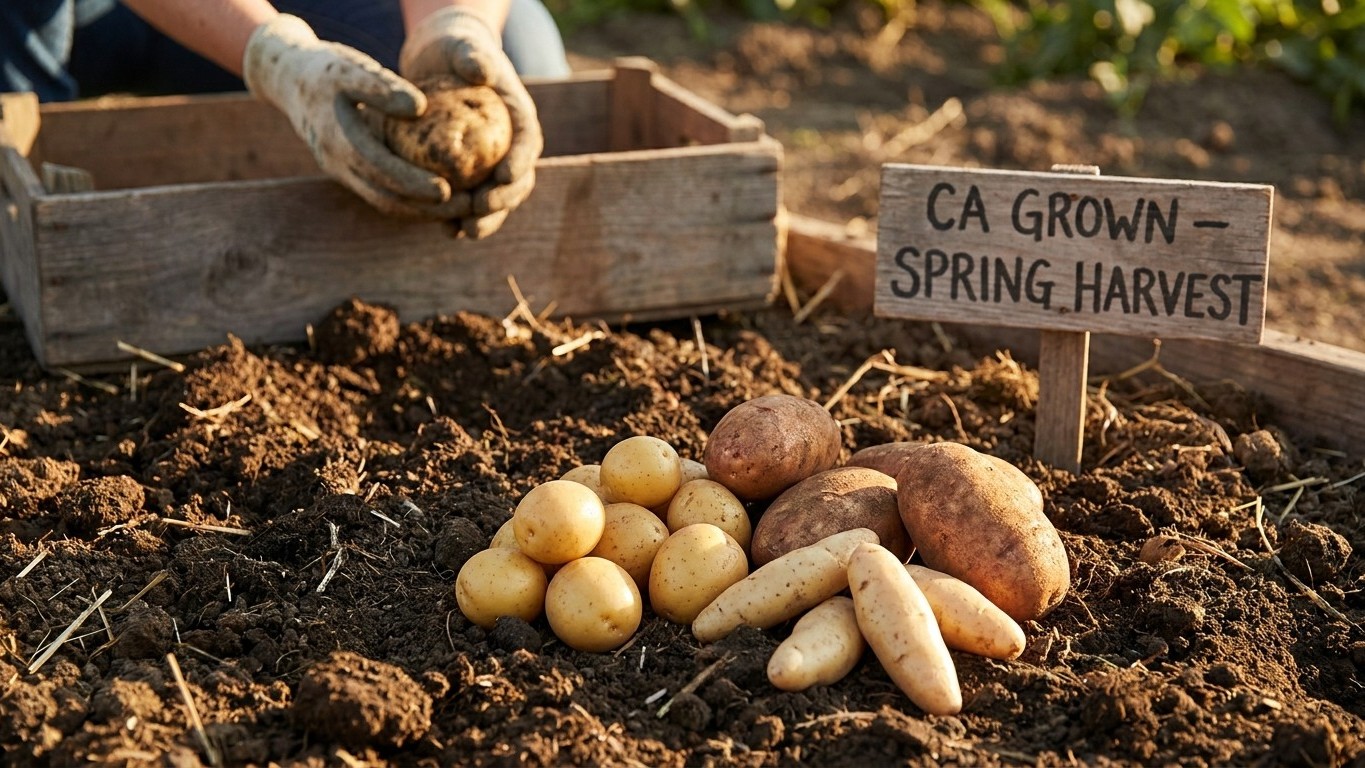

Potatoes that suit California are early and mid-season varieties grown as a spring crop and timed to soil temperature rather than a frost date. That’s because Los Angeles logged zero days at or below 32°F in three decades of record, per NOAA NCEI’s 1991-2020 Climate Normals for that station, while the state’s interior valleys routinely push soil past the 90°F ceiling that stops a potato plant from sizing its tubers, according to Utah State University Extension.
The short answer
California doesn’t have one potato climate, it has at least three, and the variety question only makes sense once you know which one you’re gardening in. Along the coast and through Southern California, the NOAA NCEI 1991-2020 Climate Normals for Los Angeles (station USW00023174) show no computable freeze normal at all, a frost-free season effectively listed as 365 days. That’s not a rounding of a late frost date. It’s the absence of one. For a gardener in that zone, the limiting factor was never going to be cold.
The limiting factor is heat, and the number that matters comes from Utah State University Extension: soil temperatures above 90°F inhibit tuber set and fill. A potato plant doesn’t stall gracefully in hot soil. It simply stops putting starch into the tubers it already started, and no amount of extra watering reverses that once it happens. Given how many low-desert and Central Valley afternoons push soil well past that mark by early summer, the variety choice for most of California isn’t about finding something that “likes heat.” It’s about finding a variety that can finish its bulking before the soil gets there.
That’s why the practical answer leans toward early and mid-season potatoes rather than late ones. The University of Maine Cooperative Extension, in Bulletin #2077, classes potatoes by season length, early, mid-season, and late, without publishing a days-to-maturity figure for any of them, because that number shifts too much with soil temperature and daylight to be reliable across regions. An early variety reaches its bulking window and finishes it before the soil crosses 90°F. A late variety is often still trying to size tubers when the heat arrives, and in a California summer that race usually goes to the heat.
Northern California, the Sierra foothills, and the high desert are the exception to all of this. Those regions do freeze, sometimes hard, and a gardener there is working against a real spring frost date the way a Midwestern gardener would. Treating the whole state as frost-free because Los Angeles is would be a mistake with a real cost: planted too early in a freezing region, a potato crop is lost to cold, not heat. The two constraints, frost in the north and mountains, heat in the valleys and south, never overlap on the calendar the way a gardener might hope.
What actually decides it
Two separate mechanisms are doing the work here, and they don’t operate on the same clock. Understanding both means you can reason through a California county this page never names.
The heat ceiling that ends the season early
Utah State University Extension’s fact sheet is specific about the physiology: once soil temperature climbs above 90°F, tuber set and fill are inhibited. This isn’t the plant wilting or the leaves scorching, it’s the below-ground process that actually makes a potato a potato quietly shutting down. A gardener who keeps watering through that stretch, thinking drought stress is the problem, is treating the wrong symptom. The soil temperature is the trigger, not the moisture level, and once the ceiling is crossed for long enough, later cooling doesn’t restart meaningful bulking on that crop.
This is also why days-to-maturity numbers are unreliable enough that neither source publishes one. A “mid-season” variety in a cool coastal fog belt might bulk for weeks longer than the same variety planted in a Central Valley location where soil hits 90°F a month sooner. The season class tells you the plant’s relative pace. Local soil temperature tells you how much time it actually gets.
The planting window that frost or its absence sets
The other mechanism is the planting trigger itself. Per Utah State University Extension and the University of Maine Cooperative Extension’s Bulletin #2077, potatoes go in the ground as soon as soil reaches 50°F, which lands roughly 14 to 21 days before the last frost date, wherever a last frost date exists. In frost-free Los Angeles, that trigger becomes purely a soil-temperature question with no frost date to count backward from. In Northern California or the Sierra, the old backward-count from an actual frost date still applies.
Put the two mechanisms together and the reasoning generalizes: figure out how early your soil hits 50°F, and figure out how many weeks you have before it likely crosses 90°F. That gap, not the calendar month, is your growing window, and it’s what should decide whether an early or mid-season variety fits.
How to do it
- Check your soil temperature directly, with a probe thermometer at planting depth, rather than relying on the air temperature or a generic calendar date.
- Plant once soil reaches 50°F, per Utah State University Extension and University of Maine Cooperative Extension guidance, which in a frost-prone region falls 14 to 21 days before Your Last Frost date, and in a frost-free coastal or Southern California location simply falls whenever soil reaches that mark.
- Choose an early or mid-season variety class if your region tends to cross 90°F soil temperature by early or midsummer, since late-season classes need a longer bulking window than that heat ceiling allows.
- Buy certified seed potatoes rather than saving pieces from a grocery-store tuber or an uncertified source, because uncertified seed carries virus that a home gardener can’t see or screen for.
- Track soil temperature through the season and treat the approach of 90°F as the practical end of productive tuber bulking, not a cue to increase watering.
- Dig the crop once the heat ceiling has been crossed for a sustained stretch, rather than leaving tubers in soil that’s no longer sizing them.
What goes wrong
- Planting by the calendar instead of the soil. A gardener who plants on a fixed date, ignoring actual soil temperature, either sets seed into soil still too cold or misses the early window entirely. Check soil temperature directly and plant at 50°F, regardless of what the calendar says.
- Assuming the whole state is frost-free. Los Angeles carries no computable freeze normal, but the Central Valley, Northern California, and Sierra foothills do freeze. Applying the coastal frost-free pattern to an inland or mountain garden risks losing a crop to a real spring frost. Check your local frost history rather than borrowing Los Angeles’s.
- Choosing a late-season variety class in a hot-soil region. A late class needs a longer bulking window than a Central Valley or desert summer typically allows before soil crosses 90°F. Favor an early or mid-season class where that heat ceiling arrives early.
- Watering harder once growth stalls in midsummer heat. Utah State University Extension’s mechanism is a soil-temperature ceiling on tuber fill, not a moisture deficit, so extra water doesn’t restart bulking once soil has crossed 90°F for a sustained stretch. Treat the stall as a heat signal and plan the next season’s planting earlier instead.
- Reusing uncertified seed potatoes. Seed saved from a grocery tuber or a neighbor’s uncertified stock carries virus risk that isn’t visible in the tuber itself. Buy certified seed each season instead.
Common questions
Do coastal California gardens need to worry about frost dates at all?
Per the NOAA NCEI 1991-2020 Climate Normals for the Los Angeles station, no freeze normal is computable there and the frost-free season runs the full year. Planting timing in that zone is set by soil temperature reaching 50°F, not by a frost date, since there effectively isn’t one to count from.
Can a late-season potato variety still work in California?
Neither Utah State University Extension nor the University of Maine Cooperative Extension publishes a fixed maturity length for any season class, so it isn’t a flat no. But a late class needs more bulking time before soil crosses the 90°F ceiling, and in most California interior and southern locations that window is shorter than a late variety typically wants.
Why does my potato patch stop growing tubers in July even though I’m watering it well?
That pattern matches the mechanism Utah State University Extension describes: soil above 90°F inhibits tuber set and fill directly, independent of moisture. Extra watering doesn’t reverse it once the ceiling has been crossed for a sustained period.
Is it worth buying certified seed potatoes instead of saving my own?
Yes. Uncertified seed, including tubers saved from a previous home crop or bought at a grocery store, can carry virus that isn’t visible on the surface and can reduce yield without any obvious warning sign. Certified seed is screened specifically to avoid that risk.