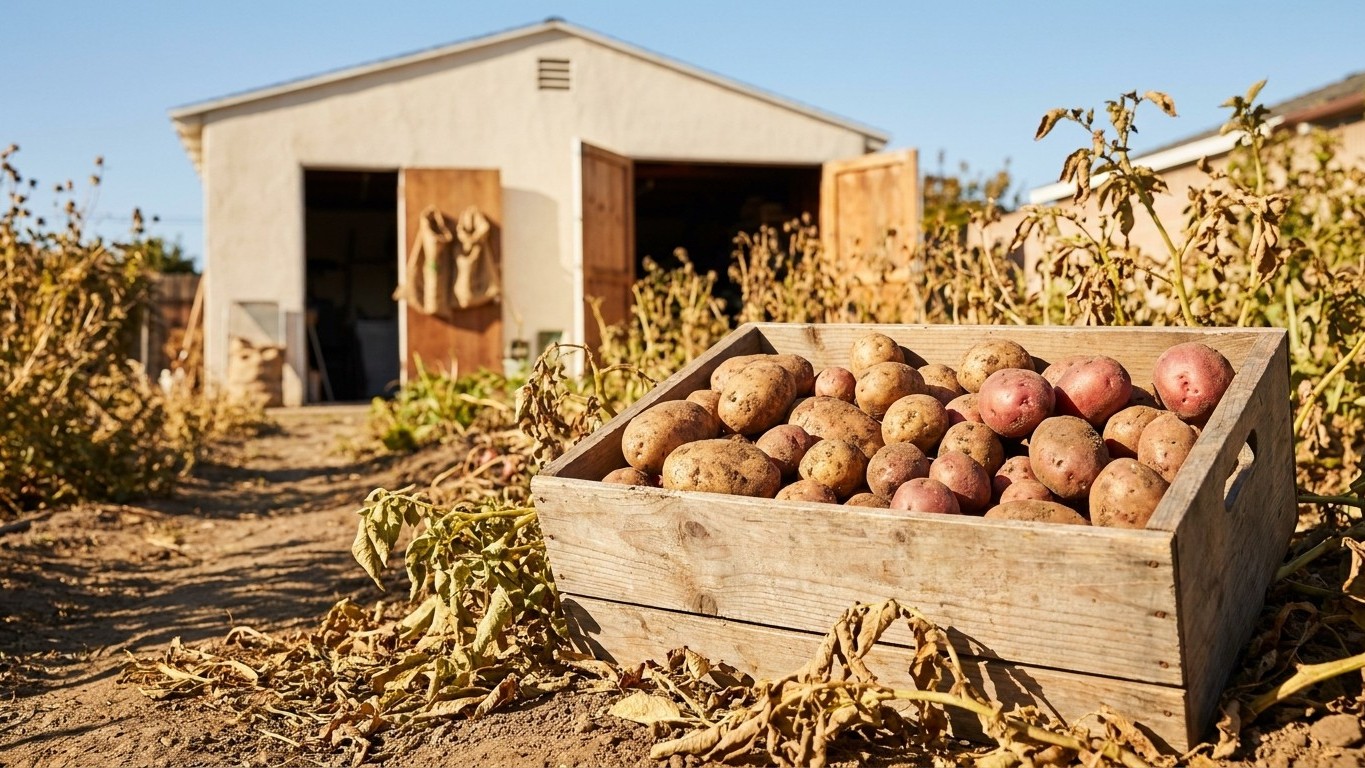

In coastal and Southern California there is no fall frost to plan around at all: NOAA records show zero days at or below 32°F in thirty years at the Los Angeles reference station, a frost-free season listed as 365 days. Harvest is a maturity call, not a frost race. The bigger question is storage. The coldest month there averages a 49.1°F low, which means an unheated space often runs warmer than the 40-45°F potatoes need, not colder.
The short answer
California is not one climate, and this page can only speak precisely to the coastal and southern reference point in the data: Los Angeles. There, NOAA NCEI’s 1991-2020 Climate Normals show no computable frost date because no freeze occurs in an average year. That changes how you time harvest. Instead of watching a forecast for a killing frost, gardeners here dig once the vines yellow and die back on their own, or once they choose to stop watering and let the foliage collapse. There’s no calendar frost cue to wait for.
That absence of cold is exactly what makes storage the harder half of the job in this climate. The mean daily minimum for the coldest month at the Los Angeles station is 49.1°F, per NOAA NCEI. Potatoes want a storage range of 40-45°F, according to Utah State University Extension, or 38°F at 95% humidity, per the University of Maine Cooperative Extension. A coastal or Southern California garage, shed, or covered porch in winter is rarely going to freeze, but it’s just as rarely going to sit down in the low 40s or high 30s on its own. Left alone, an unheated space here tends to hover close to that 49°F figure, or above it in a sheltered spot, which is warm enough to wake the tubers into early sprouting well before spring.
Northern California, the Central Valley, and the Sierra foothills and higher elevations are a different story entirely, and this figure does not describe them. Those regions do experience real freezes in winter, sometimes hard ones, and a grower there needs to check local frost data rather than borrow the Los Angeles normals. If you garden in Redding, Fresno, Tahoe, or anywhere with a documented frost season, treat this page’s numbers as a coastal and southern reference point only, and look up your own station’s normals before you assume your shed won’t freeze.
For the frost-free zone, the practical upshot is this: you get to skip the anxious pre-frost dig that gardeners in colder states have to manage, but you have to work harder to find or create a storage spot that’s actually cool enough, not just one that’s merely unheated.
Curing, and where
Curing is the step between digging and storage, and it’s non-negotiable if you want potatoes to keep past a few weeks. Utah State University Extension specifies 55-60°F with high humidity for two to three weeks, which lets cut and bruised skin heal over before the tubers go into longer-term storage. In coastal and Southern California, that temperature band shows up naturally in fall and early winter almost everywhere except during a heat spell, which makes timing and shade the real variables, not finding warmth.
- Dig on a dry day and shake off loose soil without washing the tubers; wet skin cures poorly and invites rot.
- Move them out of direct sun immediately. Coastal and Southern California sun, even in fall, can push a spot well past 60°F and scald or green exposed skins within an hour.
- Set them in a single layer, not piled, in a shaded porch, a detached garage with the door cracked, or a covered patio corner where airflow moves but direct light doesn’t reach.
- Check the space’s actual temperature rather than guessing. If afternoon highs there run past 60°F, curing will happen too fast and unevenly; move the crop to the coolest shaded spot on the property, even if that’s just the north side of the house.
- Hold humidity up by loosely covering the potatoes with a burlap sack or a single layer of newspaper, since dry California air in fall pulls moisture out of skins faster than curing schedules assume.
- After two to three weeks, brush off dried soil and sort out any tuber that’s gone soft, moldy, or green before moving the rest into winter storage.
A basement is the classic curing spot in colder states, but most California homes are slab-on-grade with no basement to use. That’s not a loss, it just means the shaded porch or garage does the job instead, as long as you’re watching the thermometer rather than assuming “outside in fall” is automatically in range.
Storing through this winter
Once cured, potatoes want a dark space at 40-45°F according to Utah State University Extension, or 38°F at 95% humidity according to the University of Maine Cooperative Extension. Set that against the 49.1°F coldest-month minimum at the Los Angeles reference station, and the mismatch is obvious: an ordinary unheated garage or shed here tends to run warmer than either target, not colder. That’s the opposite problem gardeners in freezing climates deal with, where the risk is the crop turning to mush overnight. Here, the risk is a slow, steady sprouting that starts weeks or months earlier than it should.
Finding 40-45°F in a Southern or coastal California winter usually means picking the coolest, darkest interior space available and treating it seriously: an insulated closet on an exterior wall, an unheated interior room kept closed off from household heat, or a well-insulated cooler or box kept in the coolest corner of a garage. A cardboard box or paper sack inside a plastic tote with the lid ajar, tucked into the darkest, least-heated part of the house, often gets closer to that range than an open garage shelf does. Refrigeration is too cold and too moist for whole storage runs and tends to convert starches to sugar, so the goal is a cool room, not a fridge.
Darkness matters as much as temperature. Any light exposure during storage, even low ambient light through a window, turns skins green and produces solanine, a compound that makes the tuber unpleasant and potentially harmful in quantity. A covered box or an opaque bin solves this cheaply. Check stored potatoes every couple of weeks through winter, pulling out any that have started to sprout, soften, or show rot, since one bad tuber spreads decay to its neighbors quickly in the mild, faintly humid conditions coastal and Southern California winters tend to produce.
What goes wrong here
- Storage space runs too warm. A 49.1°F coldest-month minimum means many garages and porches sit above the 40-45°F target all winter. Find the single coolest, darkest interior spot in the house instead of defaulting to “the garage,” and check it with an actual thermometer before trusting it.
- Early sprouting. This is the direct result of the above: potatoes sitting near 49°F rather than 40-45°F sprout well ahead of schedule. Rub off small sprouts as they appear and use those tubers first rather than waiting for the whole batch to hold.
- Sunscald and greening during curing. Fall and winter sun in this climate is stronger than gardeners expect, and a curing spot that seemed shaded at 10 a.m. can bake by 2 p.m. Move the crop, don’t just cover it, once you notice direct light reaching it.
- Skins drying out too fast. Low humidity during Southern California’s dry season can pull moisture from curing potatoes before wounds seal, leaving them shriveled going into storage. A loose burlap or newspaper cover during the two-to-three-week cure holds humidity up without trapping rot-causing moisture.
- Pest and disease pressure at digging time. Wireworm and scab damage can go unnoticed until harvest. Utah State University Extension’s guidance on appropriate insecticides and appropriate fungicide, applied during the growing season rather than after digging, is the effective window; once tubers are out of the ground, damaged ones should be used first and not stored long-term.
Common questions
Do I need to wait for a frost before harvesting potatoes in coastal or Southern California?
No. NOAA NCEI data for the Los Angeles reference station show no freeze occurs in an average year there, so there’s no frost date to wait for. Harvest is based on vine dieback or your own decision to stop watering, not a frost forecast.
Will my garage freeze my stored potatoes over winter?
In coastal and Southern California, unlikely. The coldest month there averages a 49.1°F minimum, well above freezing. The realistic risk in this climate is the opposite of freezing: storage running too warm and the crop sprouting early.
What if I garden in Northern California, the Central Valley, or the Sierra?
Those regions do see real freezes, and the Los Angeles-based figures on this page don’t describe them. Check your own local frost normals before assuming an unheated space is safe from freezing there.
How long should potatoes cure before I put them into storage?
Utah State University Extension recommends two to three weeks at 55-60°F with high humidity, done in a shaded, well-ventilated spot out of direct sun.