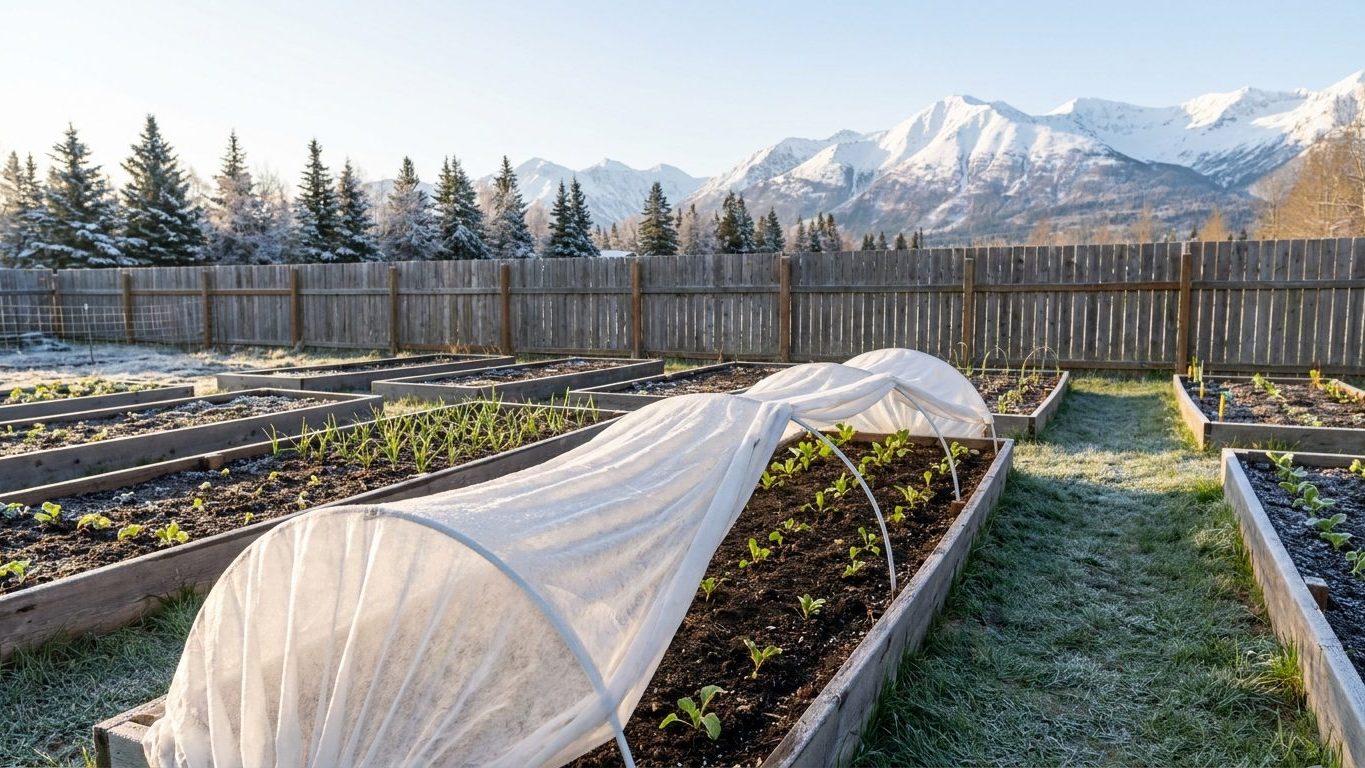

Cover your garden in California only when a freeze is forecast, and only where freezes happen. Coastal and southern gardens, such as those around Los Angeles, get through an average year without a single one. The northern part of the state, the Central Valley and the Sierra do freeze, so covers there go on the evening before a clear, calm, cold night. Elsewhere, covers are for heat, wind and pests.
The short answer for California
Put the cover on in the evening when the overnight low is forecast at 32°F or below, and take it off the next morning once the air warms. That rule applies wherever California freezes. Fabric row cover traps some of the warmth the soil gives off overnight, which is why it works best on still, clear nights and does much less when wind keeps stripping the heat away.
The reference station for coastal and southern California is in Los Angeles, at 33.94 degrees north. NOAA’s 1991-2020 climate normals there show that no freeze occurs in an average year, and daily records show zero days at or below 32°F in 30 years. The station lists 365 frost-free days, so there is no last-frost date to plan around. The mean daily minimum of the coldest month is 49.1°F, which is cool but nowhere near freezing.
For a gardener on the coast or in the southern basins, that changes the question. A frost calendar does not apply, and neither does the habit of waiting for a safe planting date. Warm-season crops can go in early, and cool-season crops grow through winter in the open. The covers that earn their keep are shade cloth, insect netting and bird netting. Shade cloth goes up before a forecast heat wave, not after the leaves have scorched. Netting goes on when seedlings emerge or fruit starts to color.
Inland and north, the calendar returns. Frost cloth is a tool for the shoulder weeks, the nights in fall before the first hard freeze and the nights in spring after tender transplants go out. Tomatoes, peppers, squash, basil and beans suffer at freezing. Kale, chard, carrots and most hardy greens shrug off a light freeze and rarely need a cover. Cover the tender plants and leave the hardy ones alone.
Cover edges should reach the ground and be pinned down with soil, boards or stakes, because cold air creeps in under a loose hem. Hoops or stakes keep fabric off the leaves, since fabric resting on foliage can pass the cold straight through. The broader approach is laid out in Extending the Growing Season in California.
What will not work here

A frost-date calendar copied from another state fails first. Gardeners in the Midwest or Northeast wait for a last spring frost and cover plants on fixed weeks. Those dates do not exist for the coast and the southern basins, where no freeze occurs in an average year. Holding transplants indoors until a “safe” date wastes months of growing weather.
Closed plastic tunnels fail next. Clear plastic traps heat on sunny days, and in a climate where the coldest month still averages a nighttime low of 49.1°F, a sealed tunnel is more likely to cook seedlings than to protect them. Even in colder parts of the state, a tunnel left shut through a sunny winter afternoon can overheat. If you use plastic where freezes occur, vent it on mornings that will turn warm, and close it again at dusk.
Frost cloth left on through a heat wave is a quieter mistake. Fabric that saved the tomatoes in November will hold in heat and block airflow in a hot week in June. Choose the cover for the threat in front of you. Heavy frost cloth is for cold nights, light shade cloth is for strong sun, and neither belongs on the plant for the other job.
Weekly deep watering fails under summer shade structures too. A hot, dry summer with water restrictions punishes anyone who irrigates on a fixed day. Covers that cut sun can slow evaporation, but they do not replace mulch and watering matched to what the soil is doing. Check the soil a few inches down and water when it is dry there, rather than by the calendar. Drip lines under shade cloth stretch a restricted water allowance further than overhead spray, which loses much of its water to the air.
Finally, row cover will not rescue plants from a hard freeze that goes well below the forecast. A single layer buys a few degrees at best. On nights when the forecast is marginal, add a second layer or water the bed in the afternoon, since moist soil holds and releases more heat than dry soil. If you are weighing which extender suits which job, Which Season Extenders Work in California compares them.
What changes across California
California is not one garden. The USDA Plant Hardiness Zone Map (2023, built on 1991-2020 normals) runs from 5a to 11a across the state, and the zone number rests on one variable, the average annual extreme minimum temperature. That spread is wider than the distance between Minnesota and southern Florida. There is no single cover date for the state, and any advice that gives one is wrong for most of it.
The Los Angeles figures describe the coast and the southern basins. They do not describe Sacramento, Fresno, Redding or a mountain town. The Central Valley, the northern interior and the Sierra all see freezes, and higher elevation means colder nights and a shorter stretch between the last spring freeze and the first fall one. If you garden in the north or at altitude, treat the freeze rule in the first section as your starting point and plan for a real frost calendar. Cover earlier in fall, keep covers handy later into spring, and wait longer before setting out tender transplants.
Latitude adds another wrinkle. Day length, not warmth, tells an onion to stop making leaves and start swelling a bulb, and the 33.94 degrees north figure belongs to Los Angeles. A gardener far to the north has longer summer days and shorter winter ones, so onion varieties and planting windows shift. Check your own latitude before copying a southern timetable.
Within a single county, the difference between a coastal strip and an inland valley a few miles away can be large. Cold air drains downhill and pools in low spots, so the bottom of a slope freezes when the top does not. Hills, buildings and large bodies of water all nudge temperatures. To find the hardiness zone for your location, look up your ZIP code on the USDA Plant Hardiness Zone Map, rather than guessing from the zone of a friend in the next town.
Where to check this for your own county
The best local source is University of California Agriculture and Natural Resources, the state’s extension service. It runs county offices staffed by advisors and Master Gardener volunteers who work with the soils, elevations and weather of your area every day.
Look for two things there. The first is the local planting calendar for your county, which states sowing and transplanting windows by crop and, where freezes occur, the cover advice that goes with them. The second is the list of varieties that have been trialed in your county, because a tomato that thrives on the coast can stall in inland heat, and a variety bred for short northern summers may bolt early in the south. Many county offices also post pest alerts, water-use guidance and answers to common questions from local gardeners.
A county recommendation beats a state one. What you are reading is the state-level picture. It tells you the shape of the problem, which is freeze in some regions, heat and drought in others, and a very wide range of zones. It cannot know whether your street sits in a cold pocket or on a warm south-facing slope. Your county advisors can.
Call or email the office if the website does not give you what you need. Advisors tend to answer practical questions quickly, and they know the local record. Bring the questions that matter: when the last spring freeze usually falls in your part of the county, which crops are worth covering and which are not, and what has worked for gardeners nearby.
Checking this against your own garden
Your own observations outrank every date and zone number you read. Three signs will tell you more than a calendar, and none needs a gadget.
- Soil warmth by feel. Push your hand a few inches into the bed in the morning. If the soil feels cold and damp, warm-season seeds will sit and rot. If it feels mild, they will sprout. Compare a sunny spot with a shaded one, and the difference is your microclimate.
- The first male flowers on squash and cucumbers. They open before the female flowers, and when they appear early, the bed is warming faster than the neighborhood average. If they come late, cover sooner in fall and plant later in spring.
- The first true leaves on seedlings. The first pair that unfolds are seed leaves; the next pair look like the adult plant. Seedlings that reach true leaves quickly are in a warm spot. A stalled seedling points to cold soil or a cold pocket in the yard.
Write down what you see and the dates you see it. After two seasons you will have a calendar tuned to your yard, which is worth more than any general chart.
Common questions
Do I need frost cover in Los Angeles?
Almost never. The Los Angeles reference station has no freeze in an average year and 365 frost-free days. Shade cloth and netting are the covers that matter there.
When should I take frost cover off?
Take it off the morning after, once the air has warmed and the sun is on the bed. Leaving it on a sunny day can overheat the plants and keep pollinators away from flowers.
Does the 32°F rule apply to every plant?
No. 32°F is the freezing point of water, and tender plants such as tomatoes, peppers, basil and beans are damaged by it. Hardy greens, carrots and many brassicas tolerate a light freeze without cover.
Can I use the same row cover in summer and winter?
Not well. Heavier frost cloth holds heat and restricts airflow in hot weather. Use shade cloth or light netting for summer sun and pests, and keep frost cloth for cold nights.