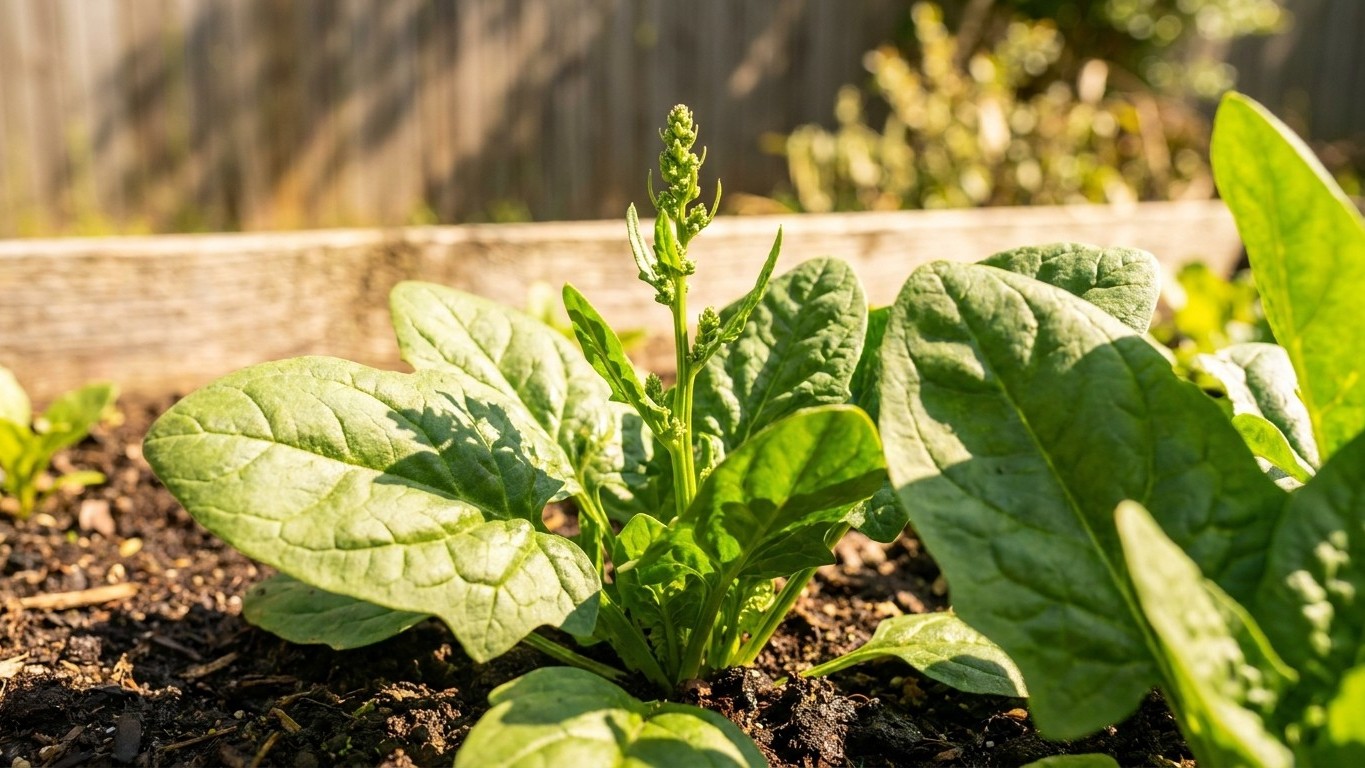

Yes, spinach will bolt early across most of California, and the mild coastal and southern climate makes it worse, not better. Long summer days push the plant toward flowering no matter how gentle the thermometer stays, so a cool coastal summer buys almost no extra time. The real growing windows sit in late winter, early spring, and fall, when both daylight and heat stay lower.
The short answer
On the longest day of the year, the reference station for this data (Los Angeles) sees 14 hours and 16 minutes of daylight. That number matters more than most gardeners assume. Spinach flowers, or bolts, in response to long days combined with warm temperatures, so as the days stretch toward that mid-June peak, the plant is being pushed toward seed production whether or not the air ever gets hot. This is the opposite of what happens with onions on the other side of this site: for onions, long days build the bulb. For spinach, long days dismantle the crop.
That distinction matters because California’s coastal and southern zones are famous for mild summers, and it’s tempting to think a gentle summer means a longer harvest. It doesn’t. Day length runs on the calendar, not the local microclimate, so the trigger toward flowering arrives on schedule regardless of how comfortable the afternoons feel.
Heat is a separate factor, and here the picture is more forgiving, at least along the coast. The reference station averages just 2.4 days a year reaching 90°F or higher, which is a light heat load by national standards. Spinach grows best below 75°F, and that ceiling also marks where the leaves start turning bitter, so this region’s mild temperatures help quality even as day length works against the calendar. In practical terms, for coastal and southern California the dominant limiter is day length, with heat acting as a secondary factor that becomes more serious the farther inland you garden.
That caveat is worth repeating: this data describes the coastal and southern climate represented by the reference station. Northern California, the Central Valley, and the Sierra foothills freeze most winters and run far hotter in summer, so the constraints there are a different mix of cold and heat rather than the frost-free, day-length-driven pattern described here.
How long the spring window really is
The standard advice for direct-sowing spinach is to get seed in the ground two to three weeks before the last frost, since the crop tolerates cold well. That rule assumes a last-frost date exists to count backward from. In this climate, it doesn’t.
- NOAA’s 1991-2020 climate normals and thirty years of daily records show zero days at or below 32°F at the reference station, with a frost-free season listed as all 365 days of the year.
- That removes the usual cold-based anchor entirely. There’s no last-frost date to subtract two or three weeks from, because there’s no frost to begin with.
- The calendar constraint shifts fully to day length and warmth. Days lengthen steadily from winter toward the June peak of 14 hours 16 minutes, and growth quality declines once temperatures push past 75°F.
- The workable spring window is whatever stretch of the year stays under both of those pressures at once, which in practice means the deep winter and early spring months, before daylight climbs too far toward its solstice peak.
- Once that stretch closes, usually well before summer technically begins, continuing to sow simply invites bolting even if the air itself never feels hot.
The upshot is a spring window measured in a handful of weeks rather than a full season. Growers who plant later, expecting the mild coastal climate to stretch the harvest, are usually the ones surprised by flower stalks showing up while the leaves are still small.
The autumn crop, and when the soil lets you sow
Fall spinach avoids the day-length problem almost entirely, since daylight is shrinking rather than growing through that part of the year. But a different obstacle takes its place before the season even opens.
Soil still too warm to germinate
Utah State University Extension notes that spinach seed germination drops off once soil temperature climbs above 80°F. In coastal and southern California, soil holds heat well into the shoulder season even though air temperatures rarely spike, since only 2.4 days a year reach 90°F. Soil warms and cools more slowly than air, so a gardener sowing by the calendar alone can easily hit ground that’s still too warm for reliable germination, even after the hottest afternoons have passed.
The frost that ends the season, or doesn’t
Here the region’s frost-free record changes the usual math again. With zero days at or below 32°F recorded across thirty years at the reference station, there’s no freeze to mark the end of the fall crop. A planting that germinates successfully can, in principle, keep growing right through the winter months, since nothing here kills it with cold.
That doesn’t remove the need to plan. Utah State University Extension’s guidance is to count back 50 to 75 days from the date you want to harvest. Aiming for a harvest in early December, for instance, puts the sowing window somewhere between roughly mid-September and mid-October. In practice, the earlier half of that window often overlaps with soil still sitting above the 80°F germination ceiling, so many gardeners end up sowing toward the back end of the range, once soil temperature has actually dropped. The source names four spinach varieties, Bloomsdale, Melody, Teton, and Olympia, but publishes no days-to-maturity figures for any of them, so the 50-to-75-day count-back from harvest is the only timing rule to work from regardless of which one you plant.
| Season | Main limiter | Key threshold | Practical outcome |
|---|---|---|---|
| Spring | Rising day length | 14 hr 16 min at the solstice | Short window, closes well before summer |
| Fall | Warm soil, then nothing | 80°F soil for germination | Sow once soil cools; frost never ends it |
Common questions
Does a mild California summer let spinach grow longer before bolting?
No. Bolting is triggered by long days as much as by heat, and day length follows the calendar regardless of local temperature. A mild summer improves leaf quality but doesn’t stop the plant from flowering once daylight stretches far enough.
Is frost ever a factor for spinach timing in coastal or southern California?
Not according to the thirty years of daily records at the reference station, which show zero freezing days and a 365-day frost-free season. The season here is shaped by heat and day length, not cold. Northern California, the Central Valley, and the Sierra are different climates and do experience frost.
Why would fall-sown spinach fail to germinate even in mild weather?
Soil temperature, not air temperature, is the issue. Germination drops once soil rises above 80°F, and soil in this region cools more slowly than the air does, even when heat-wave days are rare.
Do the named varieties, Bloomsdale, Melody, Teton, or Olympia, bolt at different rates?
The source naming these four varieties doesn’t publish comparative bolting or maturity data for them, so no variety-specific timing can be stated here. Plan sowing dates around the day-length and soil-temperature limits instead.