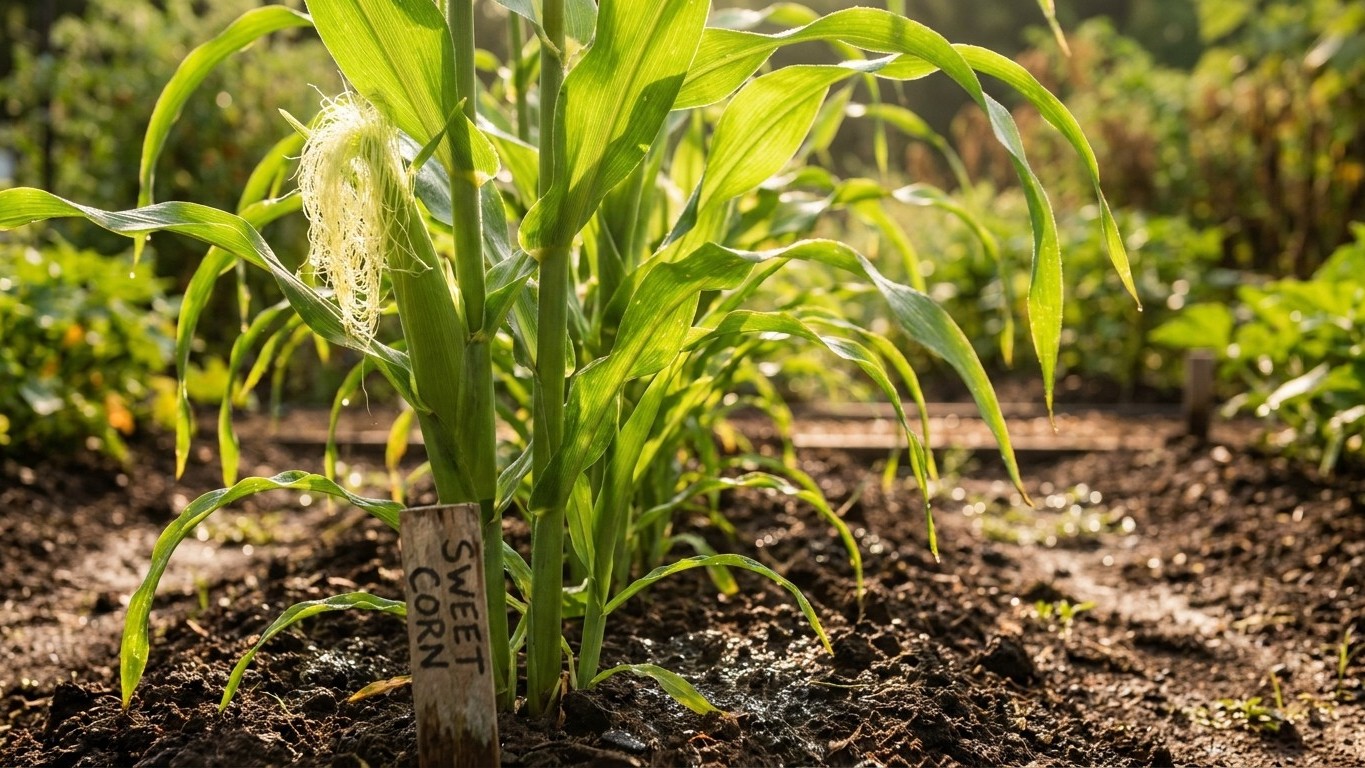

Yes, sweet corn ripens across most of California, and in the frost-free coastal and southern zones it ripens more reliably than almost anywhere else in the country. The limiting factor here isn’t frost at all. It’s how fast the soil climbs to planting temperature, and how much heat load the plants take on once they’re growing. That’s a different set of math than the frost-date planning most seed packets assume.
The short answer
Start with what the record actually shows for the reference station: zero days at or below 32°F across three decades of daily readings. NOAA’s Climate Normals can’t even compute a freeze date for this location, because there isn’t one in an average year. The frost-free season is listed at 365 days. For a gardener used to circling a last-frost date on the calendar, that’s a strange thing to work with, because the date simply doesn’t exist here.
But that doesn’t mean you plant whenever you feel like it. Sweet corn germinates on soil temperature, not air temperature and not frost risk. Utah State University Extension is blunt about the threshold: soil needs to be above 60°F before seed goes in the ground. In a frost-free coastal or southern California yard, that 60°F mark still arrives later than people expect, sometimes well into spring, because cool marine air and shaded soil lag behind the calendar even when nighttime lows never touch freezing. Treating “no frost” as “warm enough to plant” is the single most common misread of this climate.
Once soil hits 60°F, the clock most gardeners actually care about starts: sweet corn needs 60 to 90 days from planting to harvest, depending on the type. With a 365-day frost-free window in the reference zone, that 60-to-90-day stretch fits with enormous room to spare. There’s no autumn deadline forcing an early start, no scramble to beat a first-frost date, because in an average year that date doesn’t come at all. This is the rare climate where the corn calendar is set by soil warmth and summer heat load, not by a shrinking window between two frost dates.
Heat load matters more here than in most sweet-corn regions. The reference station averages 2.4 days a year at 90°F or hotter. That’s not a brutal number on its own, but it tells you where the real stress on the crop will come from: water demand during pollination, and heat stress on silks and tassels during the hottest stretch of summer, not frostbite in spring or fall. Irrigation planning and timing plantings around the hottest weeks matter more here than worrying about a freeze that statistically isn’t going to happen.
One caution worth repeating: this frost-free picture describes coastal and southern California, not the whole state. Northern California, the Central Valley, and the Sierra foothills freeze in a normal year, and their planting math looks nothing like this. Nobody should read a Los Angeles-area normal and assume it applies to Sacramento or Redding.
Does a late variety fit here?
A 60-day variety
A shorter-season type, roughly 60 days from planting to harvest, fits this territory with room to spare wherever the frost-free pattern holds. Once soil crosses that 60°F line, there’s no fall deadline pressing in behind it. A 60-day variety also gives a gardener flexibility to stagger plantings a couple of weeks apart, spreading the harvest out instead of getting buried in ripe ears all at once, which matters more in a long growing season than in a short one.
A 90-day variety
A longer-season type, up to 90 days, also fits comfortably in the frost-free coastal and southern zones, where a 365-day season leaves no autumn cutoff to race against. The tradeoff isn’t season length here, it’s heat. A 90-day planting timed so pollination lands during the hottest stretch of summer, when the reference station is most likely to see those 90°F-plus days, risks poor kernel fill and stressed silks. Shifting the planting date so tasseling avoids the peak heat window matters more than counting days against a frost calendar that, in this climate, mostly doesn’t apply.
That calculation flips in Northern California, the Central Valley, and the Sierra. Those regions do experience real frost, but the specific spring and fall frost dates for those areas aren’t part of the figures published here, and shouldn’t be guessed at. A gardener in one of those zones needs to check local frost data before assuming a 90-day variety fits their season, and leaning toward a shorter-season type is the safer default until that local number is confirmed.
What goes wrong here
- Soil sown too cold. Because there’s no frost date to anchor planting decisions, it’s tempting to sow the moment the calendar says spring. But air temperature and soil temperature aren’t the same thing, and cool, shaded, or heavy soil can sit well under 60°F even in a frost-free yard. Seed rots or germinates unevenly. The fix is a soil thermometer, not a calendar date: wait for a consistent 60°F reading before planting, regardless of what the frost forecast says.
- A variety too late for the season. This is mostly a Northern California, Central Valley, and Sierra problem, where real frost dates exist even if they aren’t detailed here. A 90-day type planted without knowing the local fall frost date can run out of season before it finishes. The remedy is checking local frost data first, and defaulting to a shorter-season type when that data isn’t in hand.
- Sweetness lost to cross-pollination. This one has nothing to do with climate. Utah State University Extension notes that su, se, and sh2 sweet corn types lose their sweetness if they tassel at the same time, because wind-blown pollen from a starchier type crosses into the sweeter one. No isolation distance is published for this, so don’t plant by a rule-of-thumb footage. Instead, stagger planting dates so different types tassel in different weeks, and plant in blocks of three or more rows rather than a single skinny row, which is the shape recommended for reliable pollination regardless of type.
Common questions
Does Southern California ever get a frost that threatens sweet corn?
Not in an average year. NOAA’s daily record shows zero days at or below 32°F over three decades at the reference station, and the season is listed as frost-free for all 365 days. The gardening risks here are heat and water, not freeze damage.
Can I plant more than once for a longer harvest window?
Yes, and the long frost-free season makes staggered plantings practical. Since the 60-to-90-day clock isn’t racing a fall frost date in coastal and southern zones, spacing plantings a couple of weeks apart spreads the harvest instead of forcing everything to ripen at once.
How do I know the ears are actually ready?
Look for three signs together, not just one: silks that have turned dry and brown, husks that are still moist and green, and milky (not clear or dry) juice when a kernel is punctured. Any single sign alone can be misleading.
Why did my sweet corn turn out starchy instead of sweet?
The most likely cause is cross-pollination between different sweet corn types, or with field corn, tasseling at the same time. Timing plantings so types don’t tassel together, and growing in solid blocks rather than thin rows, addresses the cause more reliably than any spacing rule of thumb.