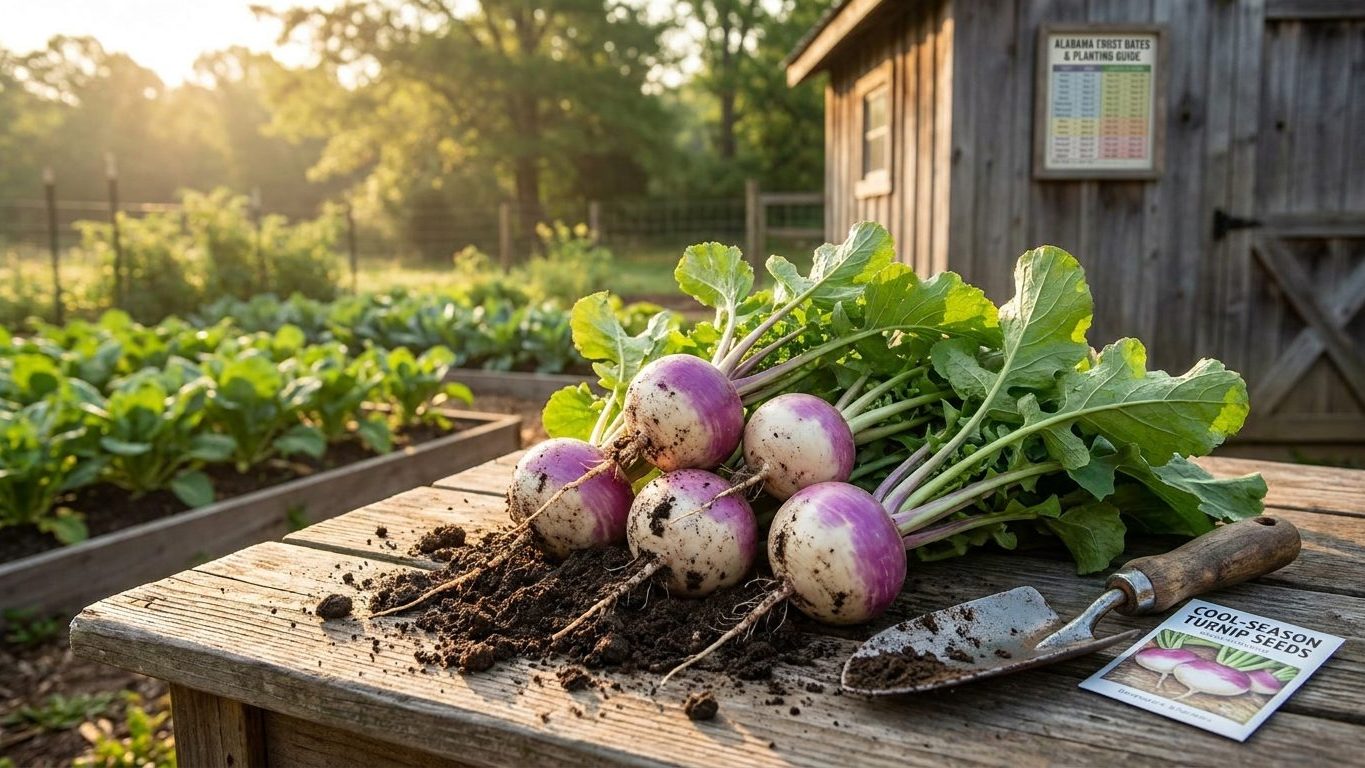

California doesn’t have one turnip calendar, it has several. Along the coast and through Southern California, sowing is a fall-into-winter game because there’s no real frost to dodge. Inland, in the Central Valley and up into the Sierra foothills, growers still need to watch for real freezes and time around a shorter cool season.
The short answer for California
Start with where the data actually points. At the Los Angeles reference station, NOAA’s 30-year record shows zero days at or below 32°F, and the frost-free season is listed as a full 365 days. That’s not a rounding quirk, it means an average year along this stretch of coast and through the Southern California basin simply doesn’t freeze. For gardeners in that belt, the sowing question isn’t “when’s the last frost,” it’s “when does the heat back off enough for a cool-season root crop to size up without bolting or turning woody.”
Turnips are a cool-season crop, and the practical window for coastal and Southern California runs from late August through October, with a second, lighter window in late winter before spring heat rebuilds. That fall sowing matters because it lets the crop mature through the mild, frost-free winter, when the mean daily minimum of the coldest month sits at 49.1°F at the Los Angeles reference station. That’s well above freezing, so roots aren’t at risk of cold injury there. They’re at risk of the opposite problem: not enough of a cold snap to slow bolting if you sow too early while afternoon heat still lingers.
Inland is a different conversation, and this page doesn’t have a computable frost-date record for the Central Valley or Sierra foothills the way it does for the Los Angeles coastal reference. Those areas do freeze in a typical winter, sometimes hard, and borrowing the coastal “no frost” answer for them would be wrong. If you garden in Fresno, Sacramento, or up in the foothills, treat this section as a coastal/Southern California answer only, and lean on the county-level check described further down for your own sowing dates.
What both regions share is the underlying logic: turnips want cool soil and moderate air temperatures to bulk up their roots without turning fibrous or bitter. Where frost is absent, that cool window is carved out of fall and winter. Where frost is present, it’s carved out of spring and fall around a hotter, shorter summer.
What will not work here

Sowing turnips in the heart of a California summer is the single most common mistake, and the reason is straightforward heat physiology, not something specific to this crop. Turnip roots stop bulking and start pushing up a flower stalk, called bolting, once daytime and nighttime temperatures stay warm for an extended stretch. In the Central Valley, where summer highs routinely blow past 100°F, and even in the coastal basin where the coldest month still averages a mild 49.1°F minimum, there’s rarely a cold enough stretch in June, July, or August to hold a spring-sown crop in check. The fix isn’t a different variety, it’s avoiding sowing between roughly June and August statewide.
A second failure mode is watering on autopilot. California’s summers are dry almost everywhere outside the immediate coastal fog belt, and many counties layer on drought-driven water restrictions in a typical year. Turnips have shallow roots that dry out fast in loose, sun-baked soil, and a grower who waters once a week on a fixed schedule, the way they might for an established shrub, will end up with cracked, woody, or hollow roots by harvest. The crop needs more frequent, lighter watering through any warm stretch, not a single deep soak.
The USDA’s own hardiness data underlines why a single blanket rule fails here: California spans zone 5a all the way to 11a, one of the widest ranges of any state in the country. A planting rule built for the Los Angeles reference point, where winter lows barely dip below 49°F on average, would be a poor fit for a high-Sierra garden sitting in zone 5a, where real hard freezes and a much shorter frost-free season are the norm. Treating the state as one climate, whether that means sowing dates, watering frequency, or variety choice, is the fastest way to lose a crop here.
Rutabaga, the slower cousin of the turnip, adds another wrinkle: it typically needs a longer run of cool weather to bulk up properly. In the parts of California where the cool season is squeezed between a mild-but-brief chill and an early return of heat, rutabaga has less margin for error than a fast turnip variety, and a late sowing that would still work for turnips can run out of cool weather before rutabaga finishes.
What changes across California
A hardiness range of 5a to 11a means California isn’t a single garden, it’s dozens of them stacked across elevation and distance from the coast. That’s roughly the difference between a climate that never freezes and one where the ground can lock up hard for weeks. There is no single sowing date that serves both ends of that spread, and any calendar that gives you one number for “California” is simplifying past the point of usefulness.
The Los Angeles reference station, sitting near the warm end of that range with a coldest-month minimum of 49.1°F, tells you what’s possible along the immediate coast and through the Southern California basin: winter sowing, near year-round harvests of quick crops, and heat rather than cold as the main hazard. Move inland to the Central Valley floor, and the season compresses because summer heat arrives earlier and lingers longer, even though winters there still see real frost some years. Climb into the Sierra foothills or higher elevations, and the calendar flips again: shorter growing seasons, later last frosts, and earlier first frosts in fall squeeze the cool-season window from both ends.
Coastal fog belts complicate things further. Two gardens fifty miles apart, one right on the coast and one just over the first ridge inland, can sit in noticeably different zones because of that marine influence. This is exactly the kind of variation the USDA map exists to capture, and it’s also exactly why this page can’t tell an individual reader which zone they’re standing in.
The only responsible move here is to point at the tool rather than guess. Check the USDA Plant Hardiness Zone Map for your specific address before locking in a sowing date, especially if you’re anywhere outside the immediate coastal strip, since that single lookup will do more to correct a generic calendar than any rule of thumb in this article.
Where to check this for your own county
Everything above is a state-level pattern, built from one coastal reference station and one statewide zone range. California’s cooperative extension system exists specifically to narrow that down, and it’s run through the University of California Agriculture and Natural Resources network. The umbrella site is https://ucanr.edu/, and from there you can reach county-specific offices covering everywhere from Humboldt to Imperial County.
Once you’re on your county’s extension page, two things are worth hunting down specifically. The first is a local planting calendar, often built by local master gardener programs, that translates the general fall-or-spring cool-season logic into actual months for your specific valley, coastline, or foothill area. Because California’s frost patterns and heat timing shift so much over short distances, a calendar built by growers working your county’s actual microclimate will consistently beat a statewide estimate.
The second thing to look for is which turnip and rutabaga varieties have actually been trialled in your area. Extension offices frequently track which varieties perform well against local pest pressure, local soil types, and local heat or fog patterns, information that simply doesn’t exist at the state level. A county recommendation, built on local trial data and local grower experience, outranks anything a statewide page like this one can offer, precisely because this page is describing California in general, not your specific patch of it.
If your county’s page doesn’t have a dedicated vegetable calendar, most UC ANR county offices still list contact information for a master gardener helpline, and a quick call or email is often the fastest way to get a straight answer for your specific ZIP code.
Some gardeners also time this by the Moon: when to plant turnips by the moon, as almanac tradition rather than fact.
Checking this against your own garden
Every date on this page is a regional average, and your own garden will tell you more than any calendar once you know what to look for. Three signals matter most for turnips, and none of them need any equipment beyond your hands and your eyes.
Start with soil warmth by feel. Push your fingers a couple of inches into the bed in the morning, before the sun has warmed the surface. If the soil still feels cold and slightly damp rather than cool-neutral, germination will be slow no matter what the calendar says, and it’s worth waiting another week or two, especially at higher elevation or in a shaded bed that lags the open garden next door.
Next, watch how fast true leaves appear after the first seed-leaf pair. A quick push to true leaves within a week or so signals soil and air temperatures are genuinely in the crop’s comfort zone, while a sluggish, stretched-out seedling that takes noticeably longer is a sign your particular spot is running cooler than the regional average, common in fog-belt gardens or anywhere with heavy afternoon shade.
Finally, keep an eye out for an early flower stalk pushing up from the center of the plant before the root has had much time to size up. That’s bolting, and if you see it happening on a fall planting well ahead of schedule, it’s telling you your particular microclimate ran warmer than expected that season, information worth writing down for next year’s sowing date more than any state-level figure ever could.