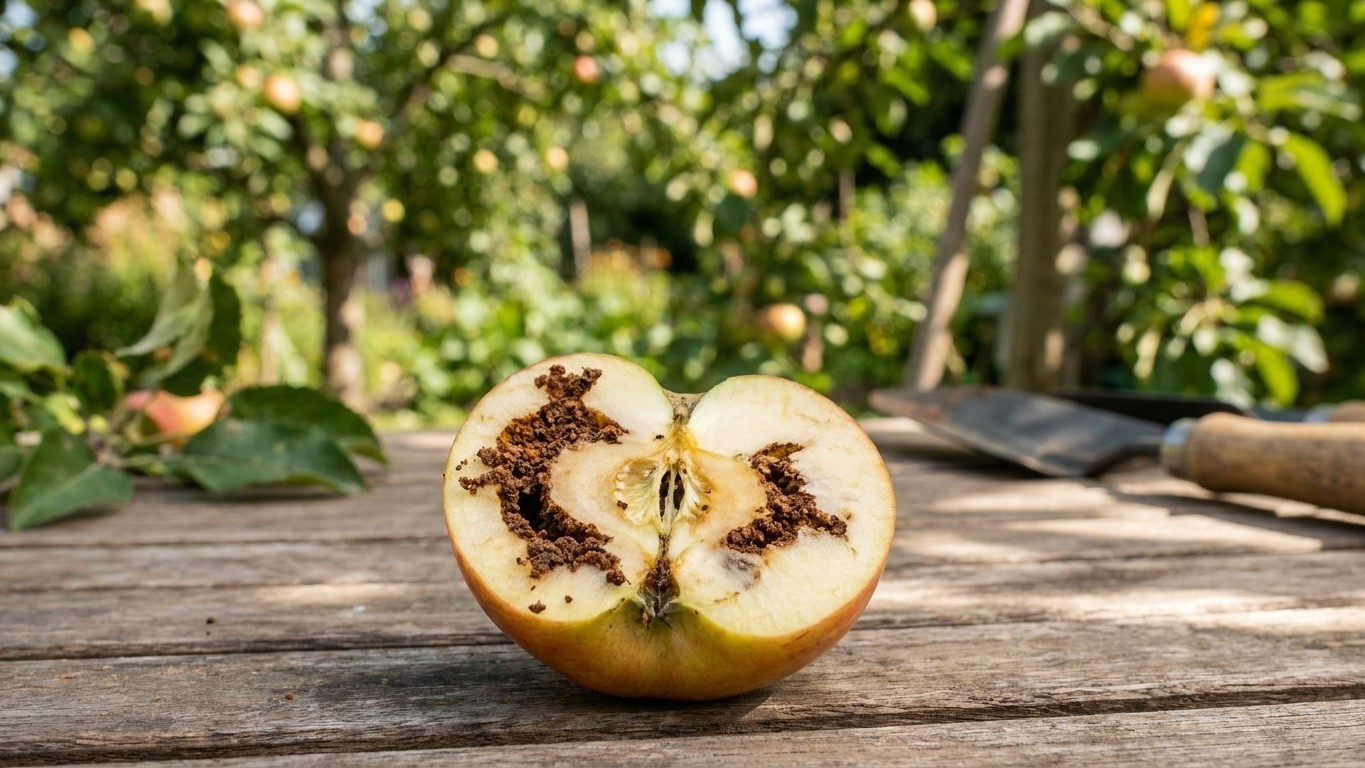

Pick apples in Colorado when the seeds inside have turned brown and the fruit twists free from the branch without tearing, not by a date on the calendar. In the Denver area, that stage usually lands between late August and the first hard frost, which the National Centers for Environmental Information sets at September 30 to October 12 for the metro reference station. Apples picked before that window keep for weeks; apples caught by an early freeze often don’t keep at all.
When apples are ready to pick in Colorado
The calendar is a poor guide here because Colorado’s growing season is short and its elevation swings hard from one county to the next. What actually decides harvest timing is the tree’s own stage of development, read against two frost dates that bracket the season at the Denver reference station (USW00003017, NOAA NCEI 1991-2020 Climate Normals): the last spring freeze, which falls between May 1 and May 11, and the first fall freeze, between September 30 and October 12. Everything an apple tree does, from bud break to fruit maturity, happens inside that window on the plains. Mountain towns run shorter seasons and can still see frost in July; the western slope runs on a different clock again, and no figure in this dataset covers those areas specifically.
Inside that frost-free stretch, growers watch three signals rather than a date. First, background color: the green undertone of the skin shifts toward yellow or cream as chlorophyll breaks down, even on red varieties. Second, ease of separation: a ripe apple releases from the spur with a gentle upward twist; if it resists and the stem tears, it isn’t ready. Third, seed color, checked by cutting one fruit open: pale or white seeds mean weeks of ripening left, while brown or dark seeds mean the sugars have largely finished converting from starch.
Why the frost dates matter more than the month
Winter hardiness and harvest timing are two separate questions, and conflating them is where a lot of Front Range orchard plans go wrong. Hardiness is decided by the mean daily minimum of the coldest month, which sits at 18.4 F at the Denver reference station. That figure tells you whether the tree’s wood and buds survive winter at all, not when the fruit ripens. A variety can be perfectly hardy at 18.4 F and still need more frost-free days to finish ripening than the plains reliably provide, which pushes some late-season types past the average first freeze before they’re ready. That’s the practical reason growers on the plains lean toward early- and mid-season varieties rather than the latest-ripening types common in longer-season states.
Chill accumulation is a third, separate filter. It governs whether a tree flowers normally the following spring, not whether the current year’s fruit finishes ripening. A variety can be hardy enough to survive 18.4 F winters and still need a specific amount of accumulated cold below roughly 45 F to break dormancy evenly. Get that wrong and you get patchy, delayed bloom rather than a failed harvest, a separate problem covered below.
Which ones keep, and which must be eaten
Not every apple that ripens on a Colorado tree is built to sit in storage. The apple’s own density and acidity, not the length of the growing season, decide how long it lasts once picked. Softer, thin-skinned, early-ripening types break down within days at room temperature and within a couple of weeks even under refrigeration. Firmer, later-ripening types with higher acid content can hold for months under the right cold, humid conditions, provided the Colorado growing season gave them enough frost-free days to finish maturing before that September 30 to October 12 window closes.
This creates a real tension on the plains. The apples with the best storage life are usually the latest to ripen, and the latest to ripen are the ones most exposed to an early fall freeze cutting the season short. Growers working close to the Denver frost dates generally accept a trade-off: plant mostly early- and mid-season types that ripen with a comfortable margin before the average first freeze, and treat any late-ripening variety as a smaller, higher-risk planting rather than the main crop.
Ripening groups compared
| Ripening group | Typical harvest signal | Keeping ability | Front Range risk |
|---|---|---|---|
| Early-season | Ready well before the first fall freeze, often by late August | Days to two weeks, even refrigerated | Low; margin before frost is wide |
| Mid-season | Ready in September, ahead of the average first freeze | Several weeks to two months in cold storage | Moderate; a very early freeze can cut ripening short |
| Late-season | Ready near or just before the September 30 to October 12 window | Three to six months in proper cold storage | Highest; little buffer if frost arrives on the early end of the range |
None of this means late-ripening apples are off the table on the plains. It means the planting should lean toward the varieties that finish comfortably ahead of the average frost date, with late types treated as the exception rather than the backbone of the orchard.
Storing them through a Colorado winter
Once an apple is off the tree, storage is a matter of temperature, humidity, and airflow, and Colorado’s dry climate works against two of the three. Cold storage for apples generally means temperatures just above freezing, around 32 to 40 F, with high humidity to slow moisture loss through the skin. Colorado’s low ambient humidity, especially on the Front Range and eastern plains, dries fruit out faster than the same setup would in a wetter climate, so a sealed container or perforated plastic bag inside the storage space matters more here than in a humid state.
An unheated garage or shed is the default cold-storage spot for a lot of Colorado households, and it works for part of the season but not all of it. Once the coldest month’s mean daily minimum reaches 18.4 F, as it does at the Denver reference station, an unheated outbuilding can drop well below the 32 F floor apples need, and hard freezing turns the flesh mealy and brown. A location that stays reliably in the 32 to 40 F band, an insulated garage corner, a root cellar, or the back of a refrigerator set slightly warmer than food-safe minimums, holds fruit far longer than one that swings with outdoor temperature.
How long the different groups actually last
- Early-season apples: best eaten or processed within one to two weeks, even under refrigeration.
- Mid-season apples: several weeks to roughly two months in a stable cold, humid space.
- Late-season, high-acid apples: three to six months in proper cold storage, the longest-keeping group grown locally.
Colorado State University’s Extension service publishes general home food storage guidance at extension.colostate.edu, and it’s the source to check for county-specific advice, since storage conditions in a mountain-elevation basement differ from a plains garage even within the same state.
What goes wrong here
The most Colorado-specific failure isn’t the deep cold of January, it’s the warm spell that interrupts it. The Front Range is known for winter temperature swings, mild stretches followed by sharp drops, and a tree that breaks dormancy too early during one of those warm spells is exposed the moment the mercury falls back. This is the mild-winter trade-off in practice: a low-chill variety needs less accumulated cold to start flowering, so it responds to an early warm spell by blooming ahead of schedule, right into the window before the last spring freeze date of May 1 to May 11. A high-chill variety that flowers later misses more of that early warm-spell exposure, at the cost of occasionally flowering a little unevenly in a genuinely mild winter. On the Denver-area plains, the frost risk from early bloom is the bigger loss, an entire crop rather than a slightly patchy one, so leaning toward higher-chill, later-blooming varieties is the safer default here.
Picking too early is the second common mistake, usually driven by impatience rather than climate. An apple pulled before the seeds have browned and before the background color has shifted will never finish ripening properly off the tree; it just softens without developing full sugar or flavor. The starch-to-sugar conversion that makes an apple taste ripe happens on the tree, not in a bowl on the counter.
Storage failures round out the list: fruit left in a garage that swings below freezing turns mealy and brown from the inside out, and fruit stored without any humidity control in Colorado’s dry air shrivels well before it spoils. Hail damage during the growing season is also a recognized regional hazard on the plains, though no source in this dataset quantifies its frequency, so growers should treat it as a general risk to plan around rather than a numbered statistic.
Common questions
Can apples be grown in Colorado’s mountain towns? Some hardy, early-ripening varieties succeed at higher elevations, but the frost dates and chill patterns for those towns aren’t covered by the Denver reference station used here, and no source in this dataset documents mountain-specific figures. Local extension offices are the right first call for a specific mountain location.
What’s the best window to pick apples near Denver? There’s no fixed date; watch for seed color turning brown, background skin color shifting away from green, and easy stem separation. On the plains, that stage typically arrives before the September 30 to October 12 average first freeze window.
Do Colorado winters provide enough chill for apple trees to flower well? The coldest month’s mean daily minimum of 18.4 F at the Denver station provides ample cold for most apple varieties’ chill needs. The bigger risk isn’t too little chill, it’s a winter warm spell triggering early bloom ahead of the last spring freeze.
How long do home-stored Colorado apples last? It depends on the variety group, not the state. Early-season apples last one to two weeks refrigerated; late-season, high-acid types can hold three to six months in a stable 32 to 40 F, humidity-controlled space, which is harder to maintain in Colorado’s dry air than in a humid climate.